By Davida Spaine-Solomon
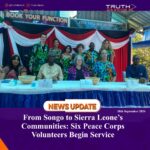
Songo, 18th September, 2026 — After 10 weeks of training in Krio, Sierra Leonean culture and community engagement, six Peace Corps Volunteers are leaving Songo for two-year assignments in Port Loko and Kono districts, where they will work with local partners in education and health.
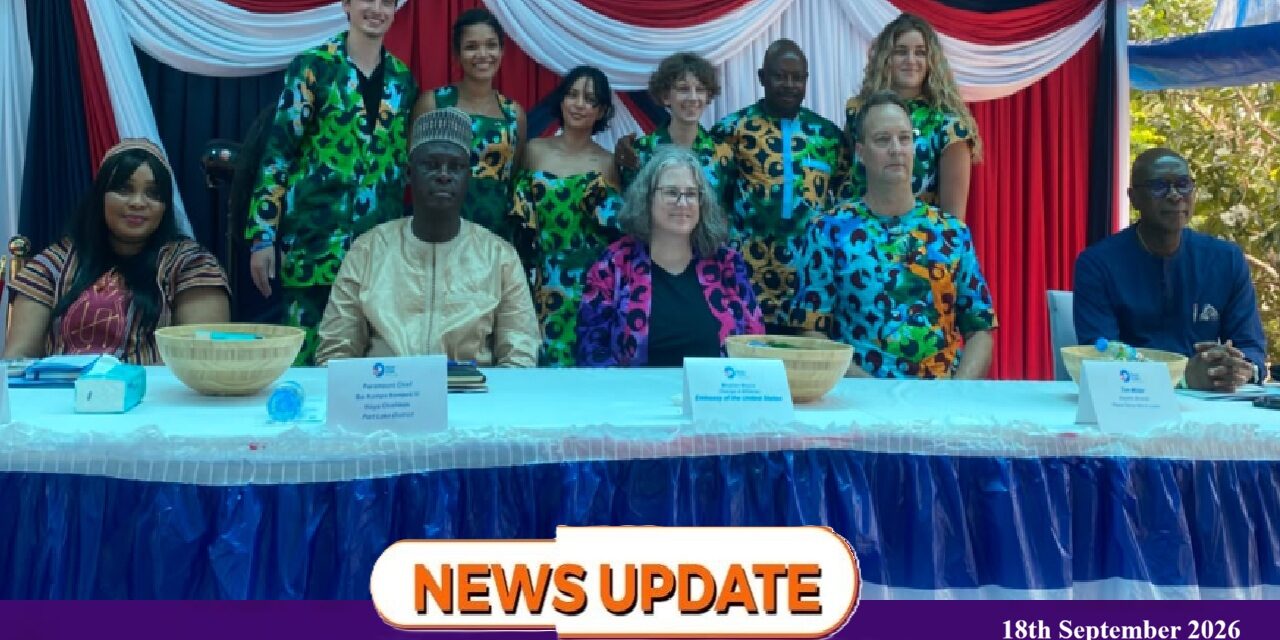
The Volunteers Hannah, Chase, Juliet, Henry, Mia and Sophia were formally inducted on Friday, September 18, at a ceremony attended by U.S. Chargé d’Affaires Meghan Moore, Minister of Basic and Senior Secondary Education Conrad Sackey, Peace Corps Sierra Leone Country Director Tim Miller, Paramount Chief Bai Kompa Bomboli and other government, diplomatic and community representatives.
Their assignments form part of the Peace Corps’ ongoing partnership with Sierra Leone, with Volunteers working alongside local teachers, health workers, community groups and other institutions to support national development priorities while promoting cultural understanding between the two countries.
From trainees to community members
Speaking at the ceremony, Peace Corps Sierra Leone Country Director Tim Miller said the Volunteers were moving from training into a new phase of service built around partnership, respect, friendship and cultural exchange.
Miller thanked the Government of Sierra Leone, community leaders, host families, Peace Corps staff, returned Volunteers and the people of Songo for supporting the trainees throughout their preparation.
He said host families had helped transform the Volunteers from visitors into members of their communities.
Addressing the new Volunteers, Miller reflected on the aspirations people carry from childhood into adulthood and said their decision to serve represented an opportunity to turn those values into action.
“You are choosing to bring your values to life. You are choosing to be part of something real, something important, not only for Sierra Leone and America, but for yourselves,” Miller said.
He urged the Volunteers to carry the lessons they learned in Songo into their respective communities.
“Sierra Leone will make you better. You are part of something real. You are part of something important,” he said.
Paramount Chief urges Volunteers to embrace communities
Paramount Chief Bai Kompa Bomboli described the Volunteers’ transition from trainees to community members as an important stage in their service.
He said their preparation had involved learning a new language, adapting to a different culture and preparing for the realities of living and working in Sierra Leonean communities.
The Paramount Chief described the Volunteers as a bridge between Sierra Leone and the United States, saying their role would involve not only sharing knowledge but also learning from the people they serve.
He acknowledged that their service would include both rewarding experiences and challenges such as homesickness and frustration, urging them to draw on the resilience they developed during training.
He also thanked host families and community leaders for opening their homes and communities to the Volunteers.
“To our new volunteers: You join a long and proud legacy of individuals who chose to step outside their comfort zones to make a tangible difference in the world,” he said, encouraging them to serve with humility, curiosity and compassion.
Education partnership
Minister of Basic and Senior Secondary Education Conrad Sackey described the Peace Corps’ relationship with Sierra Leone as a partnership that has continued through different periods of the country’s history.
Using the proverb, “One hand cannot tie a bundle,” Sackey said transforming education requires cooperation between nations, institutions, teachers and communities.
He noted that Peace Corps Volunteers have worked alongside Sierra Leonean educators since 1962 and continued to contribute through periods of conflict, crisis and recovery.
Sackey said eight Peace Corps Volunteers are currently teaching in Sierra Leonean classrooms, supporting pupils in subjects including English, mathematics and science.
He stressed that the Volunteers were not coming to replace Sierra Leonean teachers but to work alongside them.
“When an American teacher stands beside a Sierra Leonean teacher, when hands stretch across the boundaries of nation, something simply happens,” Sackey said.
He said such collaboration allows knowledge and confidence to grow and helps pupils see new possibilities.
Sackey said the newest cohort would serve in Port Loko and Kono districts and assured them of the Ministry’s support throughout their assignments.
U.S. Chargé d’Affaires: ‘You are giving a part of your lives’
U.S. Chargé d’Affaires Meghan Moore said the Volunteers had spent the previous 10 weeks preparing for the realities of service in Sierra Leone.
She said their training included learning Krio, adapting to Sierra Leonean culture and developing the technical and practical skills needed to live and work in their host communities.
Moore acknowledged the role of Songo residents, Peace Corps staff, trainers and host families in preparing the Volunteers.
She also thanked the Government and people of Sierra Leone for their continued partnership and hospitality.
“You are giving a part of your lives in service to others,” Moore told the Volunteers.
She said the relationships they develop with their host communities would be central to their service and wished them courage during difficult moments, gratitude during rewarding ones and lasting friendships.
Host families shape the Volunteers’ experience
For the Volunteers, preparation for service extended beyond formal training.
Host families in Songo introduced them to Krio, local food, household practices and everyday life in Sierra Leone.
Madam Christiana Kuteh John, one of the host mothers, spoke about her experience hosting American Volunteer Anna Plante, who adopted the local name Aminata Joy Foday.
Christina said she spent about a month teaching Plante Krio and helping her understand Sierra Leonean culture and ways of life. She also taught her how to cook local food, do laundry and become more independent.
Plante said she wanted to serve because she enjoys helping others and is particularly interested in education.
She said she wants children not only to attend school but also to enjoy learning, adding that she hopes to work with Sierra Leonean teachers to make education more engaging.
Plante will serve in Port Loko District for two years. She said she has learned to prepare local dishes including potato leaves and beans and has developed a liking for Sierra Leonean food.
Another host family, led by Madam Marie Saccoba, hosted Volunteer Kadiatu Saccoba Sesay, whose American name is Juliet Oliver.
Two of the newly inducted Volunteers also publicly thanked their host families during the ceremony for welcoming them, supporting them and helping them adjust to life in Sierra Leone.
A partnership dating back to 1962
Peace Corps first arrived in Sierra Leone in 1962 after the Government of Sierra Leone invited 37 American Volunteers to serve as secondary school teachers.
Over the following three decades, more than 3,400 Americans served across the country, working in education, agriculture, community development and health.
The programme closed in 1994 amid civil unrest. Sierra Leone and the United States signed an agreement on November 2, 2009, to re-establish Peace Corps Sierra Leone.
Today, Volunteers serve in Sierra Leone at the request of the Government, with programmes focused on Education and Health.
The six Volunteers have now completed their training and induction and are set to begin their two-year assignments, working alongside Sierra Leonean partners in Port Loko and Kono districts.