By Truth Media
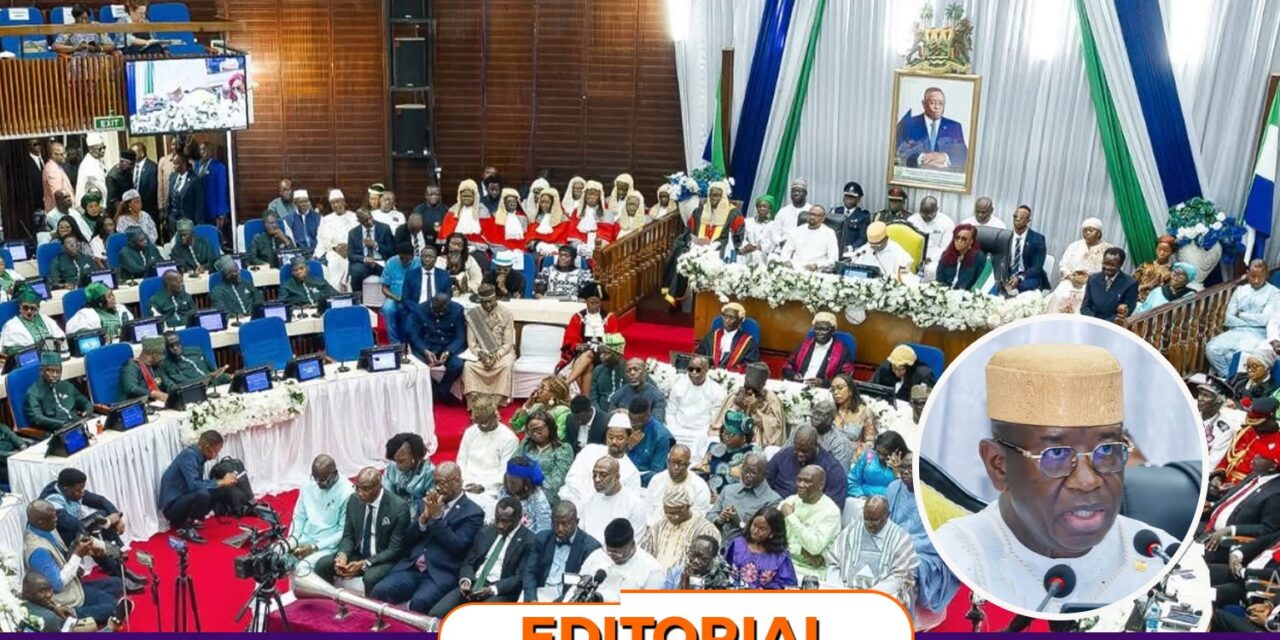
Freetown, 19th August 2026- Sierra Leone’s Parliament last Monday passed the Constitutional Amendment Bill, but the manner in which it was done has left the country grappling with questions of legality, legitimacy, and democratic credibility.
The Speaker himself has sought the Supreme Court’s interpretation of the procedure used, underscoring the controversy. The opposition All Peoples Congress (APC) has branded the process flawed, while ruling party MPs insist “ampah ampong” the matter is settled. What unfolded was yet another bitter duel between the APC and the Sierra Leone People’s Party (SLPP), with both sides determined to outmanoeuvre the other.
But in this contest, the real losers are neither the “red” nor the “green.” It is the people, citizens whose interests the amendment process was supposed to serve.
Senior lawyers have attempted to rationalize Parliament’s decision, with some arguing that the process followed the law. Yet an overwhelming majority of legal voices view the procedure as flawed. This raises the spectre of a pyrrhic victory: a triumph for one side that may ultimately weaken the democratic foundation of the nation.
Amending the constitution should never be reduced to a game of political brinkmanship. It must be inclusive, transparent, and firmly anchored in the rules the constitution itself prescribes. Instead, what Sierra Leone witnessed was a binary contest, where consensus was abandoned, the opposition staged a walkout, and the ruling party pressed ahead.
Civil society organizations have added their voices to the chorus of concern. The Lawyers’ Society, the Institute of Legal Research and Advocacy for Justice (ILRAJ), and the Sierra Leone Labour Congress have all issued statements questioning the legality of the process.
These institutions matter because they are moral guarantors, trusted to mediate when political actors fail. ILRAJ and the Lawyers’ Society bring the weight of legal expertise, while the Labour Congress represents Sierra Leone’s working class, taxpayers, and everyday citizens. Together, they embody the voices of those who may fear reprisal if they speak out directly. Their intervention signals that the issue is not merely political; it is a national concern.
Parliament’s official Facebook page declared: “The Speaker’s ruling is final and cannot be interpreted or enquired into by any court of law.” This interpretation leans on Section 94 of the constitution. Yet critics argue that even the Speaker’s rulings are not immune from scrutiny, especially when they risk undermining constitutional order.
Former SLPP Secretary General Sulaiman Banja Tejan-Sie described the episode as “a comedy of errors.” If unchecked, this comedy could spiral into a constitutional crisis. The responsibility to avert that crisis now rests squarely on the shoulders of President Julius Maada Bio.
President Bio has long championed constitutional reform, describing it as a journey spanning decades and regimes. In his address on the eve of the bill’s passage, he reaffirmed his determination to see the process through. But what he surely did not anticipate was a procedure so legally questionable that it risks tainting the credibility of the reforms themselves.
With the stroke of his pen, the bill will become law. Yet rushing to assent may undermine democracy rather than strengthen it. The shadows of the disputed 2023 elections still linger. That crisis birthed the Tripartite Committee, whose recommendations formed the backbone of this amendment bill. The intent was noble: to reduce electoral disputes, restore trust in institutions, and consolidate democracy. But if the process itself is flawed, those gains risk being lost.
Many voices from civil society to ordinary citizens have urged the president to pause. This is not a call to reject the bill outright, but to ensure that the process is not reduced to an SLPP-APC tug-of-war.
Listening to perspectives outside the ruling party’s echo chamber could protect President Bio’s legacy, safeguard democratic stability, and restore public trust. It could also prevent a repeat of the 2023 saga, where disputed elections paralyzed governance and forced international mediation.
In his recent state opening of Parliament, President Bio pledged commitment to credible elections and peaceful transfer of power. That pledge must now translate into action. Democracy is not only about winning; it is about how you win.
If the president assents to the bill in its current form, it may be politically expedient. But if he holds back, it may be the right thing to do, protecting Sierra Leone’s democratic trajectory, calming tensions, and ensuring that reforms are not born in controversy.
The choice before him is stark: to sign and risk repeating the mistakes of the past, or to pause and chart a path that places national interest above partisan triumph.
The constitutional amendment bill was meant to strengthen Sierra Leone’s democracy. Instead, the process has exposed its fragility. Parliament may have made a wrong move, but the president still has the power to correct it. His decision will not only define his government’s reputation but also shape Sierra Leone’s democratic future.