By: Yusuf Keketoma Sandi, Esq.
In November 2013, the APC Administration, led by former President Ernest Bai Koroma, introduced a Bill in Parliament. Arrow Bockarie, then Deputy Minister of Justice, presented it in what appeared to be a deliberate effort to revive a provision associated with the 1978 One-Party Constitution.
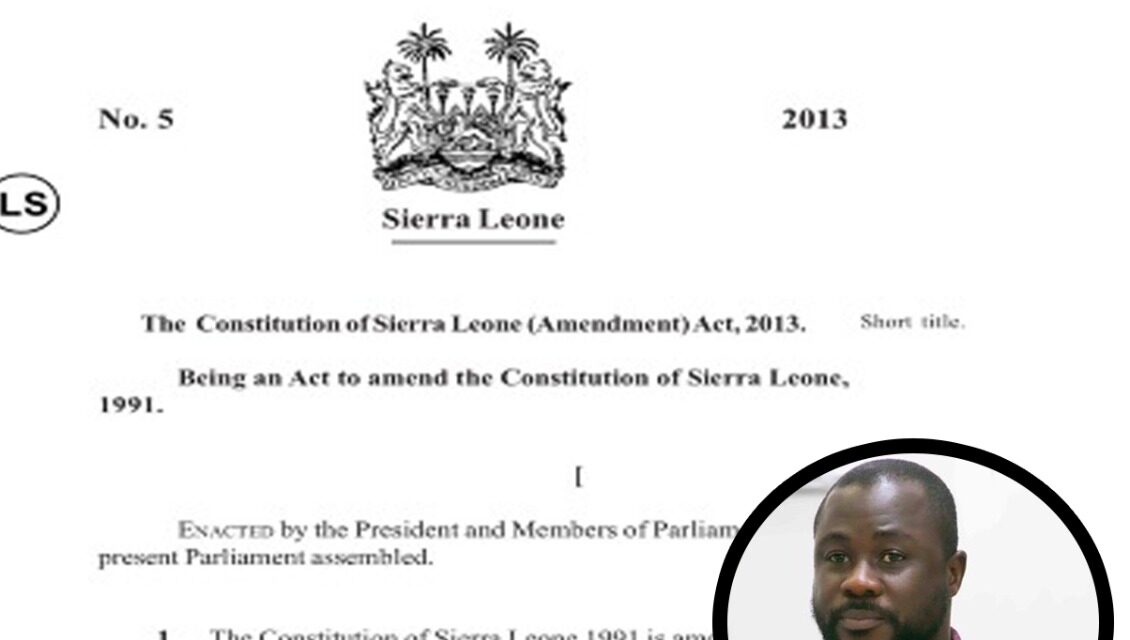
The Bill altered a fundamental qualification for election as Speaker under section 79(1) of the Constitution of Sierra Leone, 1991. It removed the requirement that the Speaker be a judge of the Superior Court of Judicature or have previously held such judicial office. It also amended subsections (2) and (3) of section 80, changing the election of the Deputy Speaker from the first sitting of each parliamentary session to the first sitting of Parliament. In effect, this transformed the Deputy Speaker’s tenure from an annual appointment into a five-year term.
The process was as controversial as the substance. In what many regarded as constitutional manoeuvring by the APC, the substantive Speaker, Justice Abel Stronge, was effectively sidelined. After the prayers, Hon. Ibrahim S. Sesay, then Clerk of Parliament, announced the Speaker’s absence and invited the Deputy Speaker, APC’s Hon. Chernor Ramadan Maju Bah, to preside.
The APC appeared to be in such a hurry that, although the House was called to order at 10:00 a.m., the Constitution of Sierra Leone (Amendment) Act 2013 had been passed by 12:55 p.m. In less than three hours, the Bill had gone through all three readings, the committee stage and the voting process, which faster than lightning.
The vote was conducted by a collection of voices under Standing Order 45 (S.O. 45). Curiously, our APC friends, who now portray themselves as the new “guardians of the Constitution”, considered that procedure sufficient, proper and lawful. Some observers even suggested at the time that APC MPs needed speech therapy merely to pronounce section 108(2)(b) of the Constitution of Sierra Leone, 1991, in the Chamber. No recorded vote was taken to establish that the Bill had secured, on the second and third readings, the support of not less than two-thirds of the Members of Parliament.
Following the voice vote, the Bill was declared passed and became law. The Deputy Speaker and APC MPs were apparently so confident that the non-entrenched provisions in sections 79(1), 80(2) and 80(3) could be amended through a collection of voices, without recourse to section 108(2)(b), that the matter was not even referred to the Supreme Court for an opinion.
Before the Bill was passed, on 31 October 2013, the SLPP, then the main opposition party, issued a scathing press release condemning it. The party described the proposed amendments as an attempt to return Sierra Leone to its authoritarian past, drawing directly from the notorious 1978 One-Party Constitution. During the parliamentary proceedings, Hon. Dr. Bu-Buakei Jabbi, of blessed memory, also strongly opposed the Bill, describing it as wholly irrelevant and unnecessary.
On 19 November 2013, the very day the Bill was passed, twenty-eight civil society organisations, including the country’s leading civil society groups, issued a joint statement condemning the proposed amendment and urging President Ernest Bai Koroma to withhold his assent.
Lo and behold, President Koroma signed the Bill into law on 29 November 2013. The civil society organisations’ appeal to the former President not to sign it ultimately amounted to locking the stable door after the horse had bolted.
This history matters because constitutional principles cannot be applied selectively. Whatever one’s view of the Speaker’s ruling during the passage of the Constitution of Sierra Leone (Amendment) Act 2026, it must be acknowledged that Speaker Sengepoh Thomas delivered a considered ruling and referred the matter to the Supreme Court.
The contrast between 2013 and 2026 is instructive. The 2025 Bill underwent months of dialogue, engagement and consultation. In 2013, by contrast, there was no considered ruling by the Deputy Speaker after the voice vote, no referral to the Supreme Court, no meaningful prior consultation and no broad public engagement.
The Bill was introduced and passed on the same day, in approximately three hours. The APC may criticise the 2026 process, but a party that once rushed a constitutional amendment through Parliament in a single sitting, without a recorded vote, judicial referral or meaningful consultation, cannot credibly present itself today as the defender of constitutional principle.
The test the APC has set today is one it failed in 2013. The constitutional compliance it demands today is the very compliance it bypassed in 2013. The legality it now invokes was disregarded in 2013. The constitutional interpretation it seeks today was ignored in 2013. The APC cannot fail its own test on constitutional amendment and then turn around and demand that the SLPP pass it. That is the height of double standards and political hypocrisy.
In the same vein, the allegations of cash and cars trumpeted by my friend and Minority Leader, Abdul Kargbo, are both laughable and ill-advised. Given the public’s low level of trust in politicians, I am not sure he genuinely believes those allegations will be taken seriously. The leaked audio, confirmed by Hon. Tawa Conteh, Deputy Speaker, suggests that it was an APC MP who was seeking assistance to support the Bill.
In light of the leaked audio, the allegations may prove to be Abdul’s foot-in-mouth moment. As a parliamentary leader, my friend Abdul Kargbo should have risen above mudslinging and grassroots gossip and focused on the substance of the debate. Instead, he may have opened a can of worms capable of swallowing him as well.
On the substance of the matter, the APC may have an opportunity before the Supreme Court to explain why, in 2013, it considered Parliament constitutionally entitled to amend non-entrenched provisions through the Constitution of Sierra Leone (Amendment) Act 2013 by relying on a collection of voices under S.O. 45, without securing the votes of not less than two-thirds of Members of Parliament as required by section 108(2)(b).
The APC’s position is not grounded in constitutional principle; it is driven by political survival. It is not founded on the consistent application of the Constitution; it is based on applying the Constitution selectively. At a time like this, the Constitution of Sierra Leone (Amendment) Act 2013 remains fresh in our minds. And on that record, the APC has failed its own test.