By Davida Spaine-Solomon
Freetown, 2nd June 2026- Women in the Media Sierra Leone President and business owner Estina Taylor-Tucker has publicly criticized what she describes as a lengthy and fragmented NGO renewal process, arguing that excessive bureaucracy is preventing local organizations from accessing funding and delivering services to communities.
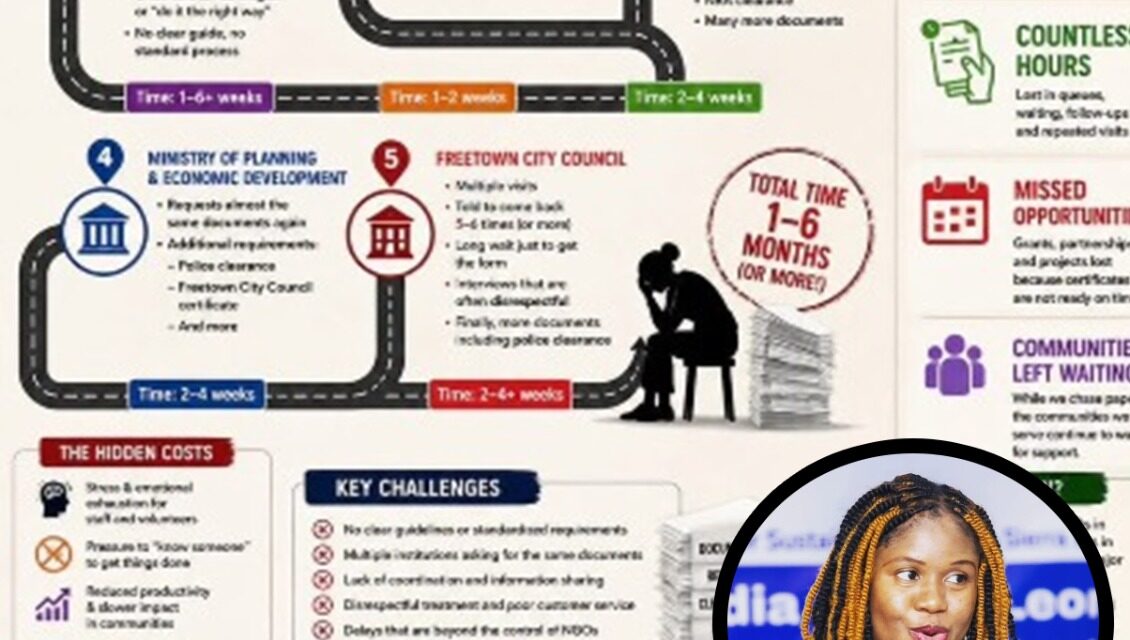
Sharing her experience after months of navigating the renewal process for her women’s empowerment organization, Taylor-Tucker said NGOs are required to submit similar documents to multiple institutions, resulting in delays, additional costs, and lost opportunities.
According to her, the renewal process began at the Ministry of Gender, where her organization completed forms, submitted supporting documents, and underwent several rounds of reviews and corrections before receiving a Service Level Agreement.
The organization was then directed to the Sierra Leone Association of Non-Governmental Organizations (SLANGO), where officials requested staff and board lists, annual reports, audited accounts, NASSIT clearance, NRA clearance, and other compliance documents.
After securing certification from SLANGO, which was established by an Act of Parliament to coordinate and regulate NGOs, Taylor-Tucker said her organization was required to submit many of the same documents again to the Ministry of Planning and Economic Development (MoPED).
The process did not end there. She said NGOs must also obtain certification from the Freetown City Council, a stage she described as particularly frustrating due to repeated visits, long waiting periods, and delays in accessing required forms and approvals.
Taylor-Tucker further noted that organizations are now being asked to obtain police clearance certificates, adding another layer of cost and administrative procedures.
She estimated that completing the renewal process can cost organizations more than Le15,000 while consuming significant time and resources.
Questioning the efficiency of the current system, she asked why multiple government institutions require nearly identical information from NGOs instead of operating through a centralized platform that allows agencies to verify compliance and share records.
While acknowledging the importance of accountability, transparency, and regulatory oversight, she argued that efficiency is equally important, particularly for smaller local organizations with limited resources.
Taylor-Tucker revealed that delays in obtaining updated certification recently caused her organization to miss a grant opportunity that could have supported its annual activities.
According to her, the organization began its Community-Based Organization registration process with the Freetown City Council in January. Although all required documents were submitted, the certificate was not issued until May 2. The grant application deadline had passed in February.
“We missed it because the system took too long,” she said, adding that many local organizations face similar challenges while trying to meet donor deadlines.
She also expressed concern about perceptions that administrative processes can move faster for individuals with personal connections, stressing that institutions should function efficiently and fairly for all citizens rather than relying on influence or personal networks.
Despite her criticism, Taylor-Tucker commended public servants who provide timely support and guidance to organizations navigating the compliance process.
However, she maintained that the broader system remains slow, fragmented, and burdensome for local NGOs.
“Local NGOs are not asking for special treatment,” she said. “We are asking for a system that allows us to spend less time chasing certificates and more time serving communities.”
She warned that delays in certification have wider consequences, including missed grants, postponed projects, and communities waiting longer for much-needed support.