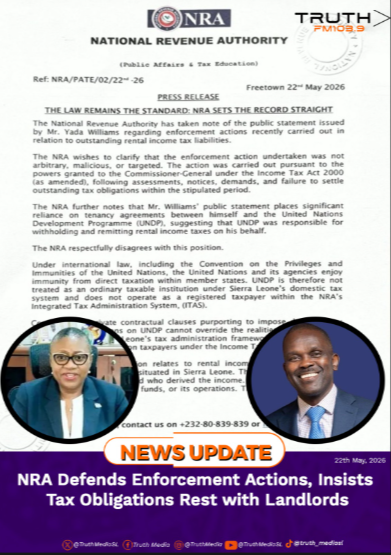
Freetown, 22nd May, 2026 – The National Revenue Authority (NRA) has defended its recent enforcement actions over outstanding rental income tax liabilities, insisting that measures taken were lawful, professional, and grounded in Sierra Leone’s Income Tax Act 2000 (as amended).
In response to public statements by lawyer Mr. Yada Williams, the NRA clarified that enforcement was not arbitrary or targeted but followed assessments, notices, demands, and failure to settle obligations within the stipulated period.
The Authority rejected claims that the United Nations Development Programme (UNDP) should bear responsibility for the tax liability. Citing the Convention on the Privileges and Immunities of the United Nations, the NRA stressed that UNDP enjoys immunity from direct taxation and is not treated as a registered taxpayer under Sierra Leone’s Integrated Tax Administration System.
Instead, the liability relates to rental income earned by a private landlord, with the NRA emphasizing: “The taxable person under the law remains the landlord who derived the income.”
The NRA underscored that private tenancy agreements do not constitute proof of tax payment. Taxpayers alleging that taxes were withheld on their behalf must provide verifiable evidence such as withholding certificates, ITAS payment records, receipts, or corresponding filings. In the absence of such proof, the Authority remains legally entitled to recover taxes due.
The Authority also dismissed assertions that enforcement measures could only apply to the premises generating rental income. It noted that the Commissioner‑General is empowered to enforce recovery against the taxpayer personally, not just the property.
The NRA condemned Mr. Williams’ “insults, name‑calling, and unsubstantiated allegations of corruption,” stressing that tax administration is a legal exercise, not a personality contest. Any evidence of mismanagement, it added, should be directed to the Anti‑Corruption Commission or the courts.
Reaffirming its stance, the NRA said it remains committed to upholding the rule of law, respecting court processes, and administering tax laws fairly and without fear or favour. It urged taxpayers to comply voluntarily and resolve disputes through lawful objection and appeal mechanisms.