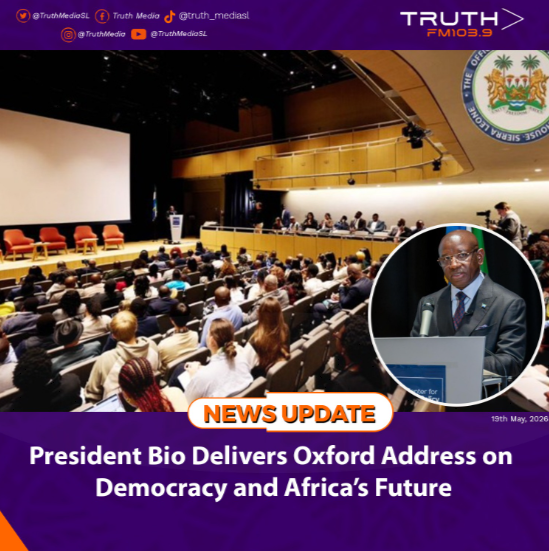
Oxford, England – 18th May 2026 — Sierra Leone’s President and current Chairman of the ECOWAS Authority of Heads of State and Government, Dr. Julius Maada Bio, has delivered a landmark lecture at the University of Oxford, urging Africa to defend constitutional democracy against the rising tide of coups and political instability.
Speaking at the prestigious Oxford Postgraduate Distinguished Lecture Series, President Bio addressed students, faculty, diplomats, and academics on the theme: “Defending Constitutional Democracy in an Era of Growing Coups and Electoral Uncertainty in West Africa.”
In a reflective and statesmanlike speech, he warned that democracy in the region faces dual threats: military takeovers and the slow erosion of public trust in institutions. “The greatest threat to constitutional democracy in West Africa is not only the soldier who suspends the Constitution,” he declared. “It is also the slow erosion of public trust that makes citizens begin to doubt whether constitutional systems can still protect them, represent them, and improve their lives.”
President Bio cited recent coups in Mali, Guinea, Burkina Faso, Niger, and Guinea‑Bissau as evidence of democracy under siege. He cautioned that democratic backsliding often begins subtly, through weakened accountability and tolerated excesses, creating fertile ground for unconstitutional actors.
Reflecting on Sierra Leone’s own journey, Bio acknowledged his past as a military leader before overseeing the country’s transition to civilian rule in 1996. “I first came to power through military rule. Twenty‑two years later, I returned to leadership not through force, but through the ballot box. I learned that the hardest act of leadership is not taking power. It is limiting it,” he said.
He reaffirmed Sierra Leone’s commitment to constitutional order, highlighting ongoing reforms such as the Tripartite Steering Committee and electoral reform efforts designed to strengthen public confidence. As ECOWAS Chair, he condemned coups but also warned elected governments against undermining democracy from within.
“Military coups are wrong,” he noted. “But if constitutional governments fail to govern responsibly, the potential for unconstitutional intervention increases.”
President Bio called for stronger preventive diplomacy, governance benchmarks, and regional resolve to confront democratic erosion. Addressing young Africans and global scholars, he emphasized that democracy depends on the courage of citizens and institutions. “Constitutions do not enforce themselves. Institutions do not defend themselves. People do,” he said.
Closing his address, he urged Africa’s leaders to ensure future generations never lose faith in democracy. “Our generation must ensure that no African child grows up believing that the gun is a faster path to power than the ballot,” he concluded.