By Ishmael Zay-Bangura
Freetown, 18th May 2026- The story of the Siaka Stevens Stadium refurbishment began in February 2022 when government officials launched the project with a firm pledge: the historic venue would be fully restored and reopened by April 2024. For athletes, fans, and administrators alike, that promise carried the hope of a vibrant home for football, athletics, and national celebrations.
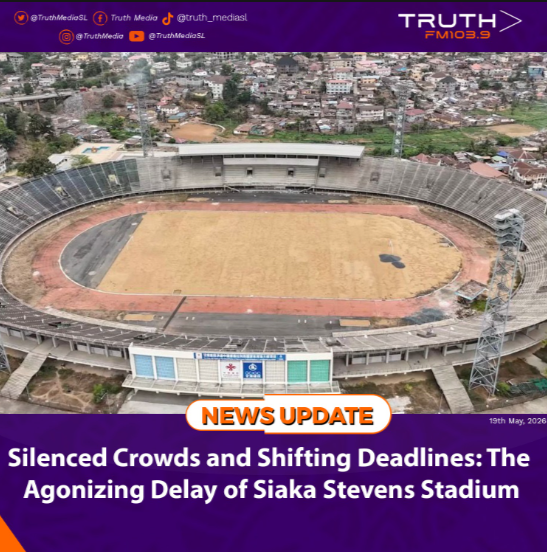
More than two years after the set deadline, the stadium remains a shell of its intended self, scaffolding still clings to half-painted stands, turf sits unlaid in the main bowl, and the roar of crowds has been replaced by the clank of machinery. Despite repeated assurances, the timeline has now slipped dramatically, with the latest projections targeting late 2026 or even early 2027 for completion.
The human cost of these delays is most painfully felt by Sierra Leone’s footballers. For them, the stadium was not just concrete and steel, it was the cauldron of national pride, the place where they could feed off the energy of home fans. Instead, players have been stripped of that privilege.
International matches and key domestic fixtures have been forced onto neutral or opposition territory, where the absence of a familiar, roaring crowd mutes their advantage. One national team player, speaking on condition of anonymity, described playing in empty or hostile away venues as, “fighting with one hand tied behind our backs. We lose not just points, but the spirit that only our people can give us.”
Beyond football, the ripple effects have paralyzed other sporting disciplines. Athletes in track and field, handball, volleyball, and swimming have seen their seasons upended. The stadium’s closure has forced them either to put competitions on indefinite hold or to relocate to uncomfortable, makeshift surroundings, often dusty school fields or uneven community pitches that bear no resemblance to regulation surfaces.
Leagues that once drew hundreds of spectators now face significant challenges: sponsorship dwindles when matches are played in obscure locations, athlete safety is compromised on substandard grounds, and the very rhythm of competitive seasons has been shattered.
A drone shot through the current site confirms the grim reality. Substantial work remains unfinished: electrical systems are only partially wired, VIP lounges lack fixtures, and drainage channels remain clogged with debris. The roof over the main grandstand still shows gaping holes. In short, the stadium today is far from the gleaming symbol of progress that was advertised in 2022.
Augusta James-Teima, the Minister of Sports, acknowledged the setbacks in an interview on Africa Young Voices (AYV), attributing the delays to mandatory safety reviews and necessary design adjustments. She reaffirmed the government’s commitment to transparency and timely delivery, insisting that the revised plan is realistic. Yet, for all her reassurances, the shifting completion date first to 2025, then to mid-2026, and now late 2026 or early 2027 tells a different story.
Each postponement deepens the negative impact on Sierra Leone’s sporting sector: investor confidence erodes, youth participation falters, and the nation’s reputation as a serious host for regional tournaments evaporates. What was meant to be a two-year revival has stretched into a five-year saga of lost opportunities, silenced crowds, and a stadium that remains, stubbornly, a monument to delay.