By Emmanuel Mbowa
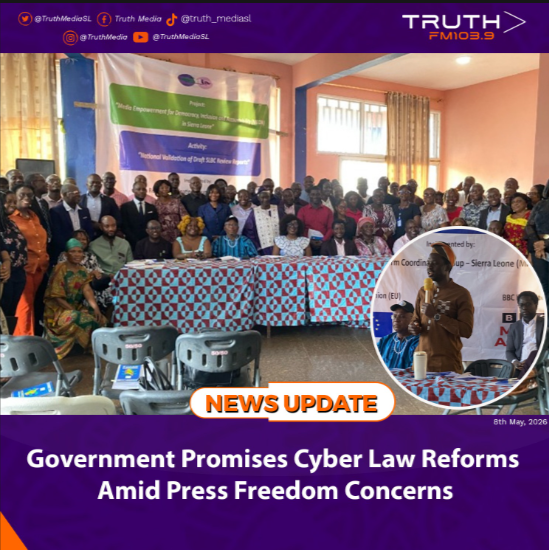
Freetown, 8th May 2026 — The government has assured Sierra Leoneans of imminent reforms to the country’s Cybersecurity and Crimes Act, following growing concerns over its use and the nation’s sharp decline in global press freedom rankings.
Sierra Leone was ranked 79th out of 180 countries in the latest Reporters Without Borders (RSF) Press Freedom Index, a drop that has unsettled media professionals and rights advocates despite the landmark repeal of Part Five of the 1965 Public Order Act in 2020, a move once hailed as a victory for free expression.
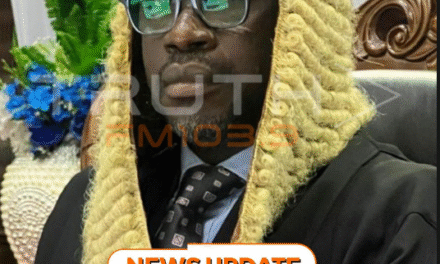
Responding to the decline, Minister of Information and Civic Education, Chernor Bah, acknowledged the challenges facing the media environment.
“We accept that this past year has seen some developments that are inconsistent with where we want to head, and we accept that it is a signal that important work needs to be done for us to change,” he said.
Bah addressed concerns about the Cybersecurity and Crimes Act, which some journalists say has been used to intimidate rather than protect.
“Where we fell short is with some people, including the law enforcers who utilise the Cyber Law particularly, not to imprison, but as the basis to invite journalists all the time to the police and hold them for five to six hours to make statements. We make sure that there is not a single journalist in this country who has spent time in jail for doing his work, but that does not mean the fact that they invite them is something we agree with,” he explained.
“It also doesn’t mean that all journalists are above the law, as there are some that actually commit crimes and others who are actually in the business of publishing something and asking for money.”
The minister revealed that the government is already working on reforms to clarify and strengthen the law’s intent.
“The AG and I want to work with the police and develop a simple and transparent regime. We want to bring the law again for review because we want to separate cybersecurity from cybercrime, have an online safety law, and we want to make sure that there is an express provision that reserves protection for public interest stories.”
Despite the challenges, Bah expressed optimism that Sierra Leone’s press freedom ranking will improve as reforms take shape.
“What I am here to say is, the commitment of President Bio to press freedom is sacrosanct. My commitment, the AG’s, and the rest of the government’s commitment is to work with the MRCG and the media as partners to protect a free society, because the democracy we want is desperately dependent on the freedom of this society and our ability to express our opinions freely.”
Minister Bah made these remarks during the Multi-Stakeholder Validation of the SLBC Review Reports, an event aimed at transforming the state-owned broadcaster into an independent and inclusive public service media institution.