By Nafisatu Olayinka Deen
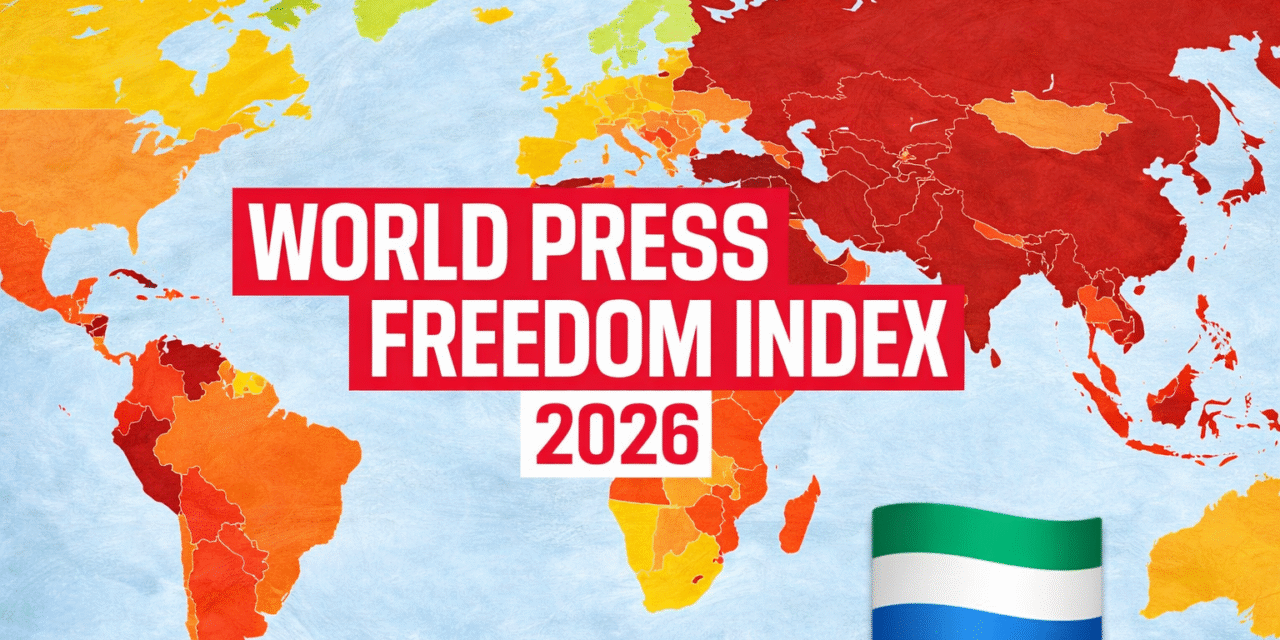
Freetown, 4th May 2026- Two decades after Sierra Leone’s civil war, the country now ranks 79th out of 180 nations in the 2026 Reporters Without Borders (RSF) World Press Freedom Index a sharp drop of 23 places from last year. The decline signals a worsening media environment and growing challenges to press freedom.
The Truth and Reconciliation Commission (TRC) once observed that “freedom of expression is the lifeblood of democracy, and the degree to which the media is independent determines how effectively it can serve as a public watchdog over officials and powerful individuals.” The Commission therefore recommended repealing the seditious and criminal libel laws.
That recommendation was realized in 2020, when Part V of the 1965 Public Order Act, which criminalized libel and sedition, was repealed, a milestone for Sierra Leone’s media landscape.
Yet, progress remains incomplete. The RSF report’s safety indicator highlights rising physical risks for journalists, particularly during politically sensitive periods, with Sierra Leone’s ranking in that category falling between 71st and 112th globally.
Communication and media expert Dr. Tonya Musa described the report as deeply concerning. While commending the legal reforms, he criticized provisions in the Cyber Security Act, arguing that they undermine earlier gains.
“Legal reforms such as the repeal of the 1965 Public Order Act marked a significant step forward,” he said. “But progress remains incomplete. The 2025 Counter‑Terrorism Bill raises concerns about potential misuse to suppress dissent, while provisions in the Cyber Security Act have reportedly been used to summon editors over charges like ‘cyberstalking.’ These developments risk reversing earlier achievements in press freedom.”
In an interview with Truth Media, freelance journalist Edward W. J. Caulker said the repeal of the criminal libel law has helped, but gaps persist that leave the media ecosystem fragile.
“The repeal was laudable. Journalists can now operate more openly than before. But the media landscape remains fragile, pressured, and unpredictable. There’s a gap between what the law says and what journalists experience daily,” he noted.
Caulker cited persistent challenges: political pressure, intimidation, economic vulnerability, safety concerns, and self‑censorship.
“Journalists still face political pressure, especially when reporting on sensitive issues. Low pay and poor welfare expose them to influence. Harassment and threats make many hold back not because they can’t speak, but because of fear and uncertainty.”
In a May 3, 2026, press release, the Media Reform Coordinating Group (MRCG) described Sierra Leone’s press freedom situation as “precarious” and “deteriorating,” though it acknowledged some positive aspects.
“The report highlights that Sierra Leone’s media landscape retains positive features, including a pluralistic sector and the continued absence of widespread journalist detentions or killings, distinguishing it from more repressive environments,” the statement read.
The MRCG also pointed to deeper structural issues undermining press freedom:
“Economic fragility of media institutions, poor working conditions for journalists, and vulnerability to political influence continue to weaken editorial independence.”
Madina Kula Sheriff, journalist at Afri Radio, said the ranking reflects troubling realities.
“This isn’t good for the country. The decline isn’t surprising given last year’s incidents of intimidation, and even a journalist banned from entering Parliament. Intimidation, whether from those in power or ordinary citizens, must stop. People should see journalists as those tasked with asking tough questions and holding power accountable.”
The Sierra Leone Reporters Union, Sierra Leone Association of Journalists (SLAJ), MRCG, and other media groups have urged the government to reflect on this year’s ranking and work toward genuine press freedom, not a “half‑baked” version.
They also reminded journalists that freedom comes with responsibility: to be accurate, balanced, and unambiguous in their reporting.
This story is brought to you with support from the Africa Transitional Justice Legacy Fund (ATJLF) through the Media Reform Coordinating Group (MRCG), under the project ‘Engaging Media and Communities to Change the Narrative on Transitional Justice Issues in Sierra Leone.’