By Algassimu Monorma Bah
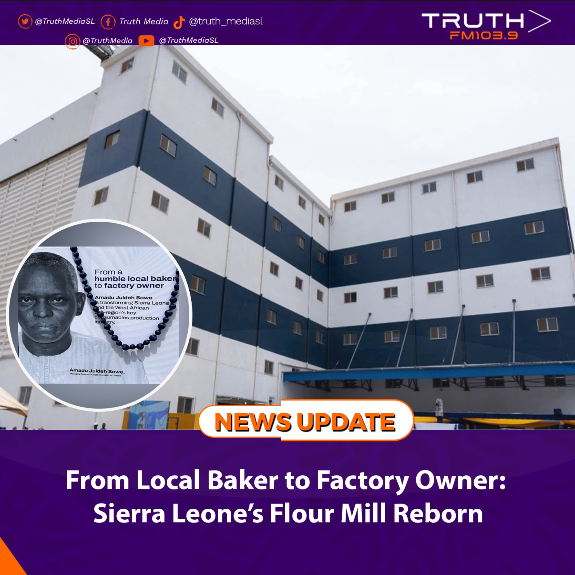
Freetown, 4th May 2026– There are moments when progress stops being a promise and becomes something you can see, touch, and believe. Standing at the newly expanded Sierra Leone Flour Mill, that moment felt unmistakable a symbol of how far the country’s industrial ambition has come, and how one man’s journey mirrors it.
Alhaji Amadu Juldeh Sowe, now Chairman of the Sierra Leone Flour Mill, began his story at the factory gates decades ago. As a young boy helping his father’s bakery, he came weekly to buy five bags of flour. They were never allowed inside customers waited at the gate for their goods.
Today, that same boy stands not outside but at the helm of the very factory he once could not enter. Under his leadership, the mill has transformed from a dormant facility into a thriving industrial hub.
When Mr. Sowe acquired the plant in 2015, it had been closed for nearly a decade, crippled by competition from imported flour. Now, with government support including land for expansion, policy incentives, and tax concessions, the mill’s production capacity has surged from 250 to 600 tons per day.
The reopening drew national and regional attention. President Julius Maada Bio, joined by First Lady Fatima Maada Bio, ministers, parliamentarians, and delegates from Guinea and Liberia, attended the launch, a sign that Sierra Leone’s industrial story is resonating beyond its borders.
Mr. Sowe praised the government’s enabling business environment, citing import duty waivers on wheat and support from financial institutions, including the World Bank.
World Bank Country Manager Abdu Muwonge described the project as a model of collaboration between government, development partners, and the private sector, aligning with the Feed Salone Initiative to boost local production and food security.
The revival of the mill is already reshaping the economy. Jobs are being created, supply chains are expanding, and the locally produced “Life Flour” brand is now competitive enough to reach markets in Guinea, Liberia, and beyond.
President Bio hailed the development as a milestone in Sierra Leone’s industrial growth, strengthening local value addition and signalling renewed confidence in private‑sector‑led development.
For many, the story is more than industrial progress; it’s a metaphor for national transformation. The image of a young boy once waiting at the gate, now holding the keys to the factory, captures the essence of Sierra Leone’s journey toward self‑reliance.
If citizens take bold steps, work with courage and perseverance, and partner with government and development institutions, Sierra Leone can truly produce what it eats and eat what it produces.
This is not just a business success story; it is a defining moment in Sierra Leone’s industrial future.