By Davida Spaine-Solomon
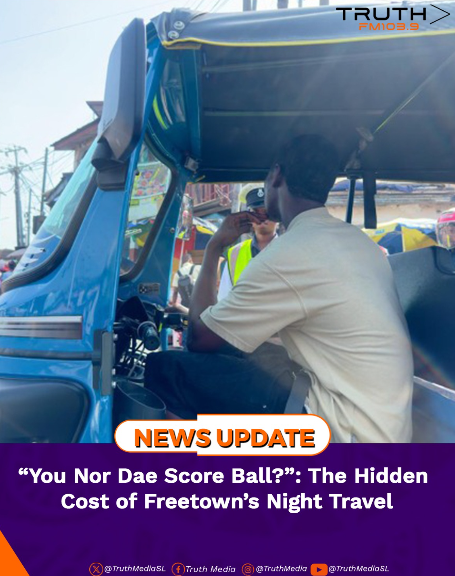
Freetown, 20th April 2026 – In Freetown, vehicles passing through nighttime checkpoints are often waved on without proper inspection. At Congo Cross, just after 10:00 p.m. one evening in early April, a car crept forward under the glare of flashlights as it approached the barrier.
A police officer stepped forward and signalled to the driver to stop, without even requesting the driver’s license, no meaningful inspection, but demanding money from him, using their bribery language, “You nor dae score ball Tiday?” Within seconds, the driver dashed the police officer some money who then quickly waved him to pass on.
This pattern was repeated across various checkpoints at Lumley, Wilberforce, IMATT Junction, Regent, and Grafton, revealing a system that many drivers noted “is no longer occasional, but expected.”
Across multiple nights of observation at those various checkpoints, a process appeared strikingly consistent: a tap on the vehicle, a quick beam of light into the interior, sometimes a brief performative search and a pause to signal expectation.
Umu Jay, a 28-year-old tricycle (kekeh) rider, explained how quickly she adapted to this practice: “At first, I thought the checks were genuine, but after a few nights, I realized they were not interested in my documents. Now, I keep the money ready before I even get there [at the checkpoint]. If you delay, they delay you [more than you could expect].”
For okada riders, the encounters were shorter but more frequent. Usman Deen, a bike rider, described the routine: “You can pass three or four checkpoints in one night, and it is always the same. The money may look small, but it adds up. If you refuse, they hold you. If you pay, you go.”
Though no official amount was stated, drivers consistently estimate payments starting from Le5 per stop, varying by location and vehicle type. The exchange was rarely direct, often masked as a handshake or subtle gesture.
For commercial drivers, these payments were not incidental; they were built into the economics of their work. A “poda-poda” driver described it bluntly: “You go out already knowing you will spend money at checkpoints before you even start making a profit. At some places, it feels fixed. No talk; just greet, exchange [give money], and go.”
Taxi drivers echoed the dilemma of compliance or being delayed. “If you insist on proper checks, you will stay there longer than expected. But if you understand how it works, you settle it quickly,” said a taxi driver.
For older drivers, the shift is unmistakable. An aged taxi driver noted that the shift is “unmistakable.” Abdul Santigie Bangura, 58, said what was once discreet is now a routine: “It is no longer hidden. They pretend to search, but everyone understands the signal. If you pay, you pass.”
In all the interviews conducted, the pattern remained consistent, not aggressive, but persistent and normalized.
The financial impact extends far beyond the drivers themselves. “Whatever we pay on the road is passed on to passengers,” a poda-poda driver explained. “We cannot absorb it.”
A representative from the union of drivers and kekeh riders, who requested anonymity, described the growing strain: “It is becoming very difficult for drivers, especially now with the high increase in fuel
[prices]. When you add these checkpoint payments, we are forced to increase fares just to survive. In some cases, prices are doubled, not because we want to, but because we have no choice.”
For commuters, traders and everyday workers, those increases ripple outward, raising the cost of transport, goods, and daily life. Women traders, especially are disproportionately affected, as transport costs eat into already narrow profit margins.
This scoreboard practice erodes trust in law enforcement. Beyond the economic toll, drivers said the practice is reshaping how they view law enforcement. “When something like this becomes normal, people begin to accept it,” Usman said. “But it should not be normal.”
What is designed as a system of public protection risks becoming a common practice, an informal toll network that operates nightly, largely unchecked.
The Silence from Authorities:
Many efforts trying to reach police authorities for comment on this proved futile at the time of publication.