By Davida Spaine-Solomon
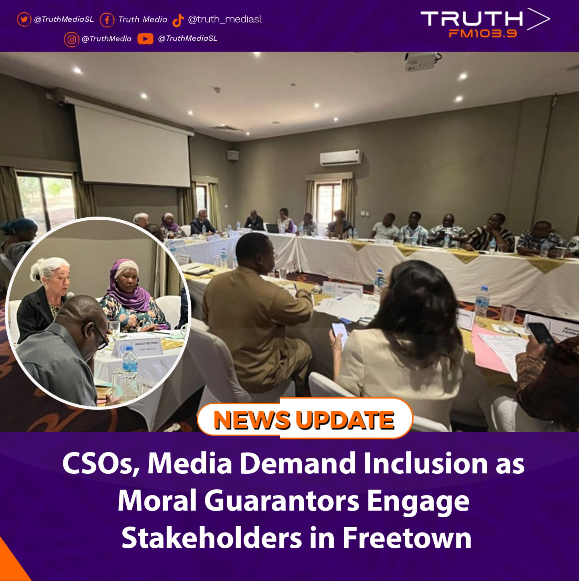
Freetown, 16th April 2026- The International Moral Guarantors on Thursday convened a high-level engagement with civil society organizations (CSOs) and media representatives at the Radisson Blu Mammy Yoko Hotel, where stakeholders raised strong concerns over exclusion, transparency gaps, and slow implementation of key peace agreement reforms ahead of the 2028 elections.
The meeting, part of an ongoing assessment mission, quickly turned into a candid forum in which civil society actors challenged the structure of the peace process and called for a broader, more accountable national framework.
Leading the push for reform, Marcella Samba, Executive Director of the Campaign for Good Governance and Chairperson of National Elections Watch, warned that while political parties remain central to the peace architecture, they are also part of the challenge undermining progress.
“Yes, two political parties are important, but they are also part of the problem. We must open the space for broader, candid national dialogue,” she said, urging a more inclusive approach to national decision-making.
CSOs Say They Were Shut Out of Key Process
A major point of tension was the exclusion of civil society and media actors from the initial peace agreement framework, which largely centered on the All People’s Congress (APC) and the Sierra Leone People’s Party (SLPP).
Speakers argued that limiting negotiations to only two political parties undermines democratic representation in a country with multiple registered parties and weakens public confidence in the process.
A representative from Amnesty International described civil society as “silent bystanders” in a process they were expected to support but were never fully allowed to shape.
“We are watching from a distance. We were not part of the process, yet we are expected to understand and support it,” he said, questioning how stakeholder engagement is defined by the Tripartite Secretariat.
Transparency and Implementation Questions Raised
Participants also pressed the Moral Guarantors on the status of the 84 recommendations agreed under the peace framework, demanding clear data on what has been implemented and what remains outstanding.
Speakers warned that without transparent reporting, claims of progress risk losing credibility.
“If we don’t know what has been achieved and where the gaps are, how can we build a credible framework for progress?” one participant asked.
Calls were also made for the publication of key electoral documents, including the strategic plan of the Electoral Commission, to strengthen monitoring and public accountability.
Growing Concern Ahead of 2028 Elections
As discussions continued, CSOs warned that the current approach risks deepening political tensions ahead of the 2028 elections if inclusivity is not urgently addressed.
Concerns were also raised about proposed electoral reforms, with some participants cautioning that changes to voting systems and thresholds must be widely consulted to avoid undermining national cohesion.
Civil society actors urged the Moral Guarantors to formally recognize CSOs and the media as key partners in the peace process going forward.
“We have paid the price for peace in this country. We cannot be excluded from shaping its future,” one speaker said.
Call for Political Compromise
Participants also appealed to both major parties to prioritize national stability over partisan advantage, urging a “win-win” approach to resolving long-standing political disagreements.
They warned that continued deadlock could weaken governance and negatively affect ordinary citizens across the country.
“This country cannot be held to ransom by political interests. There must be a win-win situation for Sierra Leone to move forward,” a civil civil leader stressed.
Moral Guarantors Respond
Responding to the concerns, the head of the delegation, Fatoumata Jallow Tambajang, acknowledged the repeated complaints over exclusion and transparency.
She assured participants that all concerns raised would be reflected in the group’s final report and emphasized the importance of national institutions such as the National Peace Commission in sustaining dialogue and rebuilding trust.
Looking Ahead
As the assessment mission continues, pressure is mounting for a more inclusive and transparent peace framework that brings in all stakeholders not only political actors.
With the 2028 elections approaching, participants warned that failure to act on these concerns could risk reversing hard-won gains in Sierra Leone’s democratic and governance progress.