By Davida Spaine Solomon
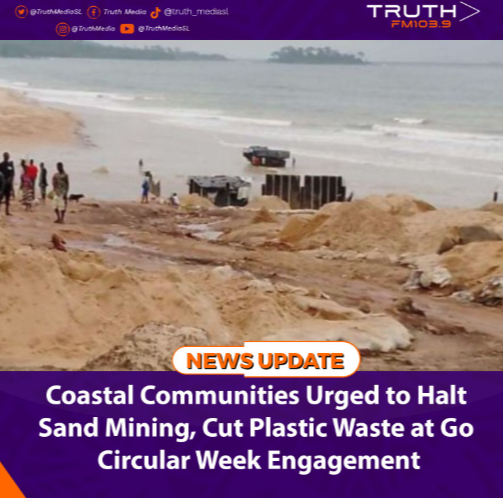
Lungi, 7th April 2016 – A strong call to action echoed across coastal Lungi on Day Three of Go Circular Week, as government officials, development partners, and residents united to confront the growing threats of plastic pollution and sand mining along Sierra Leone’s fragile shoreline.
At an engagement held at Tariq Resort, Deputy Minister of Environment and Climate Change, Hon. Mima Yema Mimi Sobba-Stephens, joined virtually to underscore the urgency of protecting coastal ecosystems. She thanked participants for their presence and stressed that raising awareness on sand mining is critical, warning that its long-term effects are “dangerous and far-reaching.”
Reflecting on a visit to Mahera community, she described it as Sierra Leone’s “gateway,” often the first impression for tourists entering the country. “What visitors see here matters,” she said, urging residents to maintain clean beaches and resist destructive practices like sand mining that erode both the environment and tourism appeal.
Sobba-Stephens highlighted the economic value tourism brings to coastal communities, calling on residents to reduce plastic use and adopt sustainable alternatives. She also appealed directly to marine transport operators, including Sea Coach and Sea Bird, to move away from single-use plastics. “Adopt alternatives like water dispensers instead of serving sachet water,” she urged, adding that such changes could significantly reduce ocean pollution.
Louise Twining-Ward, Global Sector Lead for Tourism at the World Bank, broadened the discussion by linking environmental protection to economic opportunity. She warned of the growing health risks of plastic pollution, citing concerns that microplastics entering the bloodstream of pregnant women could affect unborn children.
Community members shared firsthand experiences of polluted beaches, contaminated air from burning plastics, and blocked drainage systems that increase mosquito breeding and malaria risk. Twining-Ward emphasized that solutions must begin at the community level. “Change starts with all of us from elders teaching children better habits, to reducing plastic use and rethinking how we dispose of waste,” she said.
She also pointed to the economic potential of recycling and reusing plastics, noting that cleaner beaches attract tourists and boost local livelihoods. On sand mining, she cautioned that unchecked extraction weakens coastal defenses, accelerates erosion, and threatens homes, infrastructure, and tourism assets. “If the beaches disappear, so do the benefits they bring,” she warned.
The engagement ended with a unified call from community members for stronger enforcement of environmental laws, increased public education, and sustained collaboration between government, private operators, and residents. They pledged to take greater responsibility in protecting their coastline, recognizing that safeguarding the environment is not just an obligation, but a pathway to a more sustainable and prosperous future.