By Kelfala Kargbo
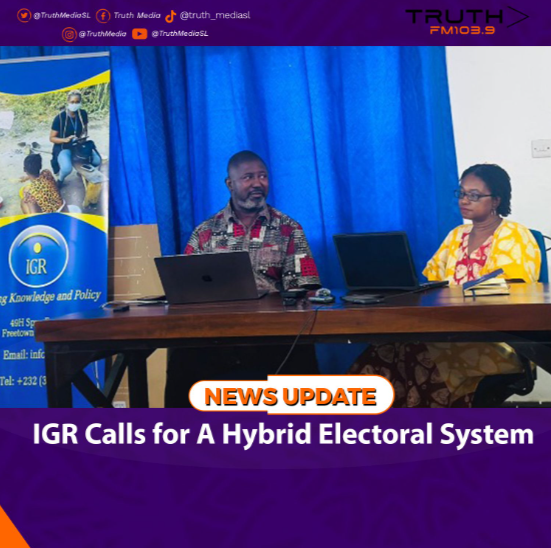
Freetown, 30th March 2026- The Institute of Governance Reform (IGR) has issued a position paper calling for the adoption of a hybrid electoral system, blending both Proportional Representation (PR) and First-Past-the-Post. The paper, which falls under IGR’s critical perspectives, aimed at resolving the disagreements between the government and the opposition, the All People’s Congress, about the most preferred electoral system.
The core argument of IGR’s position paper is that the first-past-the-post versus PR is a false choice, as it says both systems fail to address governance challenges.
Benefits of the hybrid system, according to IGR’s position paper, it improves accountability and inclusion, as it would bring some parts of the country closer to their representatives, while in other parts, there would be wider participation.
Also, it says it would reduce winner-takes-all politics, which often denies minority representation. It adds that political parties would have a national outlook, while having stability, trust and making politics affordable, which the country had been spending a lot on.
While speaking at the launch, Executive Director IGR, Andrew Lavalie, said that both the PR and First-past-the-post electoral systems have never worked in the interest of citizens.
Sierra Leone has conducted its elections under both the PR and the First-past-the-post electoral system. The country adopted the first-past-the-post electoral system in 2007, 2012 and 2018, while adopting PR in 1996, 2002 and 2023.
The report indicated that in all elections conducted under the PR, the Sierra Leone People’s Party had won all, while the All People’s Congress had dominated those conducted under First-past-the-post.
For the first-past-the-post constituency-based electoral system, according to the report, it promotes accountability, stating that it would directly identify and hold their representatives accountable. For the PR, according to the paper, 20% of wards currently lack councillor representation, which reduces local accountability.
“The shift to FPTP in 2007 was partly motivated by the aim to improve accountability through direct connection of MPs to geographic constituencies. Under this system, citizens have some say over who gets elected for a seat in parliament,” the report states, noting that the PR gives the parties the power to elect parliamentary representatives.
According to the report, PR system is more inclusive in nature. Despite having weak accountability, the paper says, it gives rise to inclusion and political participation.
In conclusion, the paper proposes that electoral reforms must focus on outcomes, a hybrid system offers best path forward, as it promotes accountability, inclusion and governance stability and that reforms must reshape political incentives.