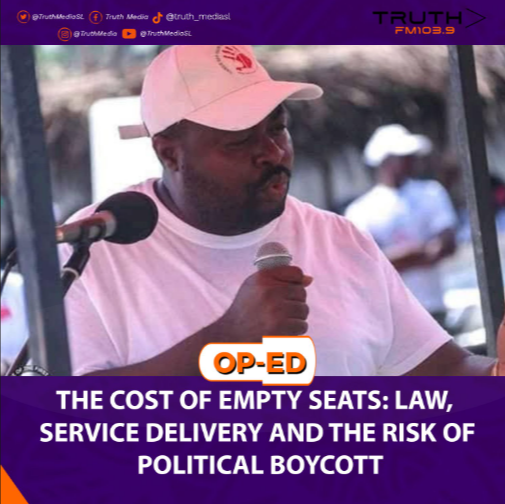
Layemin Joe Sandi (JP)
Former Mayor (Two Terms), and Former National PRO LoCASL
Freetown, 27th March, 2026- The ongoing boycott by Mayors, Chairmen and Councillors of the All Peoples Congress (APC) raises a difficult but necessary question: can elected local officials step away from governance without consequences under the Local Government Act 2022? Having served as a Councillor, Deputy Mayor and Mayor, my reflections come not from theory, but from lived experience within the system.
The law is unambiguous on one central point. It does not provide any space for elected local officials to boycott governance. On the contrary, it imposes a duty. Under section 30, councillors are required to attend meetings and actively participate in the work of council. This duty is not political, it is statutory. More importantly, section 9(1)(d) makes it clear that a councillor who absents himself or herself from three consecutive meetings without reasonable excuse risks losing that seat. Nowhere in the Act is political protest listed as a valid justification for prolonged absence. In effect, the law does not recognise boycott as a legitimate option within public office.
Beyond legality, it is important to reflect on why such a course of action may not even serve the long term interest of those involved. Local governance is the closest form of government to the people. When councillors withdraw, it is not the central government that immediately feels the impact, but the ordinary citizen. Waste goes uncollected, local disputes remain unresolved, development projects stall and trust in leadership erodes. Over time, this weakens not just the institution, but also the political credibility of those who are seen to have stepped away from their responsibilities. Public office is a trust, and once that trust is shaken, it is not easily restored.
The law also anticipates situations where councils become ineffective, and it provides remedies that may not necessarily favour those who choose to disengage. The Ministry of Local Government and Community Affairs has supervisory authority to step in and ensure that essential functions continue. Even in the absence of political actors, the administrative arm of the council, led by the Chief Administrator, does not shut down.
In practical terms, this means that basic services still go on. Waste collection and sanitation activities can continue, public spaces and markets can still be managed, and routine public health responsibilities are maintained. Council staff also continue to handle finances by paying salaries, managing day to day expenses and keeping proper financial records. Ongoing projects that were already approved, such as community works or maintenance activities, can still be supervised and carried forward. At the same time, the administrative team ensures that records are kept, official communication is handled and coordination with central government continues.
However, this continuity has its limits. The administrative arm cannot replace elected leadership. It cannot make new policies, approve major spending decisions or take critical governance actions that require political authority. In simple terms, the system can keep running, but it cannot move forward effectively.
In such circumstances, those who choose to stay away must recognise the longer term risk. Prolonged absence can gradually diminish their relevance in the eyes of the very people who elected them. As services continue, even in a limited form, public attention shifts to those who remain present and responsive. Over time, this weakens public trust and creates the perception that elected leaders have stepped aside when they were needed most.
Where the situation becomes severe and councils are unable to function, section 108 of the Act empowers the President to intervene, subject to the approval of two thirds of Parliament. This is a serious and carefully guarded step, intended only for extreme situations where governance has effectively broken down. It is not a political shortcut, but a legal safeguard to protect the people.
For Mayors, Chairmen and Councillors, this is a critical point. The longer the boycott persists, the greater the likelihood that legal mechanisms will be activated to bypass or replace their roles in order to protect service delivery. What begins as a political strategy may ultimately result in diminished authority and lost opportunity to influence outcomes from within the system.
This is why I believe strongly that this path should be reconsidered. There are always avenues for engagement and negotiation that do not require a complete withdrawal from governance. Leadership, especially at the local level, demands presence, resilience and a willingness to serve even in difficult political moments.
I therefore make a heartfelt appeal to my colleagues, past and present, who occupy these important offices. Let us not set a precedent that may one day be used against the very institutions we cherish. Let us return to the council chambers, not because the issues at stake are small, but because the people we serve are too important to be left without representation. Dialogue without ego, service without interruption and respect for the law must guide us forward.
(An experienced palm wine tapper beneath the Palm tree does not let a fallen tapping knife get lost)
My honest opinion!