By: Andrew Chokpeleh
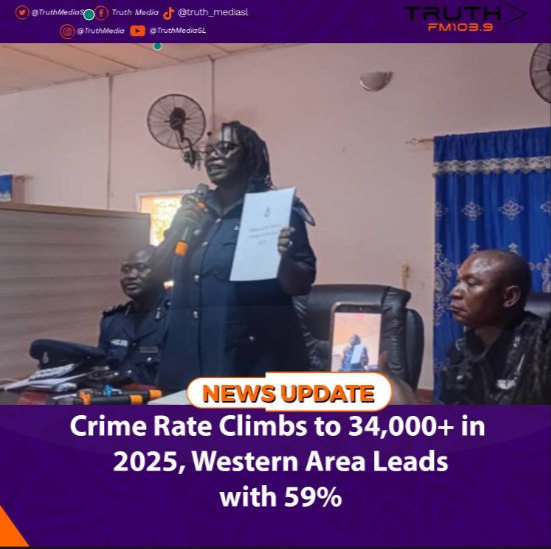
Freetown, 11th March 2026– The Sierra Leone Police have released their 2025 crime statistics, presenting what reads like a national balance sheet of law and order. The figures reveal a marginal increase in the crime rate from 0.33% in 2024 to 0.38% in 2025, translating into 34,066 recorded criminal and road traffic offences across the country.
The Western Area remains the epicenter of criminal activity, accounting for 59% of all reported cases. Within this, Freetown East registered 11,603 offences, 34.1% of the national total, while Freetown West followed with 8,487 cases, representing 24.9%. These figures underscore the heavy concentration of crime in urban and semi-urban centres, where economic activity and population density are highest.
Offences against women and children dominate the national crime profile, with 15,188 cases in 2025, 44.6% of all reported crimes. Domestic violence surged from 7,456 cases in 2024 to 12,301 in 2025, a 65% increase year-on-year. Sexual penetration of children also rose, with 1,946 cases investigated compared to 1,520 in 2024, marking a 28% increase.
Homicide cases climbed from 150 in 2024 to 168 in 2025, with Freetown West recording the highest regional figure at 43. Rape cases rose from 57 to 78, while human trafficking cases increased from 85 to 91, with children accounting for 11% of victims.
The report highlights the growing burden of drug-related offences, with 448 cases recorded in 2025. The majority involved unlawful possession of “kush,” particularly in the last quarter of the year. Analysts note that the proliferation of kush and other substances represents not only a public health crisis but also a drain on productivity, with ripple effects across the labour market and national economy.
Robbery cases, though relatively low in number, increased from 138 to 151, concentrated in Freetown East and West areas that also serve as commercial hubs. Such figures point to the direct impact of crime on business confidence and investment climate, particularly in urban centres.
Assistant Inspector General Esther Mary Kanitor-Dukuray emphasized that the statistics reflect the operational work of the police in curbing lawlessness. She noted that 614 cases were charged to the High Court, with 389 resulting in convictions — a conviction rate of roughly 63%. This judicial throughput provides a measure of accountability but also highlights the backlog of unresolved cases.
Meanwhile, AIG Matthew Senessie, Director of Operations, stressed that the data will inform future policing strategies, particularly in border areas where trafficking and smuggling pose economic and security risks. He assured the public that, despite the figures, Sierra Leone continues to experience a relatively calm security environment.