By Emmanuel Mbowa
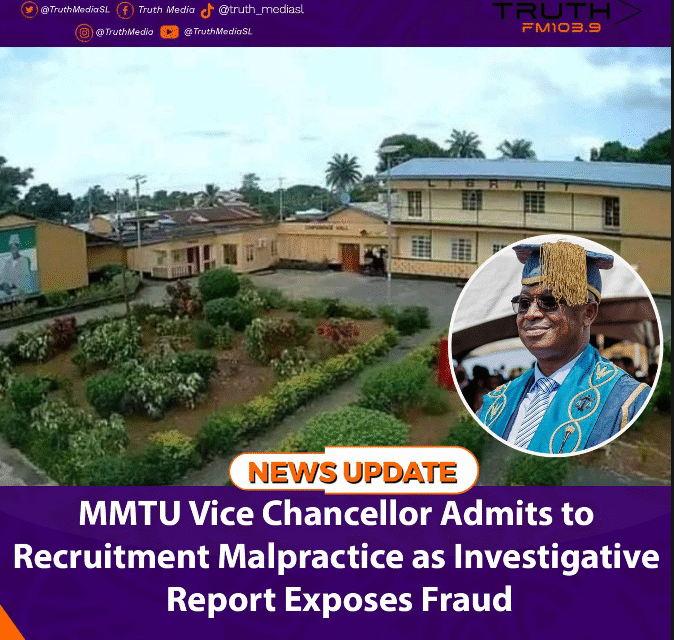
Freetown, 10th March, 2026 – A damning investigative report has rocked Milton Margai Technical University (MMTU), revealing widespread malpractice, score-sheet tampering, and victimization of senior academic staff in the institution’s recruitment and promotion process.
The 14-page report, compiled by an independent committee led by Prof. Miriam Conteh-Morgan, details how merit was allegedly traded for cronyism, with legal protocols bypassed to consolidate administrative power.
At the center of the scandal is Vice Chancellor and Principal (VC&P) Prof. Philip John Kanu, who has admitted responsibility for the irregularities.
The report describes his leadership style as “dictatorial,” particularly during a supervisory gap between the dissolution and inauguration of the University Court. Investigators found that interview score sheets were crudely altered, with correction tape used to cover actual marks and fictitious scores inserted later. In some cases, the word “Not” was hand-written before “Recommended” or “Appointable” to deliberately disqualify candidates.
At least 11 lecturers, including Christiana Njabu Foday, Prince Gevao, and Solomon Sidy Keddy, were identified as victims of what the committee called “character assassination.”
The Registry was singled out as the “weakest link,” with Deputy Registrar of Human Resources, Mrs. Khadiatu Juanah, accused of misleading statements and disingenuous testimony. The committee concluded she was deeply complicit in undermining the recruitment process.
The report also revealed that MMTU leadership ignored recommendations from the Tertiary Education Commission (TEC), appointing highly qualified staff with PhDs to ranks lower than recommended, while retaining less qualified individuals.
With no functioning grievance mechanism, aggrieved staff were forced to seek redress through the Ministry of Technical and Higher Education or the media, further damaging the university’s reputation.
The committee has recommended: Immediate reinstatement or re-grading of victimized staff, disciplinary action against the Deputy Registrar and other implicated officials, a return to democratic elections for Faculty Deans to prevent Senate appointments based on cronyism and that Prof. Kanu step aside while a thorough investigation into his stewardship is conducted.
The University Court is expected to review the findings and determine whether criminal charges will be pursued for what the report described as “fraudulent and criminal acts.”
This scandal marks one of the most serious governance crises in Sierra Leone’s higher education sector, raising urgent questions about accountability, transparency, and the protection of academic integrity.