By Davida Spaine Solomon
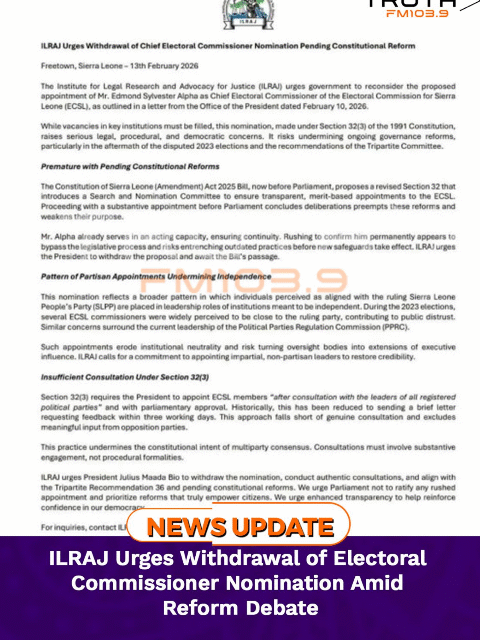
Freetown, 13th February, 2026 — The Institute for Legal Research and Advocacy for Justice (ILRAJ) has called on President Julius Maada Bio to withdraw the nomination of Mr. Edmond Sylvester Alpha as Chief Electoral Commissioner of the Electoral Commission for Sierra Leone (ECSL), citing ongoing constitutional reform efforts and concerns about transparency.
In a statement issued in Freetown on Thursday, ILRAJ said that while it recognizes the need to fill vacancies in key institutions, the proposed appointment — made under Section 32(3) of the 1991 Constitution — raises “serious legal, procedural, and democratic concerns.”
The nomination was communicated in a letter from the Office of the President dated February 10, 2026.
Reform Process Still Underway
ILRAJ noted that the Constitution of Sierra Leone (Amendment) Act 2025 Bill, currently before Parliament, proposes changes to Section 32. The Bill introduces a Search and Nomination Committee intended to ensure more transparent and merit-based appointments to the ECSL.
According to the organization, proceeding with a substantive appointment before Parliament concludes deliberations on the amendment could undermine the purpose of the proposed reforms.
Mr. Alpha is presently serving in an acting capacity, a position ILRAJ says ensures institutional continuity while lawmakers debate the new framework. The group argues that confirming him permanently at this stage may appear to bypass the legislative process.
ILRAJ is urging the President to withdraw the nomination and allow Parliament to complete its work on the amendment Bill before making a final appointment.
Concerns Over Perceived Partisanship
The advocacy group also raised concerns about what it described as a pattern of appointing individuals perceived to be aligned with the ruling Sierra Leone People’s Party (SLPP) to head institutions that are expected to operate independently.
It referenced public criticism following the 2023 general elections, during which some ECSL commissioners were viewed by sections of the public as being close to the ruling party — a perception that contributed to heightened political tensions.
ILRAJ further pointed to similar concerns regarding the leadership of the Political Parties Regulation Commission (PPRC), emphasizing the need to strengthen institutional neutrality.
The group warned that such perceptions risk eroding public trust and weakening confidence in oversight bodies tasked with safeguarding democratic processes.
Call for Genuine Consultation
Under Section 32(3) of the Constitution, the President is required to appoint members of the ECSL “after consultation with the leaders of all registered political parties,” subject to parliamentary approval.
ILRAJ argued that past consultations have often been limited to brief written correspondence requesting feedback within a short timeframe, sometimes as little as three working days. The organization described this approach as insufficient and inconsistent with the spirit of meaningful multiparty engagement.
It called for broader and more substantive consultations to ensure that appointments reflect consensus and uphold democratic principles.
Appeal to Parliament
In its statement, ILRAJ urged Parliament not to ratify what it described as a rushed appointment and instead to prioritize constitutional reforms aimed at enhancing transparency and public confidence.
The organization also referenced the recommendations of the Tripartite Committee established in the aftermath of the 2023 elections, particularly those relating to electoral governance reforms.
As debate continues, the nomination is expected to draw significant attention from lawmakers, political parties, and civil society groups in the coming days