By Davida Spaine-Solomon
Freetown, 2nd February 2026- The death of 30-year-old Kadiatu Pompay Kamara at Kambia Government Hospital has shaken families, communities and the nation at large. What began as another expectant mother seeking care ended in heartbreak and a wave of public anger after reports emerged that she underwent surgery without the supervision of a trained medical doctor.
As the story spread across social media, many Sierra Leoneans demanded answers, accountability and urgent reform at the hospital. Allegations suggested that a Community Health Officer (CHO) performed a critical surgical procedure believed to be a cesarean section and when complications arose, there was no doctor available to intervene.
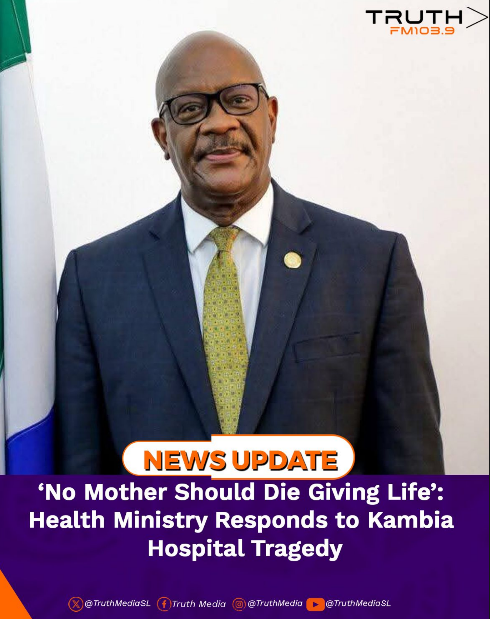
In response, the Ministry of Health has expressed deep sorrow over the loss and announced a full investigation into the circumstances surrounding Kadiatu’s death.
“Every time a life is lost, it is devastating. Our deepest condolences go to the bereaved family. Any preventable maternal death is completely unacceptable,” said Minister of Health, Dr. Austin Demby.
The Ministry stressed that the experiences shared by the family and the public will be carefully examined and that appropriate action will be taken if wrongdoing is confirmed.
While acknowledging the tragedy, the Ministry also urged the public to view the situation within the broader picture of Sierra Leone’s healthcare journey one marked by serious challenges but also significant progress.
According to the Ministry, Kambia District currently has a board-certified obstetrician-gynecologist serving as Medical Superintendent, alongside one of the country’s leading District Medical Officers, Dr. Serah Conteh. In recent years, the district recorded over two months without a single maternal death and achieved a 28 percent reduction in maternal mortality between 2024 and 2025, ranking among the better-performing districts nationwide.
On the issue of CHOs carrying out surgeries, the Ministry explained that in many low-resource settings, trained CHOs are permitted to perform minor surgical procedures as a temporary solution where doctors are scarce but only under proper supervision.
“We are not where we want to be yet, but we are moving in the right direction,” Dr. Demby said.
The government has significantly expanded medical training in recent years, with over 120 resident doctors currently in training across various specialties. Just last year, eight locally trained obstetric surgeons qualified and are now practicing in the country a major step forward from five years ago when there were virtually none.
Sierra Leone’s maternal health story, though still fragile, shows remarkable improvement. Fifteen years ago, the country had one of the highest maternal death rates in the world, with over 1,100 deaths per 100,000 live births. Today, that figure has fallen by more than 70 percent to around 354.
“These are not just statistics,” the Ministry emphasized. “They represent mothers who lived to raise their children, families that were not broken, and communities that remained whole.”
Investments in skilled midwives, improved facilities, reliable electricity, oxygen supply and medical equipment have helped raise the percentage of skilled birth attendance from 60 to 87 percent in just a few years.
However, the Ministry admitted that deeper systemic problems remain particularly the severe shortage of surgeons. With 91 percent of surgical needs unmet and only about 15 resident surgeons nationwide, many districts struggle to provide safe emergency and obstetric care.
To tackle this, the government is implementing the National Surgical, Obstetric and Anesthesia Plan (NSOAP), aimed at expanding access to lifesaving surgical services, especially in underserved areas like Kambia.
The Ministry concluded that while Kadiatu Kamara’s death is a painful reminder of the work still ahead, it must become a turning point one that strengthens accountability, improves healthcare delivery and ensures that no woman loses her life while giving life.
As Sierra Leone continues to rebuild its health system, the message from the Ministry is clear: maternal deaths that can be prevented should never be accepted and every mother deserves safe, dignified care.