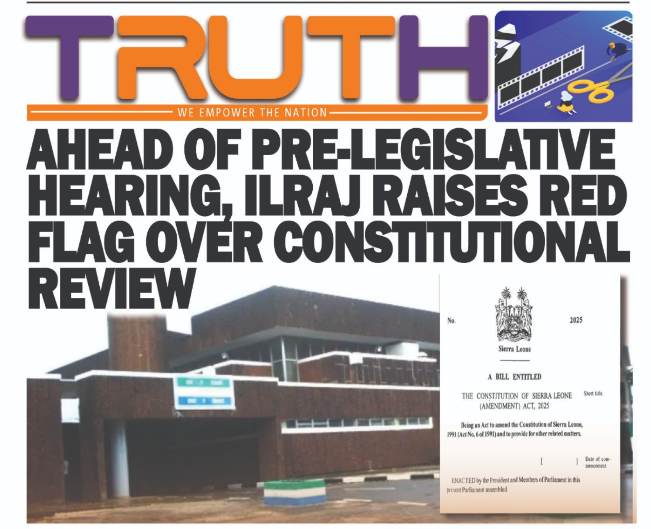
Freetown, 26th January, 2026- The Institute for Legal Research and Advocacy for Justice (ILRAJ) has raised alarm over Sierra Leone’s proposed Constitution of Sierra Leone (Amendment) Bill 2025, warning that several provisions could entrench ruling party dominance and undermine the country’s fragile democracy if not fundamentally revised.
In a detailed position paper released this week, ILRAJ cautioned that while the Bill introduces some progressive reforms, such as fixed election dates, enhanced qualifications for electoral commissioners, and a 30 percent quota for women nominees, it also contains clauses that risk weakening electoral integrity, eroding public trust, and consolidating executive power.
ILRAJ’s analysis situates the Bill within Sierra Leone’s troubled constitutional history. The organization recalled how the 1978 Constitution imposed one-party rule through coercion, and how subsequent amendments, including the controversial revival of proportional representation in 2023, were often used to secure electoral advantage rather than strengthen democracy.
“With 60 percent of Sierra Leoneans living below the poverty line and youth unemployment exceeding 70 percent, a constitution manipulated for partisan gain risks alienating citizens, fostering disillusionment, and inviting unrest,” the statement warned.
Among the most contentious proposals are:
Electoral Commission Reforms: While the Bill introduces stricter qualifications and a diverse nomination committee, ILRAJ criticized the absence of explicit non-partisanship requirements, warning this could allow partisan appointees to capture the institution.
Independent Presidential Candidates: The Bill permits independents but leaves criteria for “financial capacity and community support” vague, raising fears of economic discrimination that could reserve the presidency for wealthy elites.
Proportional Representation: The formalization of PR without broad national dialogue, ILRAJ argued, risks skewing representation and marginalizing opposition voices.
Presidential Election Thresholds: Replacing the 55 percent requirement with a simple majority plus 20 percent in two-thirds of districts could produce presidents with weak mandates and distort voter equality.
Removal of President and Vice-President: New grounds tied to party membership could be weaponized by ruling majorities, undermining stability and the direct mandate of voters.
Petition Timelines: A three-day filing window for election petitions was described as “unrealistically short,” potentially rendering the right to challenge results meaningless.
Fixed Election Dates: While predictability is welcomed, ILRAJ criticized the choice of November, citing risks of voter fatigue and logistical challenges during holiday periods.
ILRAJ urged Parliament to reject or substantially amend the Bill, calling for inclusive national dialogue and adherence to consensus-driven recommendations from the 2024 Tripartite Committee and the 2016 Cowan Constitutional Review Committee.
Among its nine key recommendations, ILRAJ proposed: Explicit bans on partisan affiliations for electoral commissioners, clear, accessible criteria for independent candidates to prevent economic exclusion and mandatory national dialogue or referendum before adopting electoral systems.
The institution also called for stronger thresholds for presidential elections to ensure legitimacy whilst extended petition timelines to align with international standards. Shifting election dates shifted to March–May to avoid holiday and rainy season disruptions and strict compliance with entrenched provisions requiring referendum approval
ILRAJ concluded that without significant revisions, the Bill risks becoming “a blueprint for one-party dominance,” echoing the dangers of the 1978 era.
“Reforms must prioritize transparency, inclusivity, and adherence to past recommendations to consolidate democracy and prevent the Constitution from becoming an instrument of entrenchment rather than empowerment,” the organization stated.