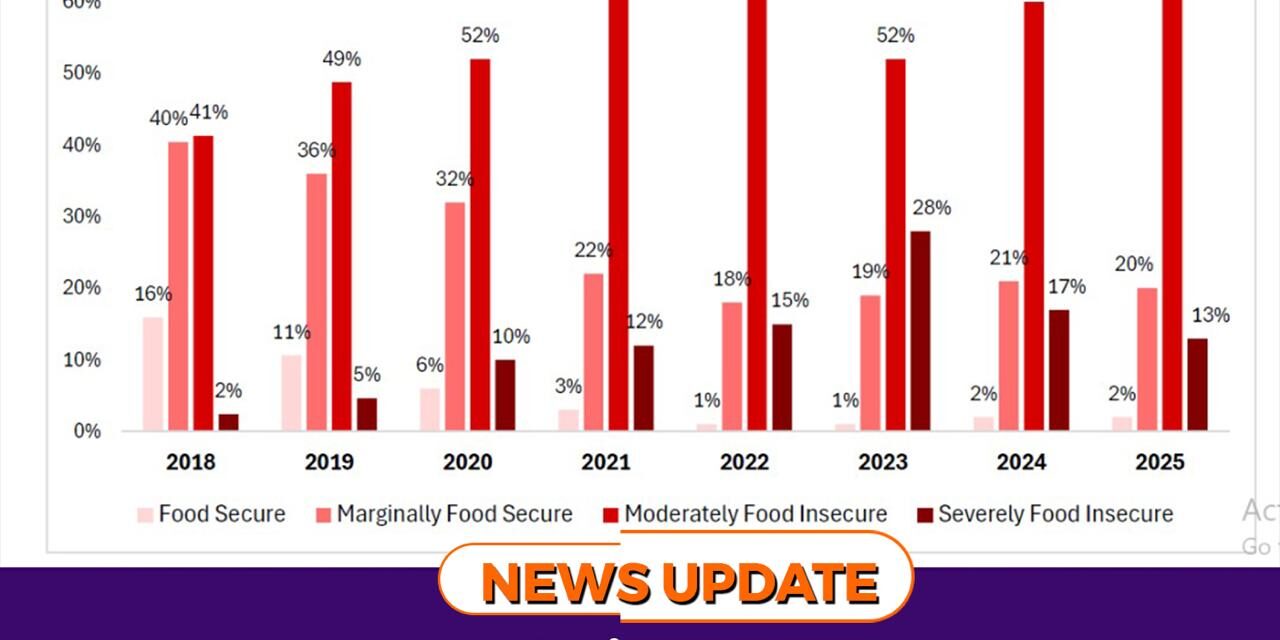
Freetown, 8th December 2025 – The latest Food Security Monitoring System Report from the World Food Programme (WFP) Sierra Leone Country Office reveals a concerning picture of the nation’s food security landscape, with 78% of the population still facing moderate or severe food insecurity during the lean season.
While the proportion of severely food-insecure individuals declined slightly from 28% in 2023 to 13% in 2025, the overall burden remains high, and the share of moderately food-insecure citizens has climbed to 65%, up from 52% two years ago.
The report, which tracks lean season trends from 2018 to 2025 using the Consolidated Approach for Reporting Indicators of Food Security (CARI), shows that only 2% of Sierra Leoneans were classified as food secure in 2025, unchanged from 2024 and 2023, and down sharply from 16% in 2018.
The data paints a clear trajectory of worsening food access over the past eight years. In 2018, 16% of the population was food secure, and only 2% were severely food insecure. By 2022, food security had collapsed to just 1%, while severe food insecurity rose to 15%.
The peak came in 2023, when 28% of the population was classified as severely food insecure, the highest in the dataset.
Although 2025 shows a 15-point drop in severe food insecurity compared to 2023, the gains are offset by a rise in moderate food insecurity, suggesting that many households remain vulnerable and are merely shifting between categories rather than achieving true stability.
Although there are marginal gains, structural challenges still remain. The share of marginally food-secure individuals has remained relatively flat over the past three years, hovering around 20%. This group includes households that are just above the threshold of food insecurity but remain at risk due to income shocks, price volatility, or seasonal disruptions.
The WFP attributes the persistent crisis to a combination of factors, including climate variability, rising food prices, limited agricultural productivity, and constrained household purchasing power.
In response to the deepening crisis, Sierra Leone’s government is doubling down on its flagship Feed Salone initiative, aimed at reducing reliance on food imports and strengthening domestic production.
Minister of Agriculture and Food Security, Henry Musa Kpaka, has hailed the passage of the Finance Act 2026 as a major win for the program, citing new tariff measures designed to protect local producers.
“There are major wins for Feed Salone in the Finance Act 2026. The new 35% import duty on eggs and tomato paste gives local producers the protection they need to grow and compete. We are already seeing strong new investments, especially in poultry, to boost local production,” Kpaka said.
He emphasized the government’s commitment to supporting agribusinesses through Feed Salone, ensuring they have the tools to expand and thrive.
“Under Feed Salone, we remain committed to helping these businesses set up, scale, and become competitive. Thank you to the Ministry of Finance and Parliament for this strategic, revenue-enhancing policy.”
Officials say the new tariff measures will not only protect local farmers but also stimulate job creation and enhance revenue generation, aligning with broader goals of economic stability and food system resilience.
The WFP report underscores the urgent need for targeted social protection, agricultural investment, and market stabilization efforts. With only 2% of the population classified as food secure, the findings call for a shift from emergency response to long-term resilience strategies.
Economic planners and development partners are expected to use the data to inform budget allocations, donor priorities, and regional food systems programming in 2026.
As Sierra Leone navigates the twin challenges of food insecurity and fiscal pressure, the success of Feed Salone and other structural reforms will be critical to reversing the trend and building a more food-secure future.