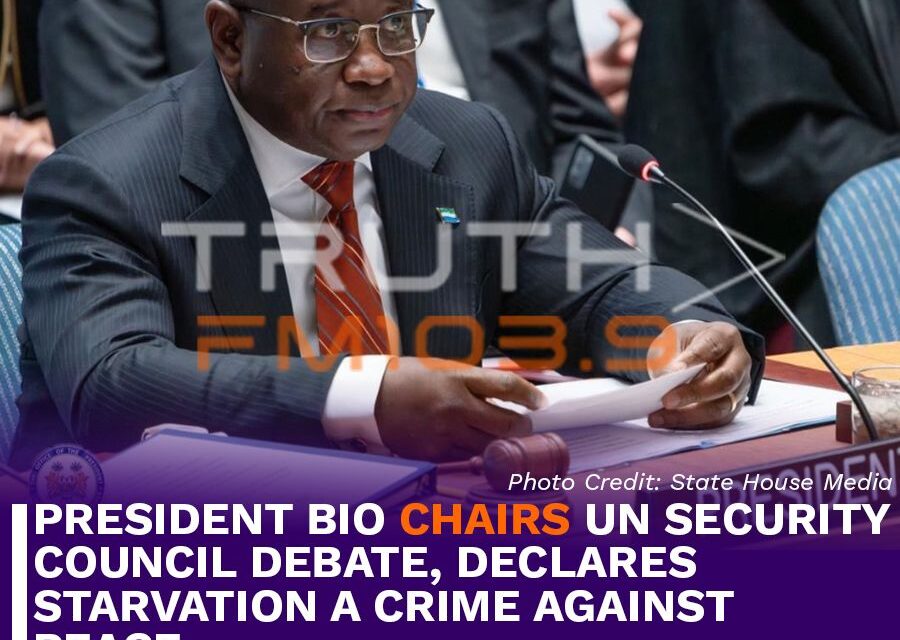
New York, November 17, 2025 — Sierra Leone’s President, Dr. Julius Maada Bio, has told the United Nations Security Council that starvation must be treated as a crime, not collateral damage, as he chaired a high‑level debate on conflict‑related food insecurity at UN Headquarters in New York.
Presiding over the session in his capacity as Chair of the ECOWAS Authority, President Bio warned that hunger is increasingly being weaponized in conflicts and urged stronger global action to protect civilians. “Deliberate starvation of populations is prohibited under international law and constitutes a war crime,” he said.
Citing crises in Gaza, Sudan, Haiti, Ukraine, and the Sahel, Bio described starvation as a “slow, silent, corrosive” form of violence that destroys livelihoods, fuels instability, and drives displacement. He outlined three key messages: starvation is a crime, food insecurity is both a driver of conflict and a peacebuilding imperative, and sustainable peace requires investment in agriculture, markets, and human capital, particularly women and youth.
The President showcased Sierra Leone’s Feed Salone Initiative as a national model linking food security to peace and development. The four‑pillar programme focuses on production, resilience, markets and value chains, and human capital, aiming to boost productivity, reduce import dependence, and build climate‑smart systems.
At the regional level, Bio highlighted ECOWAS efforts to integrate food security into peacebuilding and trade frameworks, including the expansion of the ECOWAS Food Security Reserve and the ECOWARN early‑warning network.
He proposed six global actions: protecting food systems in conflict zones, strengthening early‑warning mechanisms, safeguarding humanitarian access, advancing accountability for starvation crimes, linking peacebuilding finance to agriculture, and empowering women and youth across value chains.
“Africa does not seek sympathy but partnership,” Bio told the Council, noting the continent’s vast uncultivated arable land and youth‑driven innovation. He concluded with a call to action: “No child should be starved into submission, no harvest held hostage, and no community driven to violence by hunger.”