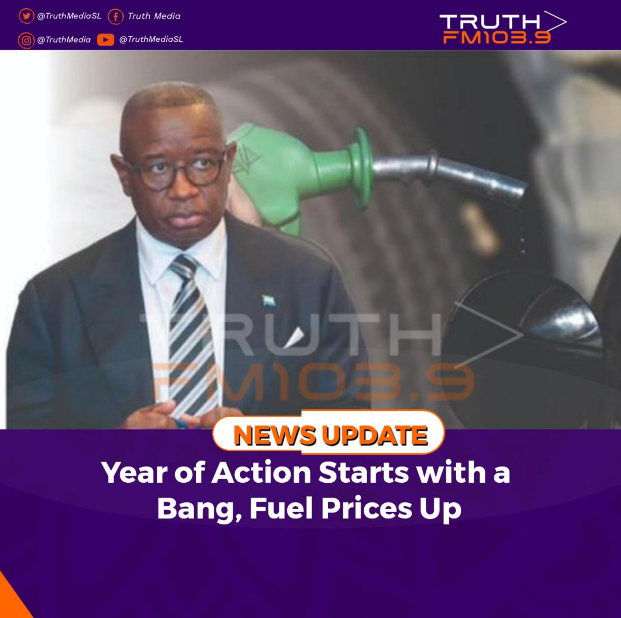
Freetown, 2nd February 2026- President Julius Maada Bio’s New Year message promised Sierra Leoneans that 2026, the “Year of Action”, would usher in hope and a better life. But barely weeks into the year, citizens are grappling with unprecedented fuel price increases that have already begun to ripple across transport, business, and household sectors.
The contradiction is stark. In November 2025, Finance Minister Sheku Fantamadi Bangura assured Parliament that the new Finance Act would not lead to higher fuel prices, insisting that only international market shifts and exchange rate fluctuations could trigger such increases.
Following the government’s implementation of a new excise rate and other charges, which moved the ceiling from 27 to 28 Leones. The impact was immediate. Transport operators and commuters across Freetown were caught off guard, with no prior notice of the hike. “There was no prior notice. It was only when we went to buy petrol that we discovered the increase,” said Abubakarr Koroma, a Kekeh rider. He recounted a bitter argument with a passenger who refused to pay the new fare.
Poda Poda drivers echoed the frustration. “Now we are buying at NLe 28.50, but there have been no new transport fares issued. If we ask passengers to pay Le 12, they argue. We are asking the government to reduce the price instead,” one driver explained.
Passengers, too, are feeling the pinch. A commuter heading to Lumley said she was stranded when an Okada rider refused to carry her for Le 20, demanding Le 40 instead. Fuel attendants, meanwhile, say they were simply following orders from management to enforce the new rates.
The knock-on effects are already visible. Metro Transport Company (MTC), which operates the Waka Fine buses, has raised fares from Le 8 to Le 12, citing unsustainable operational costs. The increase is expected to hit thousands of daily commuters hard.
Sea transport fares have also risen by 14 percent, following an agreement between the Ministry of Transport and Aviation and ferry operators. Second-class tickets now cost Le 26.11, up from Le 22.9, while first-class tickets have jumped to Le 48.22. Only pupils in uniform remain exempt.
Businesses, too, are complaining about the sudden rise in costs, warning that the increase will affect prices of goods and services across the board. Fuel, as economists often note, is the single commodity that influences nearly every other price, from transportation to food items in the market.
During parliamentary debates on the Finance Act, APC’s Hon. Abdul Karim Hamid-Kamara warned that the gains made in the financial sector would be undermined by rising costs of fuel, cement, water, and other essentials.
Despite assurances from the Finance Minister that domestic tax adjustments would not affect pump prices, Sierra Leoneans are living the opposite reality. The government’s push to raise revenue through excise taxes has translated directly into higher fuel costs, sparking widespread anger and eroding public trust.
As the Finance Act continues to be rolled out, more sectors are expected to feel the strain. For many Sierra Leoneans, the “Year of Action” has begun not with relief, but with hardship, forcing citizens to brace themselves for rising costs and reminding them of the resilience politicians often demand in times of economic difficulty.