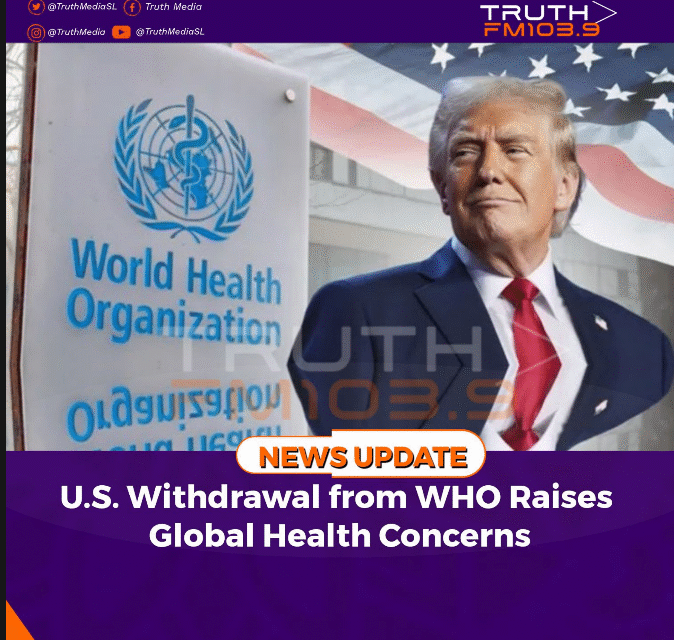
Freetown, 23rd January 2026- The United States has officially withdrawn from the World Health Organization (WHO), a move that has sent shockwaves through the global health community and raised serious questions about the future of international cooperation in fighting disease.
The Trump administration confirmed the completion of the withdrawal last week, ending nearly eight decades of U.S. membership in the WHO. The decision follows long-standing criticisms of the organization’s handling of the COVID-19 pandemic and broader concerns about accountability.
The WHO was established in 1948 to coordinate global health efforts, lead vaccination campaigns, and respond to emergencies such as Ebola, HIV/AIDS, and most recently, COVID-19. The U.S. has historically been one of its largest funders, contributing hundreds of millions of dollars annually to programs that underpin disease surveillance, vaccine distribution, and drug procurement worldwide.
By stepping away, Washington has not only withdrawn financial support but also its political influence in shaping global health priorities. Analysts warn that this could weaken WHO’s ability to respond quickly to outbreaks and sustain life-saving programs in vulnerable regions.
For countries like Sierra Leone, the implications are particularly stark. Sierra Leone relies heavily on WHO and its partners for: Vaccines against measles, polio, and COVID-19, essential medicines for malaria, tuberculosis, and HIV and for technical expertise in strengthening health systems and training medical staff.
A reduction in WHO’s resources could mean delays in vaccine deliveries, shortages of critical drugs, and weaker disease monitoring. This would leave Sierra Leone more exposed to outbreaks and undermine progress made in rebuilding its health sector after crises such as the Ebola epidemic.
Health experts caution that the U.S. withdrawal risks fragmenting global health solidarity at a time when cooperation is most needed. Without U.S. funding and leadership, WHO may struggle to maintain its reach, forcing other nations and organizations to fill the gap.
For Sierra Leone and similar countries, the challenge will be to diversify partnerships and strengthen local health systems to reduce dependency on a single global body. Yet, the absence of U.S. support is expected to leave a visible void in the fight against poverty-related diseases and in efforts to prepare for future pandemics.