By Saidu Kargbo
Freetown, 11th February 2026- As Sierra Leone explores innovative ways to finance infrastructure without overburdening the national budget, a bold but controversial idea is quietly gaining traction: introducing a toll system along the Fourah Bay College (FBC) axis.
The proposal draws inspiration from the government’s broader infrastructure financing strategy, clearly articulated by Minister of Finance, Sheku Fantamadi Bangura, who recently emphasized that not all infrastructure must be funded directly from the annual budget.
“Not all the money in the budget is required to fund our infrastructure,” the Minister noted, stressing that innovative financing mechanisms such as Public-Private Partnerships are already in use.
To make his point, the Finance Minister cited the Freetown–Waterloo Highway, one of the country’s most visible infrastructure projects.
“They built the Freetown–Waterloo Highway not with today’s money. They built it because they used its own structure, the way you finance road infrastructure,” he explained.
In essence, the road paid for itself through a financing model that looks beyond immediate government expenditure. This same logic, some argue, could be adapted, on a smaller and more targeted scale, to support Fourah Bay College, Sierra Leone’s oldest university.
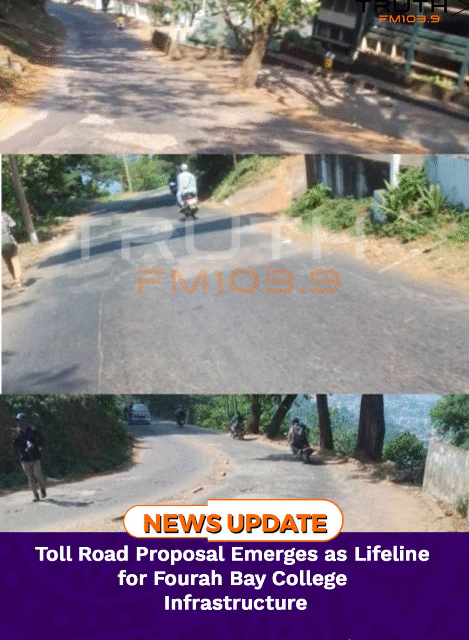
According to Dr. Andrew Christian Michael Baio, Deputy Vice-Chancellor of FBC, the road cutting through the university has gradually transformed from a campus access route into a public shortcut, heavily used by motorists with no connection to the institution.
The professor believes this presents both a challenge and an opportunity.
He argues that “to keep this private college accessible by a modern, well-paved road, it may be important to toll it.”
Under this thinking, drivers who simply want to cut through the campus to reach other destinations would pay a small fee, while those who prefer not to, can “go around, go up, and go to your place.”
Crucially, Prof. Baio’s position goes beyond fixing potholes.
The DVC believes that revenue generated from a toll system could help FBC address chronic infrastructure deficits, from water supply and electricity to student facilities.
The idea, he explains, is not only to “maintain the road,” but to ensure the university can “put it on other infrastructure.”
At a time when FBC is grappling with aging facilities and limited public funding, such internally generated revenue could provide a rare financial lifeline.
While no official decision has been announced, the proposal raises important questions about who pays for public infrastructure, how universities can sustainably fund themselves, and whether tolling a campus road strikes the right balance between public access and institutional survival.
What is clear, however, is that the idea fits squarely within the government’s current thinking. As Minister Bangura made plain, the future of infrastructure financing lies not only in budgets, but in structure, innovation, and shared responsibility.
And for Fourah Bay College, the road ahead, quite literally, may come at a price.