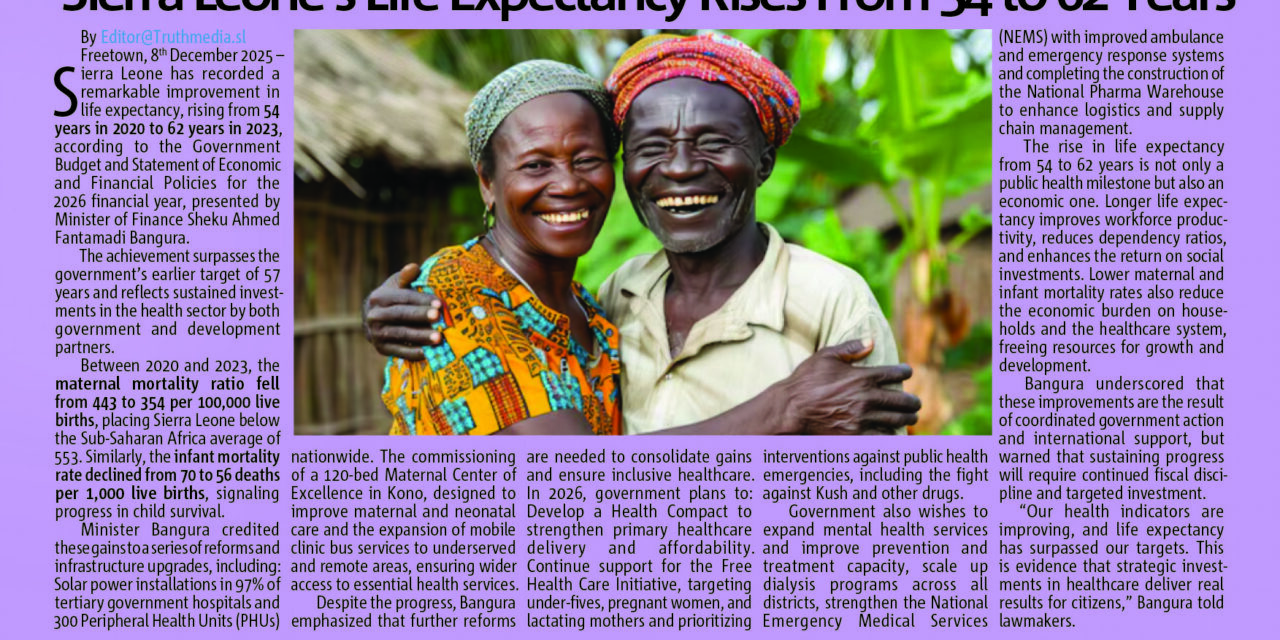
Freetown, 8th December 2025 – Sierra Leone has recorded a remarkable improvement in life expectancy, rising from 54 years in 2020 to 62 years in 2023, according to the Government Budget and Statement of Economic and Financial Policies for the 2026 financial year, presented by Minister of Finance Sheku Ahmed Fantamadi Bangura.
The achievement surpasses the government’s earlier target of 57 years and reflects sustained investments in the health sector by both government and development partners.
Between 2020 and 2023, the maternal mortality ratio fell from 443 to 354 per 100,000 live births, placing Sierra Leone below the Sub-Saharan Africa average of 553. Similarly, the infant mortality rate declined from 70 to 56 deaths per 1,000 live births, signaling progress in child survival.
Minister Bangura credited these gains to a series of reforms and infrastructure upgrades, including: Solar power installations in 97% of tertiary government hospitals and 300 Peripheral Health Units (PHUs) nationwide. The commissioning of a 120-bed Maternal Center of Excellence in Kono, designed to improve maternal and neonatal care and the expansion of mobile clinic bus services to underserved and remote areas, ensuring wider access to essential health services.
Despite the progress, Bangura emphasized that further reforms are needed to consolidate gains and ensure inclusive healthcare. In 2026, government plans to: Develop a Health Compact to strengthen primary healthcare delivery and affordability. Continue support for the Free Health Care Initiative, targeting under-fives, pregnant women, and lactating mothers and prioritizing interventions against public health emergencies, including the fight against Kush and other drugs.
Government also wishes to expand mental health services and improve prevention and treatment capacity, scale up dialysis programs across all districts, strengthen the National Emergency Medical Services (NEMS) with improved ambulance and emergency response systems and completing the construction of the National Pharma Warehouse to enhance logistics and supply chain management.
The rise in life expectancy from 54 to 62 years is not only a public health milestone but also an economic one. Longer life expectancy improves workforce productivity, reduces dependency ratios, and enhances the return on social investments. Lower maternal and infant mortality rates also reduce the economic burden on households and the healthcare system, freeing resources for growth and development.
Bangura underscored that these improvements are the result of coordinated government action and international support, but warned that sustaining progress will require continued fiscal discipline and targeted investment.
“Our health indicators are improving, and life expectancy has surpassed our targets. This is evidence that strategic investments in healthcare deliver real results for citizens,” Bangura told lawmakers.