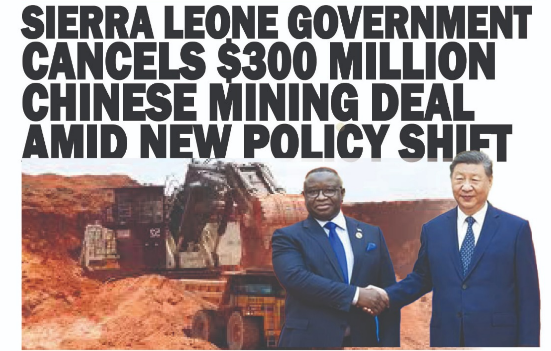
Freetown, 12th January 2026- Sierra Leone’s mineral sector is once again at the centre of debate following President Julius Maada Bio’s directive to dissolve the Mineral Wealth Fund (MWFSL) and restructure how the country manages its strategic mining assets. The move comes less than two years after the government signed a landmark agreement with China Overseas Engineering Group Company Limited (COVEC), valued at USD 300 million, to develop the Tonkolili North Iron Ore Deposit.
Between 2024 and 2025, the Mineral Wealth Fund Sierra Leone Limited entered into agreements with COVEC to finance mine construction, transport networks, and beneficiation facilities. The deal was hailed as a breakthrough, promising to unlock one of Sierra Leone’s most valuable mineral deposits. But with the government now winding up the Fund, the future of that agreement hangs in the balance.
International contracts are not easily undone. If COVEC has already mobilized financing or invested resources, Sierra Leone could face claims of breach of contract. Arbitration under international law is costly and time-consuming, and any dispute could damage the country’s reputation as a reliable investment destination. Analysts warn that if Sierra Leone is perceived as reneging on agreements, future financing for infrastructure and mining projects could dry up.
At the same time, the president’s directive reflects mounting frustration with opaque deals that have historically left Sierra Leoneans with little benefit from their own resources. By dissolving the Mineral Wealth Fund, the government is signalling a shift toward transparency, accountability and direct state oversight. In a country where mineral wealth has too often enriched outsiders while citizens remain poor, the move resonates with public sentiment.
The directives, issued under the Mines and Minerals Development and Management Corporation Act of 2023, transfer operational control of Tonkolili North to state institutions and terminate a management services agreement with MountView Konzern Management DMCC. Industry observers say this is less a shock than a reset, reflecting long-standing concerns about value-for-money and accountability in large-scale mining arrangements.
Perhaps the most significant policy signal is the government’s insistence on a competitive bidding process to identify a new strategic partner for Tonkolili North. In a sector historically shaped by negotiated deals, this approach suggests a deliberate attempt to improve investor confidence while safeguarding public interest.
The challenge now is to strike a balance. If Sierra Leone can restructure the COVEC agreement under the new framework, ensuring fairer terms, stronger oversight, and shared value, it could both honour its obligations and achieve reform. Failure to do so risks costly litigation and investor flight. Success, however, would mark a turning point in how Sierra Leone manages its mineral wealth: not as a liability, but as a foundation for inclusive growth.
As it stands, questions remain about timelines, investor appetite, and how existing agreements will be reconciled with the new governance framework. What is clear, however, is that Tonkolili North, valued at hundreds of millions of dollars, remains a test case for Sierra Leone’s evolving approach to natural resource management. The government is seeking not just ownership, but effective control, accountability, and long-term national benefit.