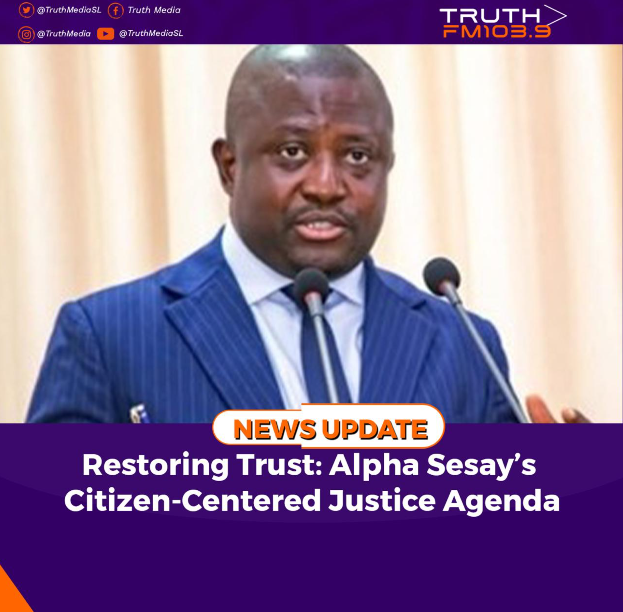
Freetown, 15th December 2025- Less than a year into his tenure as Attorney General and Minister of Justice, Alpha Sesay’s approach has already begun to reshape both the tone and substance of justice administration in Sierra Leone.
Trained in international human rights law with extensive experience in governance and transitional justice, Sesay assumed his position with a moral compass rooted in fairness, dignity, and the rule of law. His leadership has transformed the Ministry of Justice from a reactive bureaucratic organization into a more proactive, citizen-centered institution.
One of Sesay’s earliest interventions has been to accelerate the modernisation of the justice system. Recognising that access to justice depends on efficiency, transparency, and digital access, he has promoted efforts to digitise court records, streamline case management, and reduce administrative bottlenecks.
The implementation of the Criminal Procedure Act 2024 under his leadership also marked a significant milestone and has established a modern structure for criminal proceedings, minimizing delays and improving protections for the accused.
His focus on collaboration has been equally vital, fostering better coordination among the Ministry, the Sierra Leone Police, and other justice agencies to enhance law enforcement, combat human trafficking, and tackle organized crime.
His ministry’s renewed backing for the Legal Aid Board’s outreach to underserved communities, along with a more systematic review of pre-trial detention cases, is already helping to reduce overcrowding in correctional facilities and rebuild trust in the fairness of the judicial process.
At the policy level, Sesay has strengthened Sierra Leone’s commitment to human rights and anti-discrimination efforts. In March 2025 and on many other occasions, he has publicly reaffirmed the government’s commitment to eliminating all forms of discrimination, urging the judiciary to serve as a protector of the vulnerable. Such statements, while symbolic, carry significant institutional weight, especially in a system where women, youth, and rural communities often see justice as out of reach or biased.
Alpha Sesay has also been persistent in aligning Sierra Leone’s domestic agenda with international standards, thereby boosting the country’s reputation among development partners and investors seeking a stable, predictable rule of law environment. His participation in international forums, including the OECD Global Roundtable on Equal Access to Justice, has further strengthened Sierra Leone’s image as a nation committed to justice reform rooted in inclusivity.
Beyond courtroom and policy reforms, Sesay’s most significant innovation may lie in the way he has re-imagined public engagement. Rather than limiting communication to legal circles, he has taken the conversation to communities, universities, and civil society spaces.
By emphasizing transparency and civic ownership, he has elevated legal awareness as a tool for empowerment. This has begun to humanize the justice sector, transforming it from an abstract arm of government into a public service that citizens can relate to and hold accountable. Such an approach to open engagement has built legitimacy, particularly at a time when public trust in institutions remains fragile.
Alpha Sesay’s leadership represents more than administrative reform; it embodies a cultural reawakening of Sierra Leone’s justice system. His insistence on rights-based governance, inclusion, and transparency sets a new moral tone for the sector. If sustained, his approach could help bridge the gap between law and life, transforming justice from an abstract concept into a lived experience for citizens.
Even though it may be too early to declare victory, the early signals point to a justice system gradually reclaiming its purpose: to protect the rights of all Sierra Leoneans and uphold the rule of law as the foundation of national progress.
In a political environment where trust and accountability are precious commodities, Alpha Sesay’s brand of principled yet approachable leadership is not only refreshing but may prove indispensable to Sierra Leone’s democratic consolidation and investor confidence in the years ahead.