Freetown, Sierra Leone, 27th October 2025- Sierra Leone’s domestic capital expenditure has plummeted in the first half of FY2025, with only NLe866.25 million spent across key development clusters, marking a dramatic slowdown compared to previous years.
The figure represents just 19.7% of the FY2024 actuals and 19.1% of FY2023 levels, raising concerns about the pace of public investment and the government’s ability to deliver on its flagship development agenda.
The data, drawn from the Budget Bureau’s latest fiscal report, breaks down spending across two strategic pillars: “The Big Five Game Changers” and their supporting “Enablers.” These clusters represent the government’s core priorities, including food security, human capital, youth employment, infrastructure, governance, and climate resilience.
In FY2023, total domestic capital expenditure stood at NLe4.53 billion, followed by NLe4.39 billion in FY2024. But by mid-2025, spending had dropped to less than NLe1 billion, suggesting either delayed disbursements, fiscal tightening, or implementation bottlenecks.
Among the Big Five priorities: Feed Salone, the government’s flagship food security initiative, saw a steep decline in funding. Human Capital Development and Youth Employment, both critical to long-term growth and stability, received limited allocations. Infrastructure, Technology and Innovation, typically a high-spend category, showed minimal activity in the first half. Revamping the Public Service Architecture, a reform pillar, also lagged behind expectations.
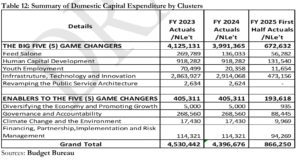
The Enabler clusters, designed to support the Big Five, fared no better. Spending on Governance and Accountability, Climate Change, and Economic Diversification remained subdued, despite their strategic importance in driving resilience and inclusive growth.
“This slowdown in capital expenditure could have ripple effects on job creation, service delivery, and investor confidence,” said a senior economist familiar with the budget framework. “If these figures reflect actual implementation delays, it’s a signal that the government must recalibrate its execution strategy.”
The sharp drop in spending comes at a time when Sierra Leone faces mounting pressure to accelerate development outcomes, especially in rural infrastructure, youth employment, and climate adaptation. With only six months left in the fiscal year, stakeholders are urging the Ministry of Finance to fast-track project execution and ensure that budgeted funds translate into tangible impact.