By: Andrew Chokpeleh
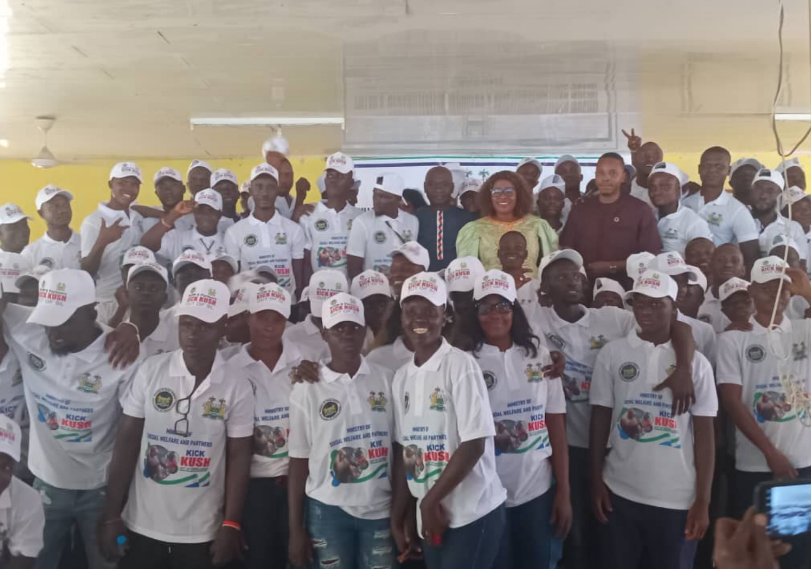
Freetown, 22nd December 2025- The Ministry of Social Welfare has successfully rehabilitated 103 former kush victims at the Hastings Rehabilitation Centre, located at the Peace Mission Training Centre. The rehabilitation process lasted for about two months, during which the victims underwent treatment and counselling.
After completing the full program, the Ministry discharged them to enable their reintegration into their respective communities.
The discharge ceremony was held at the Peace Mission Training Centre and was attended by parents and relatives of the beneficiaries and some government stakeholders. The discharged individuals formed the sixth batch to complete the rehabilitation process implemented by the Ministry and its line institutions.
Delivering the keynote address on behalf of His Excellency President Dr. Julius Maada Bio, the Chief Minister of the Republic of Sierra Leone, Dr. Moinina Sengeh, said the government is committed to addressing drug addiction. He noted that although overcoming addiction may appear difficult and sometimes impossible, it only requires strong commitment, discipline, and personal determination to disengage from drug abuse. He commended the social workers and all those who contributed to the successful rehabilitation of the victims, describing their efforts as vital to nation-building.
Dr. Sengeh also cautioned members of the public against taking photos or videos of people who are intoxicated by drugs or other substances, stressing that society has a responsibility to help such individuals understand why drug abuse is harmful to their mental and social wellbeing. He revealed that even government officials have been affected, as some of them have relatives involved in substance abuse. He reminded the public that the President declared drug and substance abuse a public health emergency, demonstrating the government’s strong commitment to stopping the flow of drugs that are destroying the future and potential of young people.
He further highlighted that the government is implementing several measures to protect young people, whom he described as the country’s human capital. Among these measures, he mentioned the recent ban on the importation of tramadol, a drug widely abused by youths and one that poses a serious threat to social and public wellbeing. He encouraged the discharged victims to become advocates and ambassadors who would help persuade other young people to abandon drug and substance abuse. He added that the government is also supporting private sector initiatives to ensure a coordinated national response to combating drug abuse.
The Minister of Social Welfare, Mrs. Melrose Karminty, said the Ministry addressed the addiction problem by bringing the victims into a drug-free zone, secured by personnel to ensure they had no access to drugs or other harmful substances. She described the discharged victims as “Ambassadors of Positive Change” who would help the Ministry engage other young people involved in drug abuse and encourage them to stop. She noted that relatives could attest to the visible improvement in the condition of those who went through the rehabilitation process.
Mrs. Karminty warned families not to mock or stigmatize their relatives who had undergone rehabilitation, as such actions could cause relapse into drug abuse. She emphasized that life after rehabilitation requires continuous support and encouragement, noting that there are many productive activities young people can engage in to improve themselves and their communities. She encouraged the discharged victims to pursue skills training as a means of earning a decent living, citing examples of individuals who are already making good incomes through such skills.
Speaking on behalf of his colleagues, Thomas Raphael Ansumana Esq., who also went through the rehabilitation process, expressed appreciation to the government and all those who supported them during their recovery. He apologized to the nation, acknowledging that they may have negatively affected their communities and the country during their period of substance abuse. He pledged that they would not return to drug use and assured that they would not waste the resources and efforts invested in their rehabilitation.
He acknowledged that the risk of relapse exists but encouraged his colleagues to avoid what he described as “external triggers” that could lead them back to drug and substance abuse. Mr. Ansumana also expressed gratitude to the Ady Macauley Foundation and other philanthropists who donated items that supported them throughout the rehabilitation and recovery process.
Additionally, he advocated for the establishment of a “Rehabilitation Village” to further support the recovery of drug victims. He explained that many young people on the streets are still suffering from drug and substance abuse and need similar intervention. He proposed that such a facility should include recreational and skills-training facilities to help beneficiaries acquire livelihoods after completing rehabilitation. He further called for proper reintegration of discharged victims into their communities, with sustained support from the government and development partners.