Freetown, 16th March, 2026 — The Government of Sierra Leone and the opposition All People’s Congress (APC) are offering sharply divergent assessments of progress under the Tripartite Committee, a body created by the 2023 Agreement for National Unity (ANU) to review electoral processes and strengthen governance.
At a feedback session this week, government officials reported what they described as “significant progress” in implementing the committee’s 80 recommendations. They noted that all eight resolutions of the ANU have been fully implemented, with “moral guarantors” confirming compliance. A full review with guarantors is scheduled for April 2026.
The steering committee overseeing implementation, chaired by Chief Minister David Moinina Sengeh, held its first quarterly meeting of the year, bringing together ministers, mayors, paramount chiefs, civil society leaders, professional associations, and development partners, including the UN Resident Coordinator. Absent were APC and SLPP Members of Parliament and leaders of APC‑controlled councils.
Reports presented by the Attorney General, the Secretariat Coordinator, the Peace Commission, and other agencies highlighted constitutional reforms now before Parliament and proposed extending the steering committee’s mandate by six months to strengthen monitoring and evaluation. Institutions such as the Office of National Security (ONS), the Electoral Commission of Sierra Leone (ECSL), and the Political Parties Registration Commission (PPRC) were cited as examples of agencies making tangible progress.
“As Chief Negotiator and signatory of the Agreement for National Unity, and as Chairman of the Tripartite Steering Committee, I am proud of the work being done to improve governance across our institutions,” Chief Minister Sengeh said.
When we remove the veil of bad politics and focus on development, it becomes clear that together, #WeAreDelivering.”
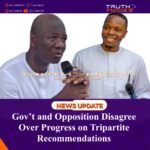
But opposition voices tell a different story. APC politician Dr. Kaifala Marah, co‑chair of the Tripartite Committee, dismissed the government’s claims as “flawed and misleading.” In a statement posted on X (formerly Twitter), he argued that nearly three years after the ANU was signed, “nothing significant has been achieved under the Tripartite Committee Recommendations.”
Marah pointed to unresolved court cases and missing APC files as evidence of stalled progress, and criticized the presidency for failing to respond to meeting requests from party leadership. “This is contrary to Resolution 6, which calls for re‑engineering and rekindling relationships at the highest level of our political ecosystem,” he noted. He added bluntly: “Half measures are half measures. Nothing more.”
The contrasting narratives underscore the political tension surrounding the Tripartite Committee’s work, which was intended to ease divisions following the disputed June 24, 2023 elections. With the committee’s deadline approaching, Sierra Leoneans are left weighing two competing accounts: one of steady progress and reform, and another of delay and unmet promises.