By Abdulai Fofanah
Freetown, 9th April 2026- The World Food Programme (WFP) July 2025 Food Security Monitoring System (FSMS) survey reported that 13 percent of households were severely food insecure and 65 percent moderately food insecure.
While the latter figure underscores the scale of vulnerability, the decline in severe food insecurity from 28 percent in 2023 to 13 percent in 2025 represents a 15‑percentage‑point reduction in just two years, a measurable sign of progress.
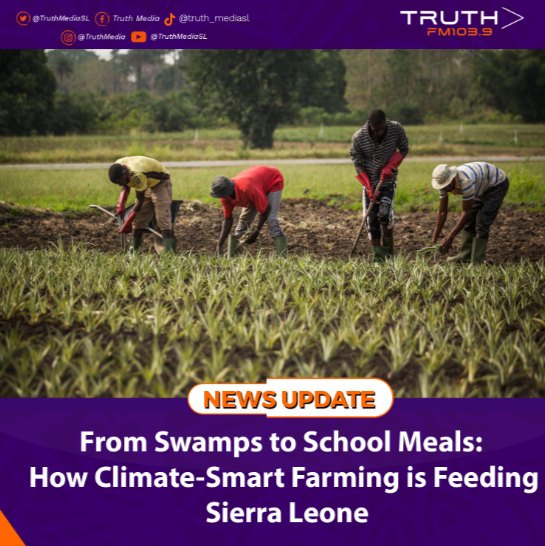
The government, supported by the United Nations, is scaling up Feed Salone and private sector‑led agricultural value chains to consolidate these gains. At the heart of this effort is the transformation of 3,830 hectares of inland valley swamps through solar‑powered irrigation systems, converting rain‑dependent plots into year‑round rice farms.
Processing and market access have also expanded. The UN upgraded 10 rice processing hubs and supported 23 facilities with drying platforms, storage, and milling units. These investments enabled procurement of 2,000 metric tons of rice and pulses, injecting nearly US$2.0 million into local economies. More than 22,000 producers benefited from aggregated sales, boosting household incomes and strengthening rural markets.
Nutrition programs reflect similar financial impact. Pilots of Home Grown School Feeding in Kenema and Bonthe reached 1,750 children, while 195 women‑led producer groups supplied 194 metric tons of orange‑fleshed sweet potato to schools in Karene, Kenema, and Bonthe. This local procurement injected approximately US$322,000 into rural economies and improved children’s access to vitamin‑rich foods.
“Linking farms to plates was central to the UN’s approach. Pilots of Home Grown School Feeding in Kenema and Bonthe reached nearly 1,750 children and supported smallholder households, while 195 women led producer groups supplied 194 metric tons of orange fleshed sweet potato to school Children in Karene, Kenema and Bonthe. This local procurement injected approximately US$322,000 into rural economies and critically improved children’s access to vitamin-rich foods.”
Yet the numbers also highlight unfinished business. With 65 percent of households still moderately food insecure, the challenge remains significant.
The progress achieved through irrigation, processing, and school feeding initiatives demonstrates what targeted investment can deliver, but sustaining and scaling these interventions will be critical to ensure that resilience reaches every household.