Freetown, 15th October 2025 – Little particles of dust floated lazily in the sunlight as I slouched in an uncomfortable plastic chair inside Connaught, Sierra Leone’s principal adult referral hospital. The dimly lit room seemed oppressive and at the far corner, a derelict oxygen machine held a bowl of half-eaten porridge.
I had never been to the emergency ward before, but today, I was here to check on James, a friend who collapsed earlier in the day at work.
I grabbed his hand, his skin pale and fragile beneath the IV taped to his wrist. His glasses were off, his eyes shut and his face calm despite the chaotic sounds from downstairs. From where I sat, the distant groans of patients waiting to be seen by tired physicians were faint but constant.
Outside the entrance, the scene was even more chaotic, with crowds of frustrated men and women, some having waited hours to be attended to, while a mother scolded her restless child poking at his wound.
Across town, about 15 miles from Freetown, the day was just beginning for the team at Hastings Clinic. The small, overburdened facility welcomed another patient, a 16-year-old pregnant girl, Kadiatu Kamara (not her real name). Her labour had started the night before, but eight hours later, she still hadn’t delivered. Two nurses, Sallay and Ramatu, hurried her inside, while Bintu, the third nurse, prepared the labour ward.
It was clear Kadiatu’s situation was dire. With the help of a Traditional Birth Attendant (TBA) at home, she’d struggled for hours, a dangerous ordeal for a teenager in Sierra Leone, where nearly half of maternal deaths are of girls under 19. A pregnant 15-year-old is three times more likely to die in childbirth than a woman in her early twenties. The ambulance driver, Amadu Kamara, had been alerted to stand by in case an emergency C-section would be needed.
At the same time, miles away in the more established Macauley Street Government Hospital, 28-year-old Zainab Turay prepared for the birth of her second child. Surrounded by experienced healthcare workers who had monitored her regularly throughout pregnancy, Zainab’s delivery was anticipated to be smoother.
For women like Zainab, access to skilled care during pregnancy is a lifeline. However, in Sierra Leone, where maternal mortality has historically been staggeringly high, childbirth can be a dangerous journey. The country once had one of the highest maternal mortality rates in the world. Despite a decline from 717 deaths per 100,000 live births in 2019 to 443 in 2023, the situation remained perilous.
According to the Sierra Leone National Reproductive, Maternal, Neonatal, Child and Adolescent Health (RMNCAH) strategy (2017–2021), maternal deaths accounted for 36% of all deaths amongst women aged 15–49 years. The leading direct causes of maternal mortality were obstetric haemorrhage (46%), hypertension (22%), obstructed labour (21%), and sepsis (11%).
Causes of neonatal deaths included prematurity (30%), asphyxia (27%), sepsis (23%), pneumonia (7%), congenital conditions (7%), and others (6%). Newborn conditions (29%), malaria (20%), acute respiratory infection (12%), and diarrhoeal diseases (10%) were responsible for more than 70% of under-five deaths. These preventable causes, combined with a strained healthcare system, made childbirth terrifying, especially for young girls like Kadiatu.
The country’s healthcare system, ravaged by the Ebola outbreak and further weakened by the COVID-19 pandemic, has yet to fully recover. Maternal deaths in Sierra Leone often result from preventable causes such as postpartum haemorrhage, hypertension and infections. The struggle is not just about the lack of healthcare workers but also about the distance and the means to access proper care. Many women, especially in rural areas, still rely on TBAs, who are not equipped to handle serious complications.
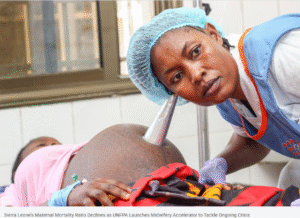
In the operating theatre at Rokupa Government Hospital (where Kadiatu was eventually referred), Kadiatu’s fate rested in the hands of a skilled medical team. At 10:30 a.m., with six hospital staff working swiftly, the lead doctor called for her vitals. The decision was made to perform an emergency C-section.
As the doctor cut her open, the baby, a tiny pink body, was pulled out. It was a boy. The nurses worked quickly to massage him back to life, while Kadiatu’s father, who had anxiously waited in the corridor, was ready to donate blood, an act that may have saved both mother and child.
Meanwhile, back at Macaulay Street, Zainab successfully delivered her baby girl, with little complication. Her regular antenatal checkups and the presence of a skilled healthcare team made all the difference.
As I got the news that Kadiatu’s baby had taken his first breath and that Zainab’s delivery had gone smoothly, I couldn’t help but feel relief. Both mothers had survived. But for many women in Sierra Leone, childbirth is still a life-threatening experience. The journey to improve maternal health in the country is long, but progress is possible.
Dr. Tom Sesay, the Director of Reproductive and Child Health, speaks of the government’s commitment to ending preventable maternal deaths. UNFPA, alongside the government, works tirelessly to provide emergency obstetric care, maternal death surveillance and family planning services.
They managed to avert nearly 4,500 maternal deaths from 2015 to 2017 alone through improved access to family planning. The figures were even higher between 2018 and 2024.
In the provinces, things are even more precarious. Regina Mahmoud is a nurse at the maternity ward of a clinic in Malal, Port Loko. The clinic, which is off-grid, is solar-powered. Technical issues and a lack of resources make solar power unreliable. Sometimes it can be difficult to find enough light when women give birth at night.
“At night when assisting with deliveries it is difficult for us. We use our phone lights to help us see during deliveries,” Regina explains. She often brings a solar-powered portable light from home to light up the maternity ward in the clinic, a simple room with one bed. “One bed isn’t enough,” she says. “There have been instances where up to four women are in labour at the same time.”
As I rose from my chair to check on James, who was now stable and recovering, I couldn’t help but reflect on the lives saved that day, Kadiatu, Zainab, the babies, and even James. A wave of hope washed over me despite the harsh realities of Sierra Leone’s healthcare system. In a country where every birth feels like a gamble, any story of survival feels like a victory.
Meanwhile, Dr. George Ameh, WHO Representative to Sierra Leone, praised the country’s ongoing efforts and achievements in reducing maternal and child mortality. He noted that Sierra Leone has achieved a 78% reduction in maternal deaths since 2000, one of the most significant improvements in the WHO African region.
“Globally, every seven seconds a mother or child dies from preventable causes,” Dr. Ameh said. “Sierra Leone’s commitment to reversing this trend is commendable. The WHO will continue to stand with the country in meeting its health targets, including the SDG goal of fewer than 70 maternal deaths per 100,000 live births by 2030.”
According to Hon. Minister of Health, Dr. Austin Demby, Sierra Leone’s approach is anchored in four core pillars: expanding primary health care, strengthening secondary and tertiary health facilities, improving referral systems, and ensuring emergency preparedness.
Today, 85% of the population live within 5 km of a health facility, and innovations such as PresTrack, a national pregnancy tracking system, are strengthening accountability and coverage. Decentralized blood transfusion services in Freetown, Bo, and Makeni, as well as investments in emergency obstetric and newborn care (EmONC), are also helping save lives.
The reduction of maternal mortality from 1,682 per 100,000 live births in 2000 to 354 in 2025, a 79% improvement, marks a tremendous step forward, Minister Demby said, underscoring Sierra Leone’s progress in building a safer future for mothers and children.