By: Emmanuel Mbowa
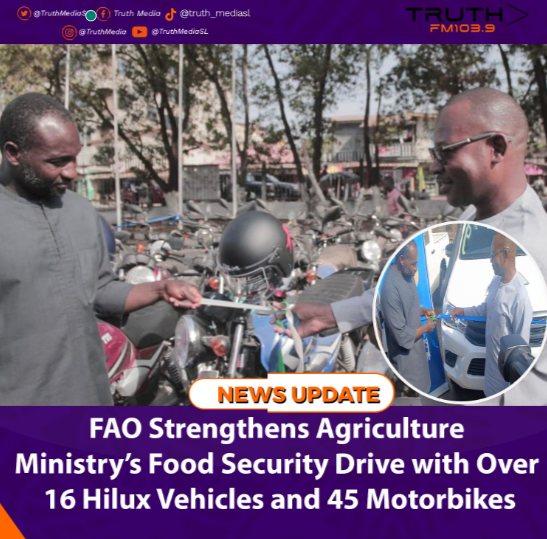
Freetown, March 2026- In a bid to boost food security through robust preparedness mechanisms and to respond to “zoonotic” disease emergencies (those jumping from animals to humans), the Food and Agriculture Organization (FAO) of the United Nations has handed over 16 Toyota Hilux vehicles and 45 motorbikes to the Ministry of Agriculture and Food Security.
Funded by the World Bank Pandemic Fund, the initiative aims to prevent potential outbreaks and strengthen resilience.
In his remarks, FAO Representative Saeed A. Bancie noted that the handover is not merely a transfer of assets, but a strategic investment in the systems and capacities that protect food security and rural livelihoods.
“Effective project implementation, especially projects focused on disease surveillance, emergency preparedness, and rapid response, depends heavily on mobility and field presence,” he explained.
He added, “The vehicles and motorbikes we hand over today are intended to strengthen exactly that. This support is particularly critical within the framework of the Pandemic Fund, which aims to reinforce national preparedness and response systems against threats that can escalate into health or food security crises.”
He further stated that the equipment will significantly enhance the Ministry’s ability to monitor activities, respond quickly to emerging threats, and support district-level operations. This will better serve farming communities, many of whom operate in remote areas that are difficult to access.
“District officers will be better equipped to conduct regular field visits, support farmer training, and ensure timely reporting and coordination of their activities,” Bancie said.
Reflecting on the Ministry’s 2026 performance level, which currently stands at about 50 percent, Minister Dr. Henry Musa Kpaka noted the urgency of the situation. “We have all seen photos of dead cows lying around; we don’t know what’s happening and yet people are consuming them. This project was designed to allow the Ministry to work with our partner, the FAO, to track, follow up, and respond through surveillance.”
Addressing the Ministry’s constraints regarding laboratory access, Minister Kpaka added, “We have the Central Veterinary Lab in Makeni. It is a wonderful facility equipped for veterinary services, disease detection, and sample testing. It is a huge resource that we didn’t have just 24 months ago. We need to continue to maintain and run that.”
He continued, “The Pandemic Fund supports this, and the FAO was the partner we worked with to develop and build that lab. In addition to the vehicles, we hope to establish another lab. We’ve observed that transporting samples from the far end of Kailahun to Makeni can be an issue regarding sample integrity. Having another facility in the southeast could help balance our coverage. We will also train vets in partnership with Njala University. There are a host of things we hope to accomplish that will make a difference.”
Minister Kpaka concluded by thanking donor partners and the FAO for their long-standing partnership and shared hope to successfully implement the program with FAO’s support..
”As the Minister of Agriculture, one of the things I am proud of is that for the past five to six years, our District Agriculture Officers (DAOs) have complained about a lack of transport. Today, they have 16 vehicles and 45 motorbikes. While some will remain at headquarters, at least eight or nine districts are going to receive brand-new vehicles.”