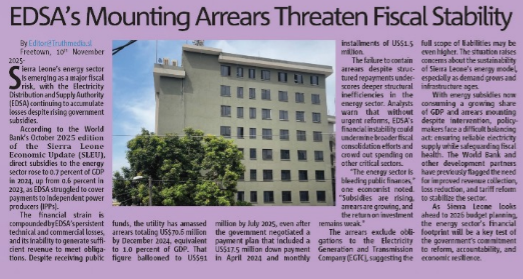
Freetown, 10th November 2025- Sierra Leone’s energy sector is emerging as a major fiscal risk, with the Electricity Distribution and Supply Authority (EDSA) continuing to accumulate losses despite rising government subsidies.
According to the World Bank’s October 2025 edition of the Sierra Leone Economic Update (SLEU), direct subsidies to the energy sector rose to 0.7 percent of GDP in 2024, up from 0.6 percent in 2023, as EDSA struggled to cover payments to independent power producers (IPPs).
The financial strain is compounded by EDSA’s persistent technical and commercial losses, and its inability to generate sufficient revenue to meet obligations. Despite receiving public funds, the utility has amassed arrears totaling US$70.6 million by December 2024, equivalent to 1.0 percent of GDP. That figure ballooned to US$91 million by July 2025, even after the government negotiated a payment plan that included a US$17.5 million down payment in April 2024 and monthly installments of US$1.5 million.
The failure to contain arrears despite structured repayments underscores deeper structural inefficiencies in the energy sector. Analysts warn that without urgent reforms, EDSA’s financial instability could undermine broader fiscal consolidation efforts and crowd out spending on other critical sectors.
“The energy sector is bleeding public finances,” one economist noted. “Subsidies are rising, arrears are growing, and the return on investment remains weak.”
The arrears exclude obligations to the Electricity Generation and Transmission Company (EGTC), suggesting the full scope of liabilities may be even higher. The situation raises concerns about the sustainability of Sierra Leone’s energy model, especially as demand grows and infrastructure ages.
With energy subsidies now consuming a growing share of GDP and arrears mounting despite intervention, policymakers face a difficult balancing act: ensuring reliable electricity supply while safeguarding fiscal health. The World Bank and other development partners have previously flagged the need for improved revenue collection, loss reduction, and tariff reform to stabilize the sector.
As Sierra Leone looks ahead to 2026 budget planning, the energy sector’s financial footprint will be a key test of the government’s commitment to reform, accountability, and economic resilience.