By Alpha Amadu Jalloh
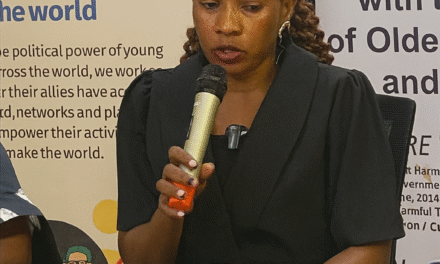
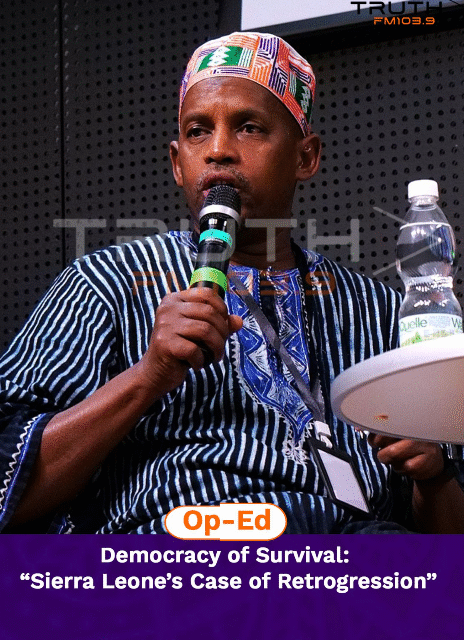
Freetown, 5th January 2025-After watching Truth Media and listening carefully to Haja Zainab Bangura, one is tempted to feel offended before feeling enlightened. Her assessment of Sierra Leone’s democratic decay was blunt, uncomfortable, and for many, painful. Yet discomfort is sometimes the first honest step toward clarity.
When she stated that every Sierra Leonean bears responsibility for the nation’s backwardness and stagnation, I initially resisted the statement emotionally, only to agree with it intellectually on many fronts.
Mrs Bangura was not speaking from a place of contempt but from experience. Her reflections were not theoretical. They were grounded in years of activism, political engagement, and direct encounters with the electorate.
Mr Amadu Lamarana Bah’s questions during the discussion were particularly revealing.
Through his line of questioning, Mrs Bangura reflected on specific moments from her campaign experience when she realised that many ordinary Sierra Leoneans did not fully understand why they were voting or who they were voting for. She explained that, in many instances, the decisive factor was not policy, vision, or governance competence, but the immediate ability of a candidate to provide a few Leones to meet daily survival needs. Once hunger was addressed, the vote was surrendered. What a tragic exchange.
Democracy reduced to a transaction of survival- She went further and spoke with visible concern about the nature of political engagement she encountered on the campaign trail. She recalled arriving in communities where people would gather, sing, and dance in celebration of her presence long before she had spoken a word about why she sought the presidency, what she stood for, or how she intended to influence change in their lives. There were no questions asked, no expectations set, no demand for clarity or direction. Support appeared to precede understanding. Once the music faded, she would move on to another community, only to encounter the same pattern again. This recurring experience troubled her deeply, not because of the warmth of the reception, but because it revealed a democracy built more on ritual than reason.
These moments forced a painful reflection- Enthusiasm had replaced inquiry, and celebration had taken the place of scrutiny. Political participation had become performative, detached from responsibility and expectation.
In Mrs Bangura’s view, this was not a failure of the people’s character, but a symptom of deeper structural challenges that have long constrained meaningful democratic engagement in Sierra Leone. The deeper tragedy is not only that people vote without understanding, but that many do not believe understanding matters. Politics is perceived as an elite game, distant from daily struggle.
Governance is seen as abstract, something that happens above and beyond the ordinary citizen. This mindset did not emerge overnight. It is the product of decades of exclusion, weak civic education, and deliberate political design.
When people are never shown how power works, they cannot be expected to demand accountability from it. Knowing who you voted for and why is not an academic exercise. It is the foundation of democratic participation. A voter who understands the ideology, track record, and commitments of a candidate is empowered to demand delivery.
Without that understanding, elections become ceremonial and leadership becomes unchallenged.
Democracy then shifts from representation to survival management. Leaders are not chosen to transform society but to temporarily relieve pressure.
Sierra Leoneans have also been conditioned to expect reward without sacrifice. The idea that a brighter future requires sustained struggle, patience, and civic discipline is often rejected. There is an unspoken belief that someone else will do the hard work while the masses wait for results.
Development is expected to arrive fully prepared, served on a platter, without the inconvenience of collective effort. This mentality weakens institutions and strengthens patronage.
The popular phrase “Chap yu chap en vote fo di ryt man” captures this contradiction perfectly. It suggests decisiveness, yet it ignores preparation. How does one know the right person without understanding the system. How does one choose wisely without familiarity with policy, budgets, institutions, and consequences. Voting correctly is not a momentary act. It is the outcome of awareness, debate, and critical thinking. When these elements are absent, the wrong choices are repeated with confidence.
Another reason many Sierra Leoneans struggle to understand politics is the deliberate mystification of governance. Political actors benefit from complexity without explanation. Laws are passed without public education. Budgets are announced without scrutiny. Institutions operate without transparency. When politics is made inaccessible, people retreat into apathy or dependency. Democracy becomes something that happens every five years, not a continuous process of engagement.
Education plays a central role in this crisis- Civic education is almost nonexistent in practical terms. Schools do not teach how the government functions in real life. Media discussions are often partisan rather than informative.
Community forums rarely focus on policy literacy. In the absence of structured knowledge, rumours become facts and personalities replace principles. Elections then revolve around tribal loyalty, regional sentiment, and emotional manipulation.
Mrs Bangura lamented that widespread illiteracy and the harsh adversity of poverty form a suffocating combination for any nation hoping to develop. Illiteracy restricts the ability to question power, while poverty compresses life into the present moment, leaving little space for long term thinking. When daily survival becomes the primary concern, democratic engagement is reduced to appearance rather than substance. Under such conditions, political choice becomes symbolic rather than deliberate, and national progress remains painfully elusive.
Her own journey gives weight to her critique. She was a co-founder of the Campaign for Good Governance, one of Sierra Leone’s most influential civil society organisations advocating transparency, accountability, and democratic reform. She later served as Minister of Foreign Affairs and International Relations under Ernest Bai Koroma, representing Sierra Leone on the international stage and engaging with global institutions.
Her perspective is shaped by both grassroots activism and state responsibility, allowing her to see clearly where the system fails and where citizens surrender their power.
Democracy of survival is the most dangerous form of democracy. It creates the illusion of participation while maintaining the reality of exclusion.
Citizens are called upon to legitimise leadership without being equipped to challenge it. The result is restricted democracy, where choice exists in theory but not in substance. Freedom to vote does not automatically translate into freedom to decide.
Sierra Leone’s restrictions are not always imposed by law.
Many are psychological and economic. Hunger restricts choice. Illiteracy restricts awareness. Fear restricts dissent. Dependency restricts imagination. Together, these forces shape a political culture where survival overrides vision.
Until these restrictions are confronted honestly, elections will continue to recycle disappointment. Responsibility therefore lies on both sides. Leaders who manipulate suffering are culpable, but citizens who repeatedly surrender their agency must also reflect.
Democracy cannot thrive where accountability is outsourced and responsibility is postponed.
The struggle for a brighter future requires discomfort, learning, and collective discipline. There is no shortcut to national dignity.
Mrs Bangura’s words should not be dismissed as arrogance or elitism. They should be treated as a warning. A nation that does not understand its politics cannot control its destiny. Voting without knowledge is not empowerment. It is participation without power.
If Sierra Leone is to escape this democracy of survival, the first step is awareness. The second is courage. The third is patience. Change will not arrive in envelopes or handouts. It will come through sustained engagement, informed choices, and the willingness to endure short term discomfort for long term dignity.
Until then, the cycle continues. Hunger meets the ballot. Survival defeats strategy. And democracy remains restricted, not by law, but by the limits we accept.