By Kelfala Kargbo
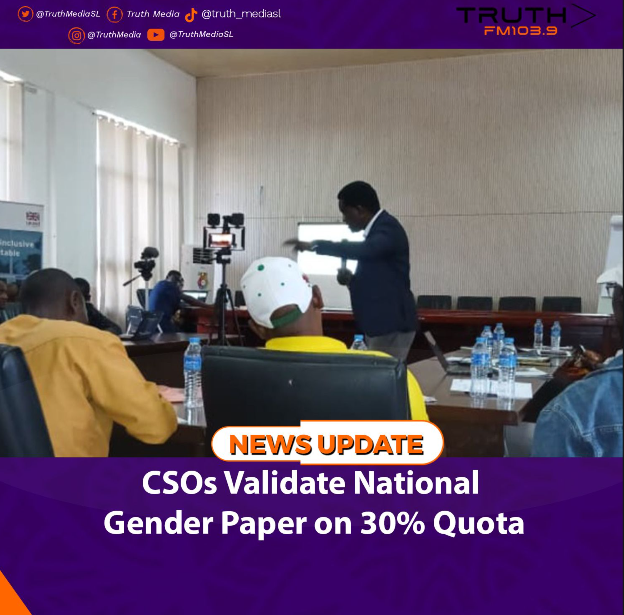
The Westminster Foundation for Democracy (WFD) has held a workshop to validate the National Gender Issue Paper, which focuses on the 30% representation of women in local councils.
The discussions on the draft paper, held at the Parliament Administrative Building under the theme “The 30% Promise: Mapping Women’s Representation in Sierra Leone Local Governance”, brought together civil society organizations (CSOs) to review the paper before its publication.
Speaking at the event, WFD Acting Country Director, Wurie Bah, said the paper aims to assess the impact of the Gender Equality and Women’s Empowerment (GEWE) Act, 2022, which provides for 30% women’s representation in governance. “The bone of contention is whether the 30% quota has been achieved in the various councils, and the challenges faced by those that have not,” Bah explained.
He added that the paper captured data from 22 local councils, collected by 16 civil society organizations across Sierra Leone. As the maiden edition, he noted, it will raise awareness about the achievements of the GEWE Act and ensure the law positively impacts women’s roles in local councils.
Research Analyst Mohamed Jalloh clarified that the paper is not a post-legislative scrutiny but rather an assessment of women’s representation, specifically in Parts 1 and 2 of the GEWE Act, which define the 30% quota. He emphasized that the quota applies not only to elective positions but also to appointive roles, particularly administrative staffing in local councils.
Jalloh said their role was to observe and refine the data presented by the CSOs, acknowledging gaps in the information. On a national level, he confirmed that the 30% representation of women in councils has been achieved. “At the moment, there is a correlation between the law and women serving as chairpersons within committees,” he noted.
However, Jalloh highlighted ongoing challenges. He revealed that women remain underrepresented in administrative positions, which are still largely male-dominated. “Even after the adoption of the GEWE Act, there is a gap in this area,” he said.
Despite the promise of greater participation under the GEWE Act, structural barriers continue to hinder women’s involvement in governance. Jalloh pointed to limited political party support in training and mentorship, cultural barriers, and sexual harassment as persistent challenges raised by respondents.
He concluded that the team is still validating and analyzing the data before releasing the final report to the public. The paper, he stressed, will test the effectiveness of the GEWE Act’s 30% quota, not only at the national level but also in the realities of local councils.