Freetown, 27 November 2025 – Civil society organizations have strongly criticized the government’s decision to impose a 15% Goods and Services Tax (GST) on bottled and bowser water in Sierra Leone, warning that the measure could worsen the country’s public health crisis and place additional financial strain on households.
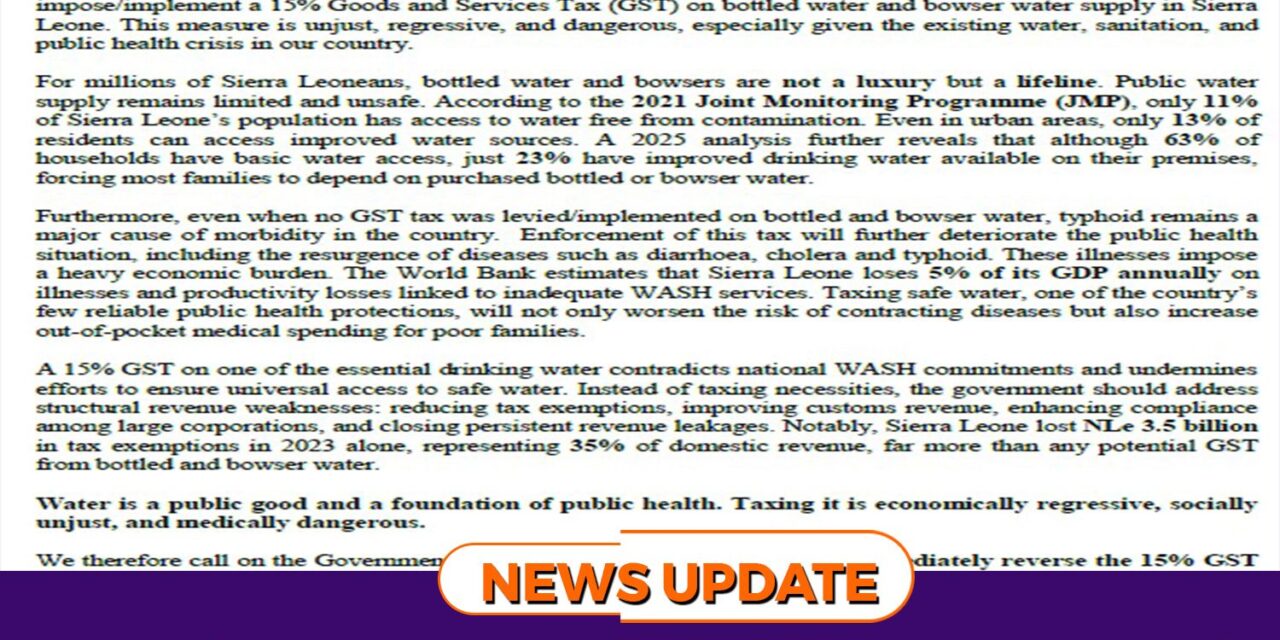
According to the 2021 Joint Monitoring Programme (JMP), only 11% of Sierra Leone’s population has access to water free from contamination. In urban areas, the figure rises only slightly to 13%, while a 2025 analysis shows that although 63% of households have basic water access, just 23% have improved drinking water available on their premises. This leaves the majority of families dependent on purchased bottled or bowser water.
Civil society groups argue that taxing this lifeline will increase costs for households already struggling with unsafe public water supply. They point to the World Bank’s estimate that Sierra Leone loses 5% of GDP annually due to illnesses and productivity losses linked to inadequate water, sanitation, and hygiene (WASH) services.
The groups further highlight that Sierra Leone lost NLe 3.5 billion in tax exemptions in 2023, representing 35% of domestic revenue. They argue that closing revenue leakages and improving compliance among large corporations would generate far more income than taxing bottled water, which is essential for public health.
“Water is not a luxury but a necessity,” the statement reads. “Taxing it is economically regressive, socially unjust, and medically dangerous.”
Even before the GST was introduced, diseases such as typhoid, diarrhoea, and cholera remained major causes of morbidity in Sierra Leone. Civil society groups warn that the new tax could lead to a resurgence of these illnesses, increasing out-of-pocket medical spending for poor families and undermining national WASH commitments.
The organizations are urging the government and Parliament to reverse the 15% GST on bottled and bowser water and instead adopt tax policies that protect public health and social welfare. They also called on civil society, media, and development partners to unite in opposing the measure and advocating for reforms that do not compromise access to safe drinking water.