By Sheriff Mahmud Ismail
Abuja, 12th January, 2026 – For much of the period leading up to Sierra Leone’s 2023 elections, the All People’s Congress (APC) appeared less like a party preparing for power than a movement trapped in its own internal quarrels.
Court battles, rival factions, disputed processes and a pervasive belief among supporters that the ruling Sierra Leone People’s Party (SLPP) was actively interfering in APC affairs combined to produce what many insiders and political observers alike described as a torturous path to the party’s long delayed National Delegates Conference (NDC). The consequences were severe: organizational paralysis, loss of momentum, and a widening gap between party leadership and grassroots supporters.
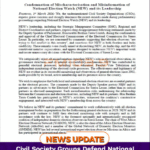
That history matters, because it explains why a seemingly technical development this week carries unusual political weight. The Political Parties Registration Commission (PPRC), in a public notice issued on January 5, 2026 announced that it has gazetted on the same date, formally acknowledged the APC’s Internal Elections Rules and Regulations and, crucially, declared that it will no longer entertain objections to those published rules.
In plain political terms, the notice does more than tidy up a regulatory process. It clears the way for the APC to proceed with its lower level elections from ward to constituency, district and region toward an eventual NDC, without the ever present threat of fresh procedural litigation.
PPRC Press Release 5th January 2026- For a party that has repeatedly seen its internal processes derailed at critical moments, this is not a small development.
A Party Worn Down by Process- To understand the significance of the PPRC’s position, one must revisit the recent past. Ahead of the 2023 elections, the APC’s efforts to organize an NDC were repeatedly stalled by internal rancour and competing injunctions. At the same time, party figures accused the SLPP led government of weaponizing state institutions to prolong APC disarray, a claim that resonated deeply with a membership already frustrated by delays and uncertainty. Whether every allegation was accurate is beside the point; what mattered politically was perception. And perception, as Machiavelli warned in ‘The Prince’, often matters more than reality in the struggle for power.
The difficulties did not end with the elections. The current electoral cycle began under a cloud: disputes over the voter registration process, logistical challenges, and, more recently, the slow and contested printing of APC membership cards. Each problem, taken alone, might have been manageable. Together, they fed a narrative of a party unable to get its house in order.
It is against this background that the PPRC’s gazetting of the APC Internal Elections Rules and Regulations must be read. The rules, now formally acknowledged, provide the framework for conducting elections at all levels of the party. More importantly, the PPRC’s declaration that objections are closed removes one of the most effective weapons of internal sabotage: endless procedural contestation.
APC Final Internal Elections Rules and Regulation-
In the language of political theory, this is the restoration of rules of the game. As Samuel Huntington famously argued, political stability depends less on the absence of conflict than on the existence of agreed procedures for managing it. By freezing the rules, the PPRC has forced all APC actors, willingly or not, onto the same institutional terrain.
The Sam Sumana Question, Settled at Last
Equally consequential is the recent ruling affirming that former Vice President Sam Sumana is eligible to contest for the APC flagbearership. For years, his status hung over the party like an unresolved constitutional riddle, dividing opinion and quietly discouraging engagement in key regions. The judgment removes another long standing thorn, one that had constrained strategic planning and fueled speculation about exclusion and injustice.
The political implications are particularly important for Kono District. Widely regarded as a bellwether and an electoral prize in national contests, Kono has often been described, sometimes lazily, as apathetic or disengaged. In truth, what many interpreted as apathy was more accurately a rational response to uncertainty. As Aristotle observed in Politics, citizens withdraw when they feel the system denies them a meaningful stake.
With the eligibility question resolved, that excuse no longer holds. The path is now open for renewed engagement, organization and competition in Kono under clear rules and with known contenders. Any continued disengagement would be a failure of leadership, not of law.
Power, Parties and the Burden of Maturity
Political parties, from ancient Rome to modern democracies, have always been arenas of conflict. Cicero warned that factions destroy republics from within, while Madison, writing in Federalist No. 10, argued that factions are inevitable but must be controlled through institutions. The APC’s recent history reflects this timeless tension: ambition without discipline, plurality without procedure. The current moment therefore demands more than celebration. It demands restraint and strategic maturity.
The closing of objections by the PPRC is not a guarantee of peace; it is an opportunity for it. How the APC leadership and flagbearer aspirants respond will determine whether the party finally turns the page or reopens old wounds under new guises. Leadership, in this context, means cooperation where possible and competition where necessary, but always within the agreed framework. Aspirants must recognize that a widely accepted NDC outcome is not merely an internal victory; it is a prerequisite for national credibility. In contemporary politics, voters punish parties that appear unserious about governing themselves.
There is also a broader national stake. Sierra Leone’s democracy is still consolidating, and a weak opposition ultimately weakens accountability. As John Stuart Mill argued, vigorous opposition is essential not only for those out of power, but for the health of the polity as a whole.
A Narrow Window, A Historic Test
The APC now faces a narrow but real window to demonstrate that it has learned from its ordeal. The rules are gazetted. Objections are closed. Legal ambiguities around key figures have been resolved. What remains is the hard work of organizing, persuading and restraining egos in service of a larger goal.
History offers both warning and hope. Ancient Greek city states fell when factions placed victory over survival. Yet modern parties across Africa: from South Africa’s ANC to Ghana’s NPP, have shown that internal renewal, though painful, is possible when leaders subordinate ambition to process. For the APC, the coming lower level elections and eventual NDC are no longer just procedural milestones.
They are a test of whether the party is ready to reclaim power, not merely for its own sake, but, as its leaders often insist, for the sake of the country. The thorns have been cleared. What remains is the courage to walk the path without drawing blood.