Freetown, 13th March, 2026 — A new opinion poll by the Campaign for Human Rights and Development International (CHRDI) has revealed that Sierra Leoneans overwhelmingly want a democracy anchored on accountability, transparency, and unity, with strong views on electoral reforms and governance priorities.
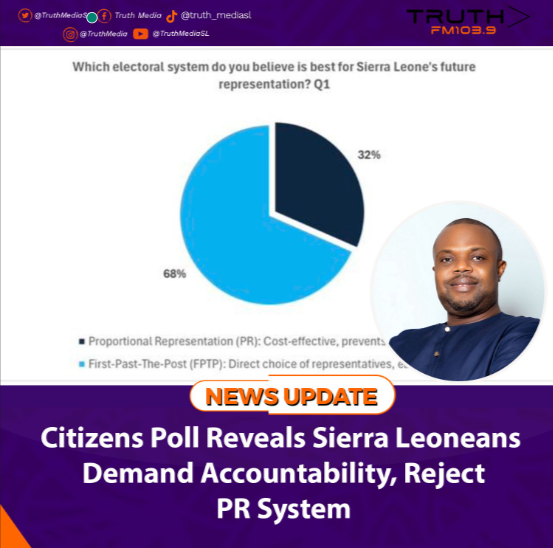
The survey shows a clear rejection of the Proportional Representation (PR) system, with 68% of respondents insisting on direct constituency representation as the best way to ensure accountability between voters and their leaders. In the same vein, 74% oppose lowering the electoral threshold, arguing that national cohesion must be safeguarded against fragmented politics.
Yet the poll also highlights a critical gap: 60% of citizens admit they lack sufficient civic education to make informed decisions on the 2025 Amendment Bill. This finding underscores the urgent need for voter education if reforms are to be meaningful and inclusive.
On the contentious issue of diaspora participation, Sierra Leoneans remain divided. Half of respondents support dual citizenship, believing it would bring valuable skills into Parliament, while 44% express concern about loyalty and divided interests.
The poll also reveals strong consensus on key governance reforms. An overwhelming 98% favor fixed election dates, citing predictability and stability in the democratic process. Meanwhile, 82% demand enforceable rights to healthcare and education, reflecting growing public pressure for social accountability and improved service delivery.
Frustration with slow institutional processes also came through clearly. 57% criticized the Tripartite Steering Committee, saying it has spent too much time in meetings and too little on concrete action.
CHRDI noted that the findings highlight a growing demand for reforms that go beyond electoral mechanics to address governance, service delivery, and citizen empowerment. The rejection of PR and opposition to lowering thresholds reflect a desire for stronger direct representation and national unity.
The poll also revealed frustration with slow institutional processes, particularly the Tripartite Steering Committee, which many respondents believe has failed to deliver tangible results.
The data suggests Sierra Leoneans are not only focused on how elections are conducted but also on the broader democratic framework, from fixed election dates to enforceable social rights. The split views on diaspora participation further illustrate the complexity of balancing inclusivity with national loyalty.