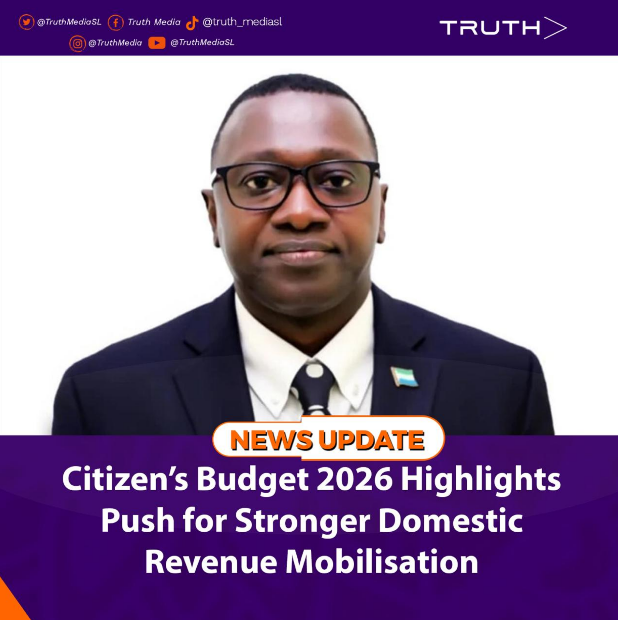
Freetown, 16th February 2026 -Sierra Leone’s Citizen’s Budget 2026 has placed domestic revenue mobilisation at the heart of government’s economic strategy, with projections showing that 85% of total receipts will come from internal sources. The simplified guide to the national budget underscores the government’s commitment to financing public services, especially for the poor and vulnerable, while strengthening accountability and transparency in public finance.
According to the breakdown, total receipts are projected at NLe 25,935 million, equivalent to 13.8% of GDP. Of this, NLe 22,164 million will be raised domestically, while grants will contribute NLe 3,771 million.
Income Tax Revenue: NL£ 8,254 million (32% of receipts, 4.4% of GDP), Goods and Services Tax (GST): NL£ 3,861 million (15% of receipts, 2.1% of GDP), Customs and Excise Duties: NL£ 5,479 million (21% of receipts, 2.9% of GDP), Mines Revenue: NL£ 1,285 million (5% of receipts, 0.7% of GDP), Fisheries Royalties: NL£ 142 million (1% of receipts, 0.1% of GDP), Parastatals Revenue: NL£ 405 million (2% of receipts, 0.2% of GDP), Other MDAs Revenue: NL£ 452 million (2% of receipts, 0.2% of GDP), Timber Revenue: NL£ 41 million (negligible, 0.0% of GDP), Treasury Single Account (TSA): NL£ 1,615 million (6% of receipts, 0.9% of GDP), Road User Charges & Vehicle Licences: NL£ 671 million (3% of receipts, 0.4% of GDP)
Grants are expected to provide 15% of total receipts, split between Programme Grants (NL£ 1,755 million) and Project Grants (NL£ 2,016 million).
The Citizen’s Budget explains that mobilising more domestic revenue is critical for economic stability and improved service delivery. By relying less on external grants, the government aims to build resilience and ensure predictable financing for health, education, infrastructure, and social protection.
The heavy reliance on income tax and customs duties highlights both strengths and vulnerabilities in Sierra Leone’s fiscal framework. Expanding the tax net, improving compliance, and diversifying revenue sources particularly in mining, fisheries, and parastatals will be essential to sustain growth.
The Citizen’s Budget is designed to make complex fiscal data accessible to ordinary citizens, reinforcing transparency in how government raises and spends money. By presenting revenue and expenditure projections in simple terms, the Ministry of Finance hopes to strengthen public trust and encourage citizen engagement in budget monitoring.