By Mohamed Jaward Nyallay
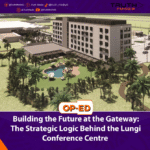
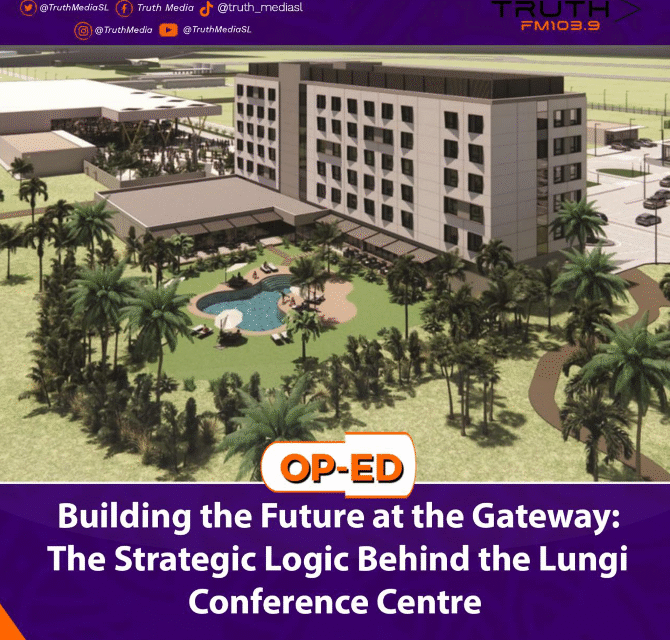
Freetown, 2nd March 2026- This week, Sierra Leone’s national conversation turned toward a single announcement: a $124 million international conference centre to be constructed in Lungi, unveiled by Finance Minister Sheku Ahmed Fantamadi Bangura.
Predictably, debate followed. Large infrastructure projects always invite scrutiny. But serious policy discussion requires more than reacting to price tags; it demands understanding strategy. And when viewed through the lens of long-term national development, this investment represents one of the most deliberate economic decisions taken by the administration of President Julius Maada Bio.
This is not merely a construction project. It is a statement about where Sierra Leone intends to grow next.
Understanding Lungi Beyond the Transit Point
To appreciate the significance of the decision, one must first understand Lungi itself.
Lungi sits along the Atlantic coastline, separated from Freetown by water yet strategically positioned as the country’s primary international gateway. Every visitor arriving in Sierra Leone lands there. Every delegation passes through it. Yet historically, few stop long enough to experience the town, invest in it, or imagine its future. For decades, Lungi has existed paradoxically as the entrance to the nation without being part of its economic centre.
The conference centre changes that equation. Government is not responding to a moment; it is executing a spatial development strategy, decentralizing growth away from Freetown and unlocking underutilized geographic assets.
Deliberate Policy, Not Impulse Spending- Critics often frame major public investments as extravagance. But modern statecraft recognizes infrastructure as an economic catalyst. The decision to situate an international conference facility in Lungi aligns with three strategic objectives: Tourism diversification, Regional economic balancing and International positioning of Sierra Leone as a conference destination.
Across Africa, countries that successfully host global meetings do not rely on coincidence. They build ecosystems. Ghana, Kenya, and Ethiopia transformed their global relevance by pairing airport infrastructure with conference facilities, hospitality investments, and commercial hubs.
Lungi now stands at the threshold of a similar transformation.
What This Means for Local Communities- Much of the criticism overlooks the most important stakeholders: the people of Lungi. For residents, this project is not abstract policy; it is a tangible opportunity. The proposed conference centre will immediately generate thousands of construction jobs during implementation, as well as long-term employment opportunities across hospitality, security, logistics, administration, and maintenance. Additionally, it will create new opportunities for local entrepreneurs in transportation, catering, retail, and tourism services.
Infrastructure follows investment. Roads improve. Electricity supply stabilizes. Telecommunications expand. Private capital moves in. Development, once concentrated in Freetown, begins to redistribute itself.
For many indigenes, this project represents the first time national development feels anchored in their community rather than passing them by.
A Foundation for a New City- Lungi has been identified within national planning discussions as a potential new city under future redistricting plans. A flagship infrastructure asset of this magnitude does more than beautify an area; it legitimizes urban status.
Should Lungi attain city designation, a future city council would inherit a powerful revenue-generating asset capable of supporting municipal services, urban planning, and local governance sustainability.
In practical terms, the conference centre could become the economic heartbeat of a new urban municipality.
Economic Multiplier Effects The project’s benefits extend far beyond its walls.
Planned facilities include: A Presidential-level meeting hall capable of hosting 20 Heads of State and delegations, a 1,400-seat multipurpose auditorium suitable for international conferences and live cultural events, a 500-seat banquet hall, multiple breakout rooms accommodating large professional gatherings.
Such infrastructure transforms Lungi into an attractive venue for: ECOWAS and African Union meetings, Investment summits, Cultural festivals, Corporate conventions and International exhibitions.
Each event translates into hotel occupancy, airline traffic, restaurant revenue, banking activity, and transport demand. In effect, the project seeds an airport city ecosystem, a model that has propelled several African economies into global conference circuits.
Competing with Freetown and Complementing It- Within a decade, Lungi could emerge not as a rival to Freetown but as its strategic partner. Freetown remains the political and historic capital. Lungi, however, has the geographic advantage to become Sierra Leone’s conference and tourism capital, relieving urban pressure while expanding national economic space.
Balanced development strengthens national resilience. The Cost Debate: Short-Term Optics vs Long-Term Vision
Large infrastructure investments inevitably provoke questions about cost. Those questions are healthy in a democracy. Yet policymaking must distinguish between expense and investment.
The true calculation is not what the country spends today, but what it stands to gain tomorrow:
Expanded tourism revenue, International visibility, Job creation, Municipal revenue generation, Private-sector expansion, Regional economic inclusion. Measured against these outcomes, the benefits overwhelmingly outweigh the initial capital outlay.
A Gateway That Finally Feels Like One- For too long, Lungi has served merely as Sierra Leone’s arrival point without sharing fully in its prosperity. Visitors landed, departed, and spent their economic energy elsewhere.
This decision signals a philosophical shift in governance: development must follow opportunity, not geography alone.
The conference centre represents confidence, confidence that Sierra Leone can host the world, diversify its economy, and build growth beyond traditional centres. Good governance is often judged not by safe decisions, but by strategic ones. In betting on Lungi, the government is not simply constructing a building. It is constructing a future.