By Kelfala Kargbo
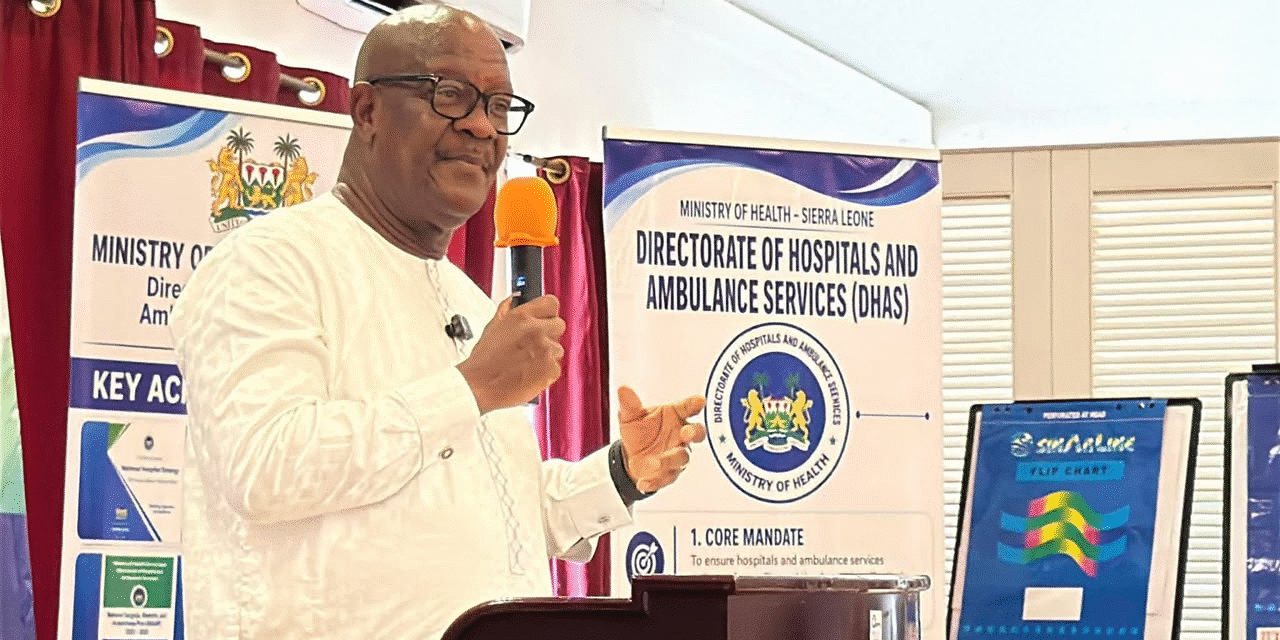
Freetown, 13th November, 2026 – The Minister of Health, Dr. Austin Demby, has called on lawmakers to pass the Mental Health Act 2026, saying it upholds the respect and dignity of mental health patients.
Speaking during the debate on the Mental Health Act in the well of Parliament on 12th November, Minister Demby said that Sierra Leone’s only mental health law is the Lunacy Ordinance Act,1902. “For 124 years, Sierra Leone has relied on the lunacy ordinance of 1902, which permits detention so long as he continues to be insane. Our understanding of care has moved forward; our law has not,” Demby said.
The law seeks to repeal and replace the Lunacy Ordinance Act of 1902, which was enacted during the colonial era. Sierra Leone has signed the UN Convention on the Rights of Persons with Disabilities, yet other African countries have already replaced their colonial-era laws on insanity: Ghana in 2012, Liberia in 2017, Kenya in 2022 and Nigeria in 2023. The Gambia is working to do the same.
According to data from the World Health Organization (WHO), more than 1 billion people worldwide are living with a mental health condition.
Minister Demby cited the Global Burden of Disease study that estimates that 1.25 million Sierra Leoneans lived with a mental disorder in 2023, while about 15 of every 100 people struggle with it. It also estimates that 794 deaths from suicide and self-harm that same year.
Currently in Sierra Leone, there is a treatment shortfall, as the Minister disclosed that an estimated 98% of people with severe mental illness received no treatment.
Causes for the alarming mental health illness in Sierra Leone, he said, have been due to an 11-year civil war, Ebola, COVID-19 and Mpox, adding that a 2024 nationwide study found about 17.2% of young people use Kush, a harmful drug, and that about 62% of Sierra Leoneans have used at least one psychoactive substance.
He further stated that Sierra Leone’s health workforce is challenged to meet the demand for mental health services in the country.
“For a population of more than 9 million, our speciality workforce includes only four psychiatrists, seven psychiatric residents, and 35 mental health nurses, according to the ministry’s 2026 figures,” he disclosed, noting that “more than 500 health workers have received mental health training, and the free 5116 helpline offers a place to seek help, but services alone cannot overcome stigma”.
The government has not been funding mental healthcare. According to Minister Demby, the Mental Health Department receives less than 0.0001% of the national budget for the health sector.
According to studies, a $1 investment in mental healthcare returns about $4 in profit, while global estimates suggest 1 trillion is lost each year to depression and anxiety.
Minority Whip of the Opposition in Parliament, Hon. Abdul Karim Kamara, expressed sentiment for the mental health department, canvassing other members of parliament to ensure allocation of budget to the department. “This is no longer a secret. We see our young people languish on the streets. Mr Speaker, our allocation to this sector needs to be improved,” he urged.
The new law, according to the Minister, will strengthen safeguards against abuse, unlawful restraint, and arbitrary detention, providing for district mental health coordinators, facility standards and inspection, and stronger cooperation among health, education, justice, and social welfare institutions.
The bill proposes that a mental health patient may be consented to whether to be in a mental health facility or not, ensuring that information of mental health patients is confidential and frowns against stigma, which is common among communities.
Looking ahead, Minister Demby said that they will be training more nurses in the mental health speciality and employ psychiatric specialists, noting that there are over 150 people who are currently in training. The bill has been committed to the legislative stage, where MPs will assess the bill clause by clause and later pass it into law.