By Davida Spaine-Solomon
Freetown, 22nd October, 2026 – The Independent Media Commission (IMC), in partnership with the National Public Health Agency (NPHA), has trained journalists and media representatives on emergency preparedness and responsible reporting during public health emergencies, as Sierra Leone strengthens its readiness against the threat of Ebola Virus Disease (EVD).
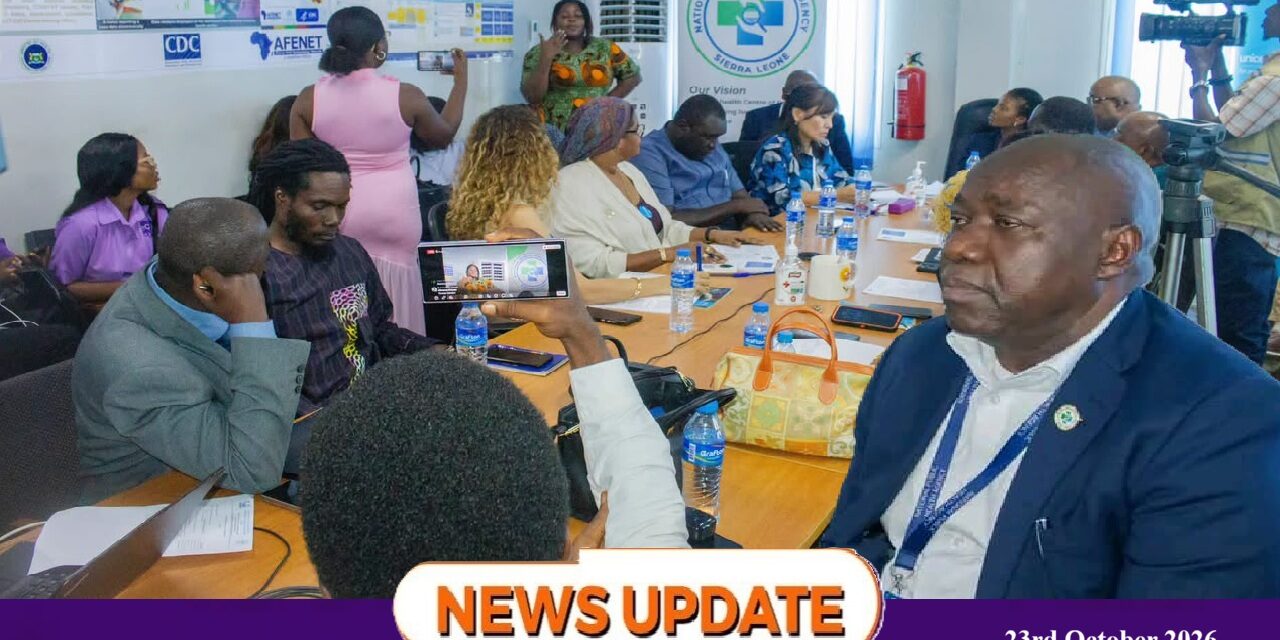
The one-day training, held on Wednesday, 21st October, 2026, at the Emergency Operations Centre, on Wilkinson Road, Freetown, focused on equipping media practitioners with the knowledge and skills to report public health emergencies accurately, responsibly and without creating unnecessary panic.
The engagement comes amid an Ebola outbreak caused by the Bundibugyo virus in the Democratic Republic of the Congo (DRC) and reports of cases in other African countries, including Nigeria and Kenya, highlighting the need for stronger surveillance, regional cooperation and public awareness.
Addressing the media dialogue, the Executive Director of the NPHA, Brig. Gen. Prof. Foday Sahr, confirmed that there is no Ebola case in Sierra Leone and that the measures being implemented are precautionary. “There is no case of Ebola in Sierra Leone. Not one confirmed, not one suspected,” he said.
He also called on journalists to verify suspected cases with health authorities before publication, avoid sensational headlines, communicate in local languages and provide platforms for experts to address public concerns.
Prof. Sahr explained that the country had strengthened its national preparedness following an assessment in May that recorded 51 per cent readiness across key emergency response areas. A reassessment conducted on 8th October showed that preparedness had increased to 83 per cent.
He said improvements had also been recorded in infection prevention and control, safe and dignified burials, contact tracing, coordination and risk communication. The country’s national laboratory is also equipped to confirm Ebola cases locally, without sending samples abroad.
However, he acknowledged that gaps remained in the supply of protective equipment and the country’s isolation and treatment capacity, which authorities are working with the Government and development partners to address.
The NPHA Executive Director outlined measures already in place, including screening at official points of entry, a health declaration requirement for travellers, district rapid response teams and the 117-emergency line, which operates free of charge around the clock.
He urged the public to seek immediate assistance through 117 if they develop symptoms, such as fever, headache, weakness, vomiting or diarrhoea within 21 days of travelling to affected countries or after contact with someone who is sick.
Speaking at the engagement, the Health Promotion and Risk Communication and Community Engagement (RCCE) Advisor at NPHA, Harold Williams, highlighted the importance of preparing journalists and media institutions to communicate effectively during public health emergencies.
The training also emphasised the need for media houses to establish preparedness measures that protect journalists working in the field while ensuring the public receives timely, verified and reliable health information.
The Deputy Minister of Health, Dr. Jalikatu Mustapha, in a separate statement, said the developments in the DRC and the reported case in Nigeria reinforced the importance of vigilance, early detection and coordinated public health responses.
The Deputy Minister reassured the public that preparedness activities did not indicate an outbreak in Sierra Leone, but reflected the Government’s commitment to protecting the population.
She further urged communities, traditional and religious leaders, civil society organisations and young people to work with health authorities, follow verified guidance and report unusual illnesses through established public health channels.
The engagement also featured the presentation of guidelines on media coverage and reportage during public health emergencies, aimed at strengthening professional standards and helping journalists counter misinformation while maintaining public confidence.
Participants were encouraged to prioritise accuracy, verification and responsible communication, particularly during health crises when rumours and sensational reporting can undermine response efforts.
Sierra Leone’s experience during the 2014–2016 Ebola outbreak underscored the importance of public trust, community engagement, early detection and effective communication in controlling infectious diseases.
The training forms part of efforts to strengthen collaboration between the media and public health authorities to ensure journalists are better prepared to inform the public and support national emergency preparedness.