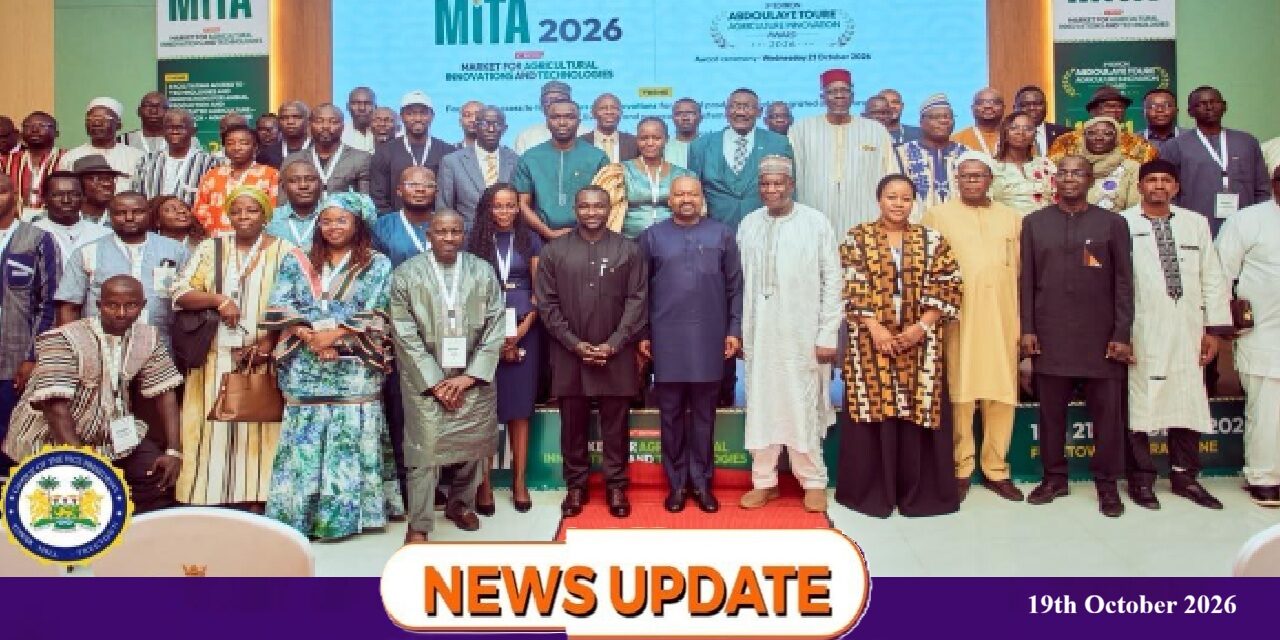
Freetown, 19th October 2026 – Vice President Dr Mohamed Juldeh Jalloh has called on member states of the Conference of Agricultural Research Leaders in West and Central Africa (CORAF) to invest in resilient infrastructure, particularly in the areas of energy and food security, to better withstand global economic shocks.
The Vice President appealed while addressing participants at the 6th edition of the Market for Agricultural Innovations and Technologies (MITA 2026), which was hosted in Freetown.
Speaking on the importance of building stronger economies across the sub-region, Dr Jalloh emphasized that investments in energy and food systems are critical for countries seeking to reduce their vulnerability to external economic pressures.
Reflecting on discussions at the conference, the Vice President said he used the platform to urge CORAF member countries to prioritize infrastructure capable of supporting long-term economic stability.
“I used the opportunity to reiterate the call for CORAF member countries to build resilient infrastructure anchored in energy and food security to strengthen our capacity to withstand global shocks that disproportionately affect small economies,” he stated.
Dr Jalloh also highlighted the importance of deeper regional cooperation and increased trade among West African countries, arguing that stronger economic integration could unlock significant opportunities for growth and development.
According to him, the region possesses enormous economic potential, but greater collaboration is needed to transform that potential into tangible benefits for citizens across West and Central Africa.
The Vice President noted that expanding intra-regional trade would help strengthen markets, improve economic resilience and create new opportunities for agricultural innovation and technology.
“I also emphasised the need to strengthen regional cooperation and expand intra-regional trade. Our region has the potential. We must now work together to turn that potential into shared prosperity,” he said.
His remarks come as regional leaders and agricultural experts continue to advocate for stronger partnerships, innovation and investment to boost food production, promote sustainable development and enhance economic resilience across West and Central Africa.