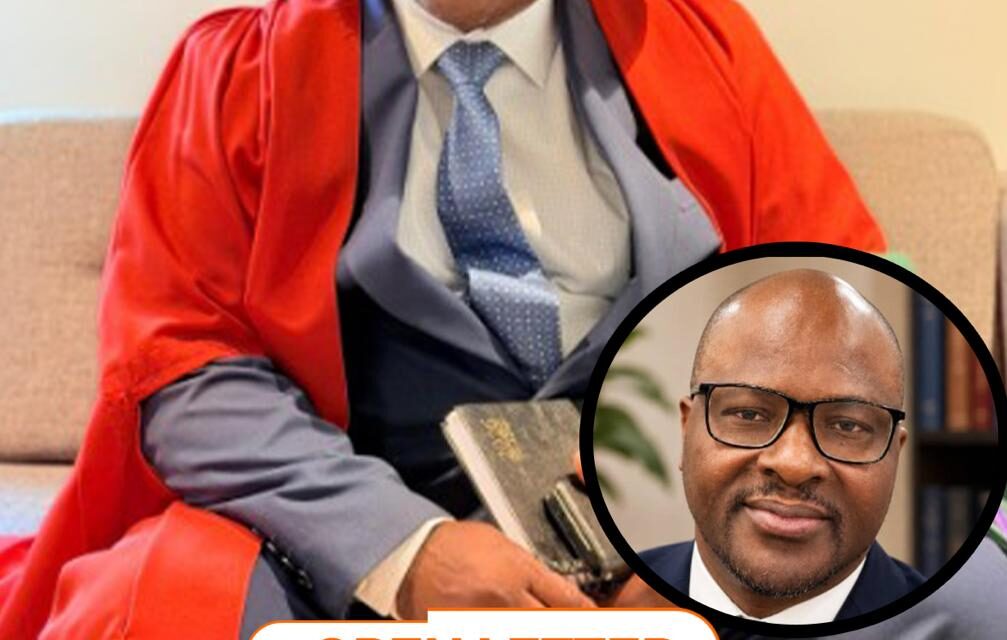
AN OPEN LETTER TO THE HON ATTORNEY-GENERAL AND MINISTER OF JUSTICE OF THE REPUBLIC OF SIERRA LEONE
10th August 2026
Hon. Comrade Alpha Sesay
Attorney-General & Minister of Justice
Republic of Sierra Leone
Constitutional Reform Beyond Political Convenience: Reflections on the Cowan Constitutional Review Commission and the Constitutional Amendment Bill 2026
Dear Hon. Comrade Attorney-General & Minister of Justice,
I hope this rather long letter finds you well.
I have chosen to preface my substantive contribution to the ongoing national debate on the amendment of the Constitution of Sierra Leone, 1991 (Act No. 6 of 1991) with this open letter for two related reasons:
First, almost ten years later, I believe the time has come to respond to certain observations made about my individual contribution to the Justice Edmond Cowan-led Constitutional Review Committee (CRC), particularly those contained in the response submitted by the then governing All People’s Congress (APC) on 7 December 2016.
Secondly, and much more importantly, that episode offers an enduring lesson in constitutional governance: constitutional rules should be designed for the country, not for the temporary convenience of whichever political party happens to exercise state power.
That second consideration is ultimately far more important than any personal disagreement arising from the CRC process.
My Contribution to the Cowan Constitutional Review Process
In September 2015, I responded to the national call for submissions to the Constitutional Review Committee.
I was not a member of the 80-person Commission. Neither was I representing a political party, civil society organisation, professional association or any other organised interest. I participated simply as an individual Sierra Leonean and public intellectual who believed that the constitutional future of our country was too important to be left exclusively to politicians and constitutional experts.
At the time, I was serving as a senior manager at the National Social Security and Insurance Trust (NASSIT) and a lecturer at the University of Sierra Leone. Amidst the considerable demands of my positions, I undertook extensive research and submitted a two-part contribution entitled:
“Away from Audience and Electoral Democracy, Towards Genuine and Effective Democracy for the People of Sierra Leone (Parts I & II).”
My central argument was straightforward. Democracy should mean more than periodically inviting citizens to vote and then relegating them largely to the role of spectators until the next election. Genuine constitutional democracy requires institutions capable of restraining public power, protecting rights, strengthening judicial and institutional independence, and providing meaningful mechanisms through which citizens can hold their government accountable between elections.
When the CRC completed its Final Report in December 2016, subsequently presented to then President Ernest Bai Koroma in January 2017, I was pleasantly surprised to discover that my submission had been cited repeatedly across different sections of that extensive report and had informed several aspects of the Commission’s analysis and recommendations.
I was, and remain, deeply humbled by that acknowledgement.
I had no institutional platform within the CRC and represented no political constituency. Whatever influence my submission acquired arose from the quality of the arguments it contained.
I nevertheless felt disappointed that, despite the extent to which the Commission relied upon my work, I was never afforded an opportunity to appear before it to explain or defend some of my more controversial proposals. Neither, to the best of my recollection, was I invited to the final presentation of the Report or subsequently involved in the numerous discussions surrounding its different iterations.
But those disappointments are now secondary. The larger constitutional questions remain.
The APC Response of 7 December 2016: A Question Left Unanswered for Ten Years
Among the responses appended to the CRC Final Report was a strongly worded critique submitted on behalf of the then governing APC by its then Secretary-General, Ambassador Osman Foday Yansaneh, entitled The Pitfalls in the CRC Report and the Revision of the 1991 Constitution: The Trouble with the Sum and Substance of the CRC Final Report.
Two aspects of that response concerned my submission directly.
The first related to the CRC’s recommendation concerning section 14 of the 1991 Constitution, under which the Fundamental Principles of State Policy contained in Chapter II are non-justiciable.
In my submission, I questioned whether constitutional commitments concerning the social and economic welfare of Sierra Leoneans should remain permanently aspirational and beyond meaningful judicial enforcement.
The APC disagreed. Ambassador Yansaneh wrote:
“The APC does not accept the recommendations of the CRC to amend Section 14.”
He further argued:
“The CRC appears unpersuasive in proposing an amendment of section 14 of the 1991 Constitution.”
There is nothing objectionable about that disagreement. Constitutional reform necessarily involves competing understandings of rights, institutional competence and the appropriate boundaries between courts, Parliament and the executive.
What I found more troubling was what followed.
Ambassador Yansaneh wrote:
“the most cited expert in the CRC report, Mr Owen Moriba Momoh KaiCombey, is not introduced anywhere in the report as an acknowledged authority on human rights or constitutionalism.”
He continued:
“Yet, the CRC was inspired by his personal views to recommend that Third Generation Rights are in the same category as First Generation rights in Chapter Three in the 1991 Constitution.”
That passage has remained with me for the past ten years.
Not because Ambassador Yansaneh disagreed with me. He and the APC were perfectly entitled to do so. The difficulty was that the criticism appeared to move away from the constitutional proposition towards the credentials of the citizen advancing it.
Instead of asking primarily whether the arguments for greater constitutional protection of socio-economic rights were doctrinally sound, democratically desirable or institutionally practicable, the response appeared preoccupied with whether Owen Moriba Momoh KaiCombey had been established as an “acknowledged authority on human rights or constitutionalism”.
That raises a much larger democratic question:
Must a Sierra Leonean first become an “acknowledged authority” before his or her ideas deserve serious consideration in the making of the country’s Constitution?
Surely not.
Expertise is indispensable to sound constitution-making, but expertise cannot become a gatekeeping mechanism through which citizens are excluded from deliberating upon the fundamental law by which they themselves are governed.
The irony is particularly striking: the independent CRC had evidently considered my arguments sufficiently relevant to cite them repeatedly and incorporate aspects of them into its recommendations. The appropriate intellectual response, therefore, was to demonstrate why those arguments were wrong—not why their author was insufficiently credentialled.
Judicial Independence: “His Views … Are Misguided”
Ambassador Yansaneh returned to my submission when addressing another issue of enduring constitutional importance: judicial independence and executive influence over judicial appointments.
My submission had questioned the constitutional architecture surrounding appointments under section 135 of the Constitution and advocated stronger institutional safeguards for judicial independence.
The argument was not that any involvement of the President in judicial appointments was necessarily incompatible with judicial independence. Executive participation exists in different forms across constitutional democracies. The relevant question was—and remains—whether Sierra Leone’s institutional framework contains sufficiently robust safeguards against actual or perceived political influence over the judiciary.
Once again, however, Ambassador Yansaneh’s response focused conspicuously upon my contribution:
“In their final report, the CRC relies too much on the position paper of Mr Owen Moriba Momoh KaiCombey.”
He then concluded:
“His views on the Constitution of Sierra Leone are misguided and not quite relevant in constitution-making.”
I confess that this latter observation baffled me then, and it continues to intrigue me today.
How could the individual contribution of a Sierra Leonean citizen, submitted in response to a national invitation to participate in constitutional reform, be regarded as “not quite relevant in constitution-making” when the constitution-making body itself had considered those views sufficiently relevant to rely upon them?
If my arguments concerning judicial appointments were misguided, the stronger response would have been to demonstrate why the existing arrangements adequately insulated the judiciary from executive influence.
If my recommendations concerning section 14 were constitutionally unsound, the appropriate response was to demonstrate why socio-economic commitments should remain permanently non-justiciable.
And if my ideas were truly irrelevant to constitution-making, then one must explain why the independent Constitutional Review Committee itself found them worthy of such repeated consideration.
Constitutional debate should ultimately be a contest of ideas, evidence and principles—not a contest of titles and credentials.
Ten Years Later: History Has Changed the Vantage Point
Time has an interesting way of testing constitutional arguments.
When Ambassador Yansaneh wrote those words on 7 December 2016, the APC controlled the presidency and the executive machinery of the state.
Today, the APC sits in opposition.
The SLPP, then in opposition, now exercises executive power.
That reversal presents an extraordinary opportunity to reconsider the constitutional questions of 2016 from a different vantage point.
I therefore respectfully invite Ambassador Osman Foday Yansaneh and the APC to revisit their response to the Cowan Commission and ask themselves:
Do we still believe today what we believed about executive power when we ourselves exercised it?
Would the APC today defend precisely the same arrangements concerning presidential power and judicial appointments?
Would it still regard stronger institutional limitations upon executive authority as unnecessary? Would it still regard proposals designed to strengthen judicial independence as “misguided”?
If the answers remain yes, then those positions should be defended afresh on constitutional principle.
If the answers have changed, there should be no embarrassment in acknowledging that fact. Democratic maturity includes the capacity to reconsider earlier positions in light of experience.
Indeed, one of the great constitutional benefits of alternation in political power is that political parties eventually experience state institutions from both sides.
The Constitution Behind a Veil of Political Uncertainty
There is a useful philosophical way of understanding this problem.
In A Theory of Justice, John Rawls famously invites us to imagine choosing the fundamental principles governing society from behind a “veil of ignorance”—without knowing beforehand what position we ourselves will occupy in that society.
The analogy is particularly instructive for Sierra Leonean constitutional politics.
Political parties should design constitutional rules behind what might be called a veil of political uncertainty: without knowing whether they will occupy State House or the opposition benches when those powers are exercised.
Before supporting a broad presidential power, therefore, every political party should ask:
Would we willingly place this same power in the hands of our political opponents?
Before defending a particular method of appointing judges, we should ask:
Would we consider this arrangement sufficiently independent if our opponents controlled the presidency and Parliament?
And before declaring constitutional commitments to education, health, welfare and social justice non-justiciable, we should ask:
What constitutional protection would we want if we were ordinary citizens seeking to hold a government we did not support accountable?
A constitutional provision that appears desirable only when our party controls the institutions through which it operates is probably a poor constitutional provision.
Section 14: Aspirations or Constitutional Commitments?
This brings me back to one of the principal controversies surrounding my 2015 submission.
Chapter II of the Constitution contains commitments fundamental to the relationship between state and citizen. Yet section 14 substantially limits their judicial enforceability.
The question raised by my submission was not simply whether so-called third-generation rights should mechanically be placed on precisely the same doctrinal footing as conventional civil and political rights.
The deeper question was this:
Should a modern Constitution solemnly promise its citizens social justice, education, health, welfare and accountable government while simultaneously denying them meaningful constitutional mechanisms for holding the state accountable for those promises?
Comparative African constitutionalism has advanced considerably since our 1991 Constitution was enacted. Constitutional experience in jurisdictions such as South Africa and Kenya demonstrates that socio-economic rights can be made judicially cognisable without transforming judges into governments or destroying the constitutional separation of powers.
The Cowan Commission itself considered comparative constitutional developments before recommending reform of section 14. That debate deserves substantive reconsideration.
Judicial Independence Belongs to the Citizen
The same reasoning applies to judicial appointments.
Judicial independence should never be viewed primarily through the interests of government or opposition.
It belongs ultimately to the citizen.
Government needs an independent judiciary.
Opposition parties need an independent judiciary.
Businesses and investors need an independent judiciary.
The poor and politically powerless need an independent judiciary.
Most importantly, Sierra Leone needs an independent judiciary.
The constitutional question is therefore not whether President Bio, President Koroma or any particular president can be trusted to exercise appointment powers responsibly. Constitutions should never depend upon the presumed virtue of individual officeholders.
The proper question is whether the institution itself is designed to remain independent when occupied by people whom we may not trust.
That is what constitutionalism means: not government by good people, but government through institutions capable of restraining power even when good people are absent.
A Lesson Also for the Present SLPP Government
Hon. Attorney-General, this history should not become merely an opportunity to reply to Ambassador Yansaneh’s APC.
It carries an equally important warning for the government in which you presently serve.
There is an African proverb which says “The memory of the dead is the warning of the living.”
Political power is temporary.
Constitutions endure beyond governments.
The provisions that appear convenient to an incumbent administration today may become the very provisions it fears when sitting in opposition tomorrow.
The SLPP should therefore avoid the mistake of evaluating constitutional proposals primarily through the prism of its present control of government. The constitutional test should instead be:
Would we still consider this provision fair if the APC—or another political party—controlled State House tomorrow?
If the answer is no, we should think again.
Constitution-making is an exercise in intergenerational statecraft. We are not designing constitutional institutions only for President Julius Maada Bio, the present Parliament, the SLPP or the APC. We are designing institutions under which Sierra Leoneans not yet born may one day be governed.
Our constitutional horizon must therefore extend beyond the next election.
The Constitutional Amendment Bill 2026: A Missed Opportunity?
This concern has acquired particular urgency in light of the Constitutional Amendment Bill 2026 presently before Parliament.
Last night, I listened carefully to His Excellency President Julius Maada Bio’s nationwide appeal to Members of Parliament on both sides of the aisle to put Sierra Leone first as they approach their consequential vote on the Bill today, 10 August 2026.
I particularly welcomed the President’s effort to situate the current process within the longer history of constitutional reform in Sierra Leone. As reflected in my present draft, that history extends through the post-war constitutional reform initiatives, the Truth and Reconciliation Commission, the Peter Tucker and Justice Cowan processes and, more recently, the political dialogue arising from the disputed 2023 elections.
The President’s central appeal—to put Sierra Leone first—is one with which I wholeheartedly agree.
Yet it is precisely because of that history that I regard the present exercise as a missed constitutional opportunity.
What is presently before Parliament is not, in my assessment, the comprehensive constitutional transformation contemplated by the much broader Cowan process. It is substantially an exercise in electoral constitutional reform.
Important though electoral reform undoubtedly is, Sierra Leone’s unfinished constitutional business extends far beyond the rules governing how and when we elect a President and Members of Parliament.
The present process does not comprehensively revisit the Cowan Commission’s proposal for seven new progressive chapters.
It does not adequately confront the continuing controversy surrounding the breadth of presidential authority under section 40.
It does not comprehensively reconsider section 14 and the status of the Fundamental Principles of State Policy.
It does not fully resolve the longstanding questions surrounding judicial independence and the constitutional architecture of judicial appointments.
And it does not provide Sierra Leoneans with the wider opportunity to ask the fundamental question that constitutional reform should occasionally permit a nation to ask:
What kind of constitutional state do we now wish to become?
That is why merely tinkering with electoral provisions, however important those reforms may be, cannot substitute for the larger constitutional conversation that has remained unfinished for years.
Beyond Electoral Democracy
Indeed, there is an interesting continuity between this concern and the title of my original 2015 submission:
“Away from Audience and Electoral Democracy, Towards Genuine and Effective Democracy for the People of Sierra Leone.”
More than a decade later, the distinction remains relevant.
Democracy is not exhausted by elections.
Free and credible elections are indispensable, but constitutional democracy also concerns what happens between elections: how presidents exercise power; how Parliament holds the executive accountable; how judges are appointed and protected from interference; how constitutional rights are enforced; how independent institutions operate; and how ordinary citizens participate meaningfully in governance.
A constitutional amendment process concerned predominantly with electoral architecture may therefore improve an important dimension of democracy while leaving deeper questions of constitutional power substantially unresolved.
Sierra Leone deserves both electoral reform and constitutional reform.
The two are related, but they are not synonymous.
Country First
This brings me to the central lesson I draw from my experience with the Cowan Commission.
No political party has a monopoly over political power. No political party has a monopoly over constitutional wisdom. And no political party has a monopoly over patriotism.
Governments change.
Oppositions change.
Presidents leave office.
Ministers leave office.
Parliamentary majorities disappear.
But Sierra Leone remains.
Our constitutional arrangements must therefore be capable of surviving these transitions. The objective should be institutions founded upon accountable executive authority, genuine separation of powers, judicial independence, enforceable rights, institutional integrity, democratic participation and respect for the sovereignty of the people. That is what putting Sierra Leone first should mean in constitutional terms.
Who, Then, Is Owen Moriba Momoh KaiCombey?
Since Ambassador Yansaneh’s 2016 response questioned why the CRC relied so extensively upon someone who had not been introduced as an “acknowledged authority on human rights or constitutionalism”, perhaps—ten years later—I may finally answer the question.
Not because my present qualifications retrospectively validate my 2015 arguments. They do not.
Arguments stand or fall on their merits.
But, for the historical record:
Owen Moriba Momoh KaiCombey is a Sierra Leonean legal scholar, lawyer, public policy practitioner and academic whose professional experience spans more than two decades across higher education, public administration, social protection, governance and legal research.
I hold a PhD in Human Rights and Public Law from the University of Galway, Ireland. My doctoral thesis, Decolonising Law in the Postcolonial Nation-State in Sub-Saharan Africa: The Case of Sierra Leone, examined the continuing influence of inherited colonial legal structures upon constitutional governance, legal institutions and statehood in Sierra Leone.
I am also a Barrister and Solicitor of the High Court of Sierra Leone, having completed my professional legal training at the Sierra Leone Law School in 2022.
My academic qualifications further include an LL.B. (Hons) from the University of Liverpool, an MA in International Relations and Public Policy from the International University of Japan, an MA in Gender Studies, and a BA in English and Political Science from Fourah Bay College, University of Sierra Leone (First Division Pass).
For nineteen years, I served at NASSIT, including in senior management and policy positions, and subsequently as Special Coordinator for the Review of the NASSIT Act 2001. I have taught at the Milton Margai Technical University, Fourah Bay College, and the Institute of Public Administration and Management, University of Sierra Leone. I have also undertaken teaching and research at the prestigoius Irish Centre for Human Rights (ICHR), University of Galway.
There is admittedly some historical irony here.
The young Sierra Leonean whose standing to speak authoritatively about constitutionalism and human rights was questioned in 2016 subsequently spent several years undertaking doctoral research on precisely those subjects.
But I consider another point infinitely more important:
I did not need a PhD in 2015 to possess the right to contribute to the making of my country’s Constitution.
No Sierra Leonean does.
A market woman in Makeni does not require a doctorate to have a view about the Constitution that governs her.
A farmer in Kailahun does not require a law degree to demand accountable government.
A fisherman in Tombo does not require admission to the Bar to care about justice.
A young graduate in Freetown does not require recognition as an “acknowledged authority” before contributing ideas about the constitutional future he or she will inherit.
Constitutional democracy belongs to them too.
Scholars may illuminate constitutional choices. Lawyers may explain their consequences. Judges may interpret the resulting provisions. Politicians may negotiate competing interests.
But the Constitution ultimately belongs to the people of Sierra Leone.
Looking Forward: From 2015 to 2026
I therefore return to this constitutional debate more than a decade after making my original submission, not principally to prove that Owen KaiCombey was right or that Ambassador Osman Foday Yansaneh was wrong.
History can make that assessment.
The more important question is whether we have learned anything from the intervening decade.
Can we design presidential powers that we would willingly entrust to our political opponents?
Can we establish judicial appointment procedures whose independence we would defend whether we occupy government or opposition?
Can we make constitutional commitments to the welfare of our people meaningful rather than permanently aspirational?
Can we move beyond viewing constitutional reform principally through the prism of elections and confront the deeper architecture of state power?
Can political parties formulate constitutional positions that remain principled when their places in government and opposition are reversed?
And, above all:
Can we build a constitutional culture in which Sierra Leone comes before APC, SLPP and every other political interest?
These, in my view, are the questions that should guide the unfinished business of the Cowan Constitutional Review process and the wider national conversation surrounding the Constitutional Amendment Bill 2026.
Hon. Attorney-General, I therefore respectfully urge the government, Parliament, opposition parties, civil society, the legal profession and ordinary citizens not to regard the present exercise as the end of Sierra Leone’s constitutional reform journey.
There remains an unfinished business.
The Cowan Report should not become merely another historical document gathering dust on government shelves. Its recommendations—whether ultimately accepted, modified or rejected—deserve serious reconsideration on their merits.
And when we disagree, as inevitably we will, our disagreement should concern the strength of the constitutional argument rather than the identity, political affiliation or academic credentials of the person advancing it.
That, perhaps, is the most important lesson I have taken from my own experience of the constitutional review process.
Ten years after Ambassador Yansaneh described my views as “misguided and not quite relevant in constitution-making,” I return to the same national conversation—not with resentment, but with an even stronger conviction that constitution-making must remain open to every Sierra Leonean willing to contribute thoughtfully to the future of our Republic.
My substantive contribution to the Constitutional Amendment Bill 2026 will therefore revisit some of the proposals I first advanced in 2015, now informed by another decade of professional experience, legal training and sustained academic research.
I approach that task with one simple conviction:
Political power is temporary. Constitutional principles must endure.
And those principles must ultimately serve neither the government of the day nor the opposition of the day, but the sovereign people of Sierra Leone—today, tomorrow and for generations yet unborn.
Yours in the service of Sierra Leone,
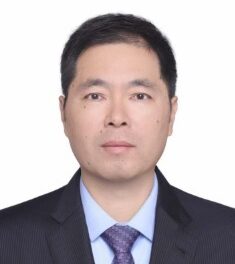
Dr Owen M.M. KaiCombey, PhD, BL
Legal Scholar | Barrister and Solicitor | Public Policy Practitioner
Waterford, Ireland
10 August 2026