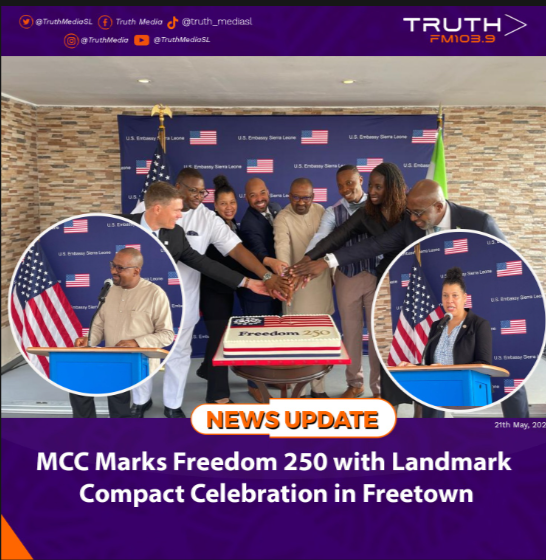
Freetown, 21st May 2026- The Millennium Challenge Corporation (MCC) has celebrated 250 years of American independence with a landmark event at its new edifice en route to Leicester Peak, overlooking the U.S. Embassy in Freetown. The ceremony celebrated America’s legacy of innovation in the electricity sector and showcased the Sierra Leone Compact, a $480 million investment aimed at transforming the country’s power sector.
In her welcome remarks, National Coordinator of the Sierra Leone Compact Development Unit, Ndeye Fatu Koroma, described the compact implementation as the culmination of years of challenges, foresight, and perseverance. She praised the leadership of President Julius Maada Bio, who signed the agreement in Washington in 2024, and Vice President Mohamed Juldeh Jalloh’s role in ensuring Sierra Leone met the qualification criteria through sustained engagement with key ministries.
Koroma emphasized that while power generation is possible through Independent Power Producers, the compact’s focus on transmission and distribution will be truly transformational. “The investments are expected to extend electricity access to households, businesses, agriculture, mining, and schools in remote areas, delivering sustainable change for Sierra Leone today and for generations to come,” she said.
Alicia Robinson‑Morgan, MCC Deputy Vice President for Africa, underscored the significance of the compact and the enduring partnership with the United States. She thanked Chargé d’Affaires Jared Yancey and Vice President Jalloh for their leadership, noting Sierra Leone’s strong commitment to shared goals. Robinson‑Morgan also recognized the tireless work of MCC’s Resident Country Mission, MCA‑Sierra Leone, and government institutions whose collaboration shaped a compact designed to deliver lasting impact.
Highlighting the theme Freedom250: American Innovation, she traced America’s legacy of ingenuity from Benjamin Franklin’s kite experiment to Edison’s electric utility system and Tesla’s alternating current technology, stressing that innovation in the power sector transformed the globe. Robinson‑Morgan explained that MCC builds on this tradition by applying modern tools, advanced analytics, rigorous evaluation, and partnership‑driven design to deliver sustainable development results.
She emphasized that the Sierra Leone Compact, backed by a $480 million MCC grant and an additional $14.2 million contribution from Sierra Leone’s government, will extend electricity access to 4.6 million people, reduce losses in the power sector, and strengthen regulation and governance.
She added that the investments will not only improve household and business access to reliable electricity but also catalyze private sector growth in mining, industry, and services, while creating a more predictable environment for American companies. She ended by reaffirming MCC’s commitment: “Lighting homes, powering businesses, and unlocking new opportunities for millions of Sierra Leoneans and American businesses, this is the future we will build together.”
Chargé d’Affaires Jared M. Yancey of the United States Embassy reflected on America’s 250‑year legacy of independence, innovation, and leadership, noting that free societies thrive when people have the foundations to build their own future. He traced U.S. history from the Declaration of Independence to modern advances in artificial intelligence, stressing that American innovation continues to inspire global partnerships for prosperity and security.
Yancey emphasized that U.S. assistance to Sierra Leone is designed to strengthen self‑reliance, not dependency, with MCC serving as a prime example. He said the Sierra Leone Compact will improve power reliability, expand grid coverage, and unlock new opportunities for communities and businesses. More reliable electricity, he noted, means better education, safer healthcare, and stronger economic growth, underscoring that American leadership is strongest when it helps partners stand on their own.
Foreign Minister Timothy Musa Kabba described the Freedom250 event as a milestone in U.S. diplomacy and Sierra Leone’s partnership with the United States. He expressed appreciation for America’s continued engagement through MCC, noting that the bilateral relationship is grounded in mutual respect, democratic values, and a shared vision for inclusive growth. Kabba said Sierra Leone is committed to elevating this partnership through expanded trade and investment.
He highlighted energy and mining as transformative opportunities, stressing the country’s goal of universal energy access and the importance of critical minerals for the global energy transition. Kabba said the MCC Compact provides a strong platform for private sector participation and institutional reform, while Sierra Leone is working to improve transparency and create a business‑friendly environment. He urged deeper cooperation in energy, minerals, and beyond, calling the partnership “strategic and truly transformative.”
Delivering the keynote address, Vice President Dr. Mohamed Juldeh Jalloh underscored Sierra Leone’s enduring partnership with the United States and the transformative potential of the MCC Compact. Speaking as Chairman of the MCC Board, he welcomed dignitaries and partners to the Millennium Challenge Account office, describing it as a symbol of U.S.–Sierra Leone cooperation. He praised America’s 250‑year legacy of democracy and innovation, noting that resilience in U.S. history offers lessons for global leadership in an era of rapid change and interconnected economies.
Dr. Jalloh emphasized that Sierra Leone’s economic growth is tied to reliable and affordable electricity, which remains a binding constraint on development. He pointed out that by 2030, the mining sector alone will require over 500 megawatts of power, far exceeding the country’s current capacity of 200 megawatts. He stressed that while generation is possible, transmission and distribution require significant investment, over $300 million, to deliver electricity to industries, schools, and communities nationwide.
The Vice President assured that with credible partnerships, particularly through the MCC Compact, Sierra Leone can overcome these challenges. He described the compact’s investments as more than financial commitments, calling them “an overwhelming vote of confidence in Sierra Leone’s future” and a foundation for jobs, growth, and opportunity.