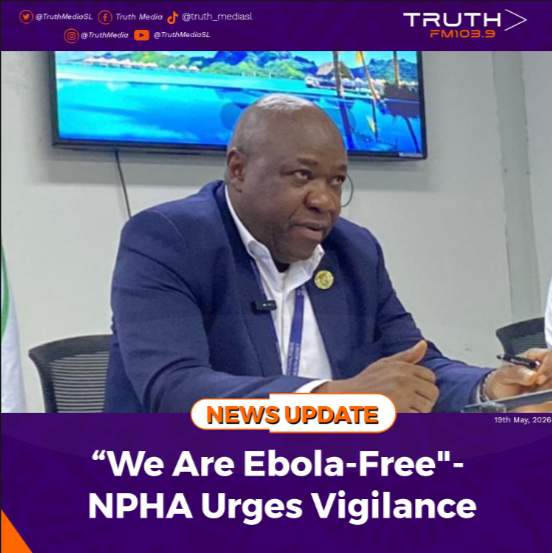
By: Emmanuel Mbowa
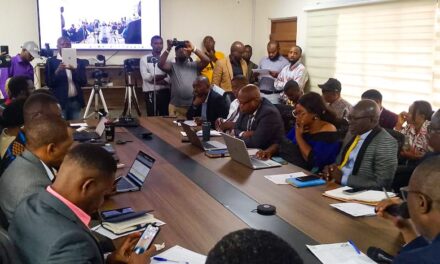
Freetown, 19th May 2026- The National Public Health Agency (NPHA) has stated that there are no confirmed, suspected, or probable cases of Ebola in Sierra Leone. The Agency revealed this to the press following WHO’s declaration of a public health emergency of international concern in response to the active Ebola Virus Disease outbreak in the Democratic Republic of Congo and Uganda.
“Sierra Leone is currently Ebola-free,” stated Prof. Foday Sahr, Executive Director of NPHA, noting, “Sierra Leone is not unprepared. Our preparedness posture is not reactive: it is grounded in the hard lessons of 2014 to 2016. So, we are not waiting for risk to escalate before we act.”
The current outbreak in the DRC, he said, is caused by the Bundibugyo strain of the Ebola virus, “a rare strain for which there are currently no licensed vaccines and no approved therapeutics.” As of 16th May, 2026, Prof. Sahr noted, the DRC has recorded 246 suspected cases and 80 suspected deaths in Ituri Province. Uganda has confirmed two laboratory-confirmed cases, including one death, both in Kampala, imported from the DRC, with no transmission identified.
“When WHO declared a PHEIC, it did so because the outbreak requires coordinated international support, not because it poses a high risk to the global public,” Prof. Sahr maintained. “This is the largest documented outbreak of Bundibugyo virus disease in history,” he revealed. “We are not waiting for risk to escalate before we act,” he said, highlighting ongoing preparation plans.
“The National Emergency Health Committee has been convened to oversee the government’s response,” he said, noting that their PHEOC has been activated at “Alert Level 2”.
Referencing WHO’s advice against travel or trade restrictions outside the affected region, Prof. Foday Sahr noted their robust screening exercise at all entry points. “Lungi International Airport, Freetown Harbour, and all major land border crossings, including Kambia, Gbalamuya, and Kailahun, are fully operational with trained personnel.”
Pre-positioned emergency supplies, Prof. Sahr said, have been put in place for high-risk border districts. “Personal protective equipment, isolation materials, and rapid diagnostics have been released to the Western Area and high-risk border districts of Kambia, Koinadugu, and Kailahun,” he continued.
He further stated that a rapid response team is already on standby in all 16 districts. “Isolation protocols are being reviewed and reinforced at key referral facilities,” stressing, “Sierra Leone is in direct communication with the Africa CDC, ECOWAS Health Authority, WHO, and neighbouring governments, including Guinea and Liberia.” “Real-time” outbreak intelligence, he said, “is being monitored around the clock.”
Given that there are no licensed vaccines or treatments for this strain of Ebola, the Executive Director called for public vigilance despite Sierra Leone being a low-risk country in the region. “Early detection and reporting are our most powerful tools. I urge every citizen and resident to call 117 immediately if you or a family member develops sudden fever, severe headache, vomiting, diarrhoea, unexplained bleeding, or rash, particularly after recent travel from the DRC,” urging precautionary measures in social gatherings. “Do not wait. Do not visit a crowded facility. Call 117 first.”
Meanwhile, Prof. Foday Sahr alerted health workers in all public and private facilities to maintain a high index of suspicion for any patient with haemorrhagic fever symptoms and any history of travel from the DRC or Uganda. “Report suspected cases immediately to your District Health Management Team or directly to the NPHA Emergency Operations Centre at 117.” Warning that they should not attempt to manage a suspected case in an unprepared facility, he added: “Activate isolation protocols and call for Rapid Response Team support without delay.”
He concluded that “the government is prepared. We ask that every Sierra Leonean be equally prepared, vigilant, calm, and cooperative.”
NPHA noted that Risk Communication and Community Engagement (RCCE) is being launched across all districts, and all updates would be communicated exclusively through verified government channels (NPHA, Ministry of Health, and SLBC).