By Nafisatu Olayinka Deen
Freetown, 5th May 2026- After Sierra Leone’s civil war, the Truth and Reconciliation Commission (TRC) found that women were largely absent from leadership positions and recommended stronger representation in decision‑making spaces.
Two decades later, Sierra Leone enacted the Gender Equality and Women’s Empowerment (GEWE) Act of 2022, guaranteeing a minimum 30% quota for women in leadership roles not only in politics and governance but also across public institutions, private enterprises, and financial bodies. The law also mandates equal pay, equal access to training and education, and improved financial inclusion for women.
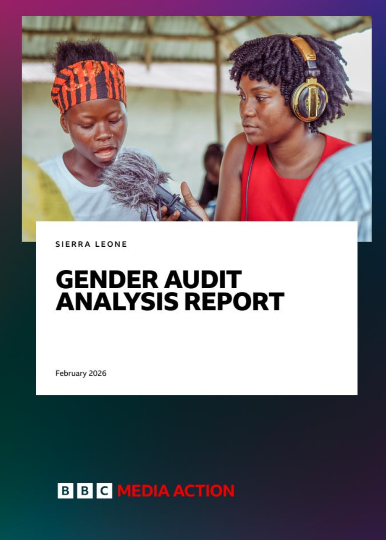
Yet the media sector tells a different story. A Gender Audit Analysis Report launched in March by BBC Media Action Sierra Leone reveals a persistent gender imbalance in ownership, leadership, and newsroom representation.
According to the report, men dominate the media workforce nationwide, accounting for 83.81%, while women represent only 16.19%. Radio, the country’s largest employer, holds 59.24% of all media jobs, with men occupying 47.24% compared to women’s 12%. In print, women hold just 2.91% of positions, leaving them excluded from key editorial and commissioning roles. Television employs 5.41% of the workforce but reports no female representation due to classification overlaps with radio. Online platforms show near parity but remain too small to offset traditional gatekeeping. Regionally, the Western Area accounts for 63.28% of all media roles, with men holding 52.25% and women 11.03%.
Complementing these findings, World Bank 2023 data shows women’s representation in business ownership at only 19.1%, underscoring the need for stronger support for female entrepreneurs and leaders.
In an interview with Truth Media, Marian Tina Conteh, Senior Project Officer at BBC Media Action Sierra Leone, described the country’s media as “a man’s world.”
“Inequality in the media space is visible. Ownership and leadership are male‑dominated. Many women trained in communication and journalism have left the field because of the challenges they face. It’s difficult for women to thrive unless they encounter men who genuinely believe in promoting women,” she said.
At the report’s launch, Josephine Kamara, Director General of the Sierra Leone Broadcasting Corporation (SLBC), affirmed the findings and emphasized her commitment to gender equity.
“Women’s representation in the media isn’t even close to the 30% quota we’re fighting for under the GEWE Act. There are clear imbalances, which is why, since I took office, our vacancy announcements strongly encourage qualified women to apply,” she said.
Eastina Taylor‑Tucker, President of Women in the Media Sierra Leone (WIMSAL), highlighted the double burden women face in the industry.
“Women encounter twice the challenges men do. Sexual harassment and intimidation especially in the northern region discourage many from joining or staying in the media. Opportunities are limited, but I’m encouraged by the growth of online spaces where women are thriving. Non‑traditional media will open more doors for women and girls,” she said.
The report’s findings call for reflection and action to ensure equal representation and strengthen advocacy for gender parity in the media. Taylor‑Tucker urged media owners, donors, and organizations to fund and support women‑led media initiatives.
“These figures aren’t just numbers they represent real women and their struggles. If we must address gender imbalance, we must see women as counterparts and co‑contributors,” she said.
Conteh echoed the call for deliberate policy action.
“It’s time for conscious efforts and institutional policies to create more spaces for women and uplift them within the media,” she said.
The report reinforces that gender equality in Sierra Leone’s media remains a work in progress one that demands sustained advocacy, institutional reform, and a cultural shift toward inclusion.
This story is brought to you with support from the Africa Transitional Justice Legacy Fund (ATJLF) through the Media Reform Coordinating Group (MRCG), under the project ‘Engaging Media and Communities to Change the Narrative on Transitional Justice Issues in Sierra Leone.’