By Davida Spaine-Solomon
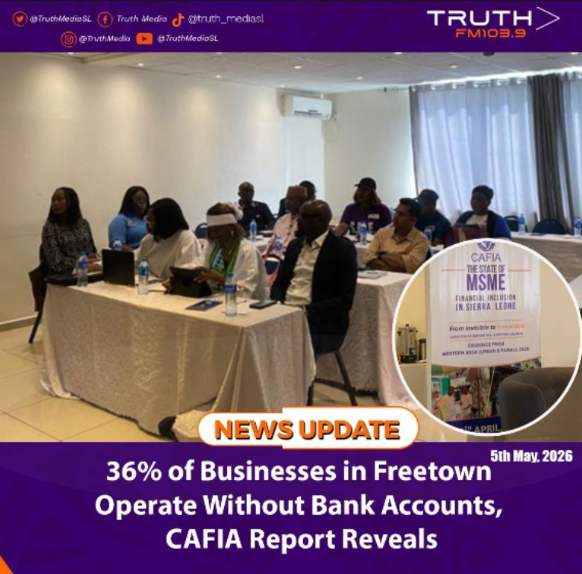
Freetown, 4th May 2026– More than one in three small businesses in Freetown, 36.4%, operate without any bank account, according to new data from the Center for Africa Financial Inclusion and Advancement (CAFIA). The findings expose a critical gap in Sierra Leone’s financial inclusion drive, even as digital access expands.
The State of MSME Financial Inclusion in Sierra Leone 2026 report surveyed 495 businesses across Freetown’s commercial corridors. While 63.6% of micro, small, and medium enterprises (MSMEs) hold some form of financial account, usage remains shallow, with cash still dominating business operations.
Researchers attribute the high unbanked rate to minimum balance requirements and a persistent preference for cash, constraints that continue to lock thousands of micro and small enterprises out of the formal financial system.
Mobile money, though widely available, is underutilized for business management. The report notes that 90.7% of MSMEs own smartphones and 52.5% accept digital payments, mostly via personal accounts, while 94% are within five minutes of a mobile money agent.
Yet only 3.6% pay suppliers digitally, and just 1% pay workers via mobile platforms, evidence of what CAFIA calls a shift that has “reached access, but not transformation.”
During a panel session, Kate Thompson of Ecobank highlighted the trust gap: “More than 80 percent of those interviewed have not even approached a bank; that is alarming.” She stressed that financial institutions must move beyond generic offerings and design products that reflect how MSMEs operate day-to-day.
Parvinjeet Kaur emphasized that MSMEs are central to the economy: “These businesses are not outside the economy; they are the economy. The issue is whether the system can see them clearly enough and support them to grow.”
CAFIA mapped 3,314 businesses and conducted extensive interviews to build what it calls the first structured baseline of MSME financial behavior in Sierra Leone. The report highlights broader weaknesses: 64% of MSMEs do not keep records, 82% did not apply for credit in the past year and high interest rates and trust issues deter borrowing. These practices undermine creditworthiness and make risk assessment difficult for lenders.
Kenyeh Barlay, Minister of Planning and Economic Development, welcomed the report as timely. She noted that financial inclusion has risen to 39%, up 10 percentage points in recent years, but acknowledged persistent challenges. “Financial inclusion is not just about access; it must translate into real economic empowerment,” she said.
CAFIA’s Financial Inclusion Index places Freetown’s MSME ecosystem at 61.7 out of 100, classifying it as “integrated but not fully transformed.” The gap between access (81.3) and usage (52.1) underscores that infrastructure is in place, but behavioral and economic barriers remain.
In its recommendations, the report calls for affordable, MSME-focused credit products, strengthened financial and digital literacy and tailored solutions for informal market operators, especially women-owned market table businesses.
CAFIA notes that Sierra Leone’s financial inclusion efforts must shift from expanding access to driving active, productive use of financial services. The launch signals a move toward data-driven policymaking and cross-sector collaboration.
“If we cannot see MSMEs clearly, we cannot support them. And if we cannot support them, we cannot grow the economy inclusively.”